
 E-Paper




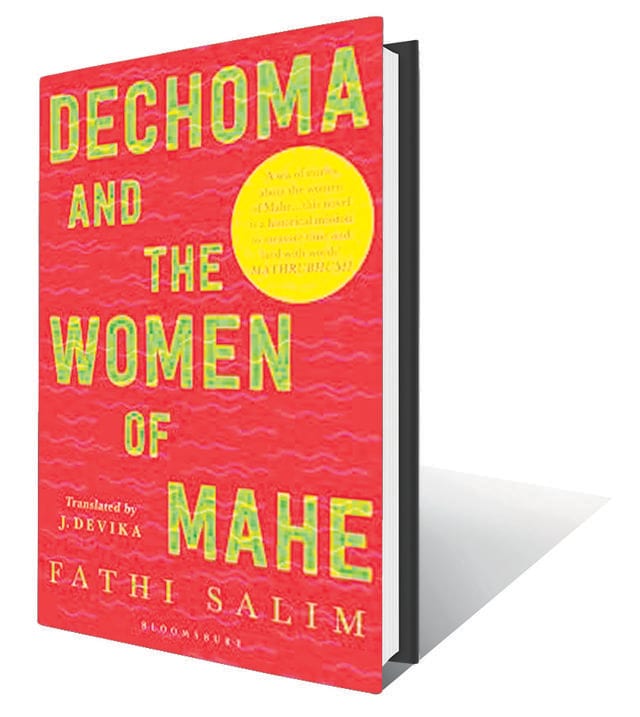
Review: Dechoma and the Women of Mahe by Fathi Salim
Translated by J Devika from the original Malayalam, the novel takes a small community as its subject to tell a story about the larger world




Right at the beginning it is clear that Dechoma and the Women of Mahe throws the handbook of writing out of the window, the building, and maybe even the city itself. What are the rules in that handbook? They say the “what about-ness” of the story should reveal itself in the first few pages, maybe even the first few paragraphs. No, says this story as it meanders and explores the inner and outer worlds of the women of Mahe, who, as the translator’s note says, live “without the burden of reformism or apologetic nods to national modernity”. These women reprimand the protagonist, the on-the-cusp-of-puberty Umaiba for her figure, her love for glass bangles, and her lack of interest in dressing up, her lack of attractiveness or monch. They crack bawdy jokes about a newly married couple and speculate about their activities on their first night together while judging another woman for “leading men astray.” They vie for material things while harbouring a desire to die on a pilgrimage.

The author’s pen does not spare even the titular Dechoma who is virtuous, hard-working and kind to Umaiba. It is clear that such virtue can also constrict the inner world; Dechoma believes an unmarried man is certain to be a pervert. Umaiba reminds her that she herself is unmarried and has turned out fine.
There are some lovely men in the story. One of them is Moothaappa who does not care that he does not have sons, talks to Umaiba in English, and tells her and his daughter Sumayya to have faith in God and to not believe in flying jinns. Not so lovely are Umaiba’s brothers who control her appearance and actions even from afar, and the “men in Dubai” who withhold their wives’ monthly allowance for posting videos or stepping out of the home without permission.
Salim also dispenses with the rule about not having too many characters. This book is all about its characters. The story progresses through them like a “game of hop-scotch” as the translator puts it beautifully in her note. The chapters are named after the characters, major or minor. Some are seen often, some not more than once, and two are dead. There is Umma, Umaiba’s mother and main disciplinarian, Maimuna, the servant girl, Shahihtha, whose marriage, pregnancy and delivery are made much of, and kind Dechoma, among others.
But it is Umaiba who is the protagonist, a position she claims in the last chapter when she comes of age. Here, she begins menstruating, loses a loved one to death, and understands how people tend to cling to loved ones left behind. She also has a flash of God-fearing-ness, a fear of hell, and of fire and brimstone. It’s a poignant moment when Dechoma tells her: “Ah, it’s all the same, kutty. Balal and pishachi and shaithan are all the same. All devils.”
Another rule in Indian writing in English is the one about a book not having too many non-English words. Well, kudos to Salim and Devika for crashing that Bastille. The translator has retained the original Malayalam words in such a way that not only do they become a part of the story but also a part of the reader’s vocabulary too. Please note this reviewer’s earlier use of the word monch. The rumination on baanku, a “Persian word and now a Malayalam one too” is particularly interesting. There’s also an exploration of dialect differences when Titheema, Umaiba’s great grandmother in Kanhangad, asks Nejmoo (Umaiba’s cousin) to get the girl two kottas of biscuits. Umaiba is delighted because, in Mahe, a kotta is a basket. She is disappointed when the biscuits arrive and she finds that her great grandmother’s kottas are only packets!
Many serious issues are also dealt with a similarly light touch. When Titheema is told that the soft drink 7-Up funds America and therefore prolongs the war on Palestine, she banishes it from the house despite her earlier love for it. Dechoma and the Women of Mahe might take a small community as its subject but its scope is far from narrow and its humour reminds the reader of the quirks of individuals everywhere and of the larger ways of the world too.
Priyanka Sarkar is a writer and translator.





