
 E-Paper







Mahipal Singh Chouhan is a Senior Content Producer at Hindustan Times Digital, with nearly five years of experience in digital journalism and content production. He primarily covers offbeat, trending and human-interest stories, with a focus on emerging social media trends, online conversations and real-world incidents that capture public attention. At Hindustan Times, Mahipal works on identifying and developing fast-moving digital stories, adding context and journalistic perspective to viral moments while maintaining accuracy, clarity and readability for online audiences. Before joining Hindustan Times Digital, he was associated with DNA India, where he gained experience in newsroom workflows and digital storytelling. He holds a degree in Journalism and Mass Communication from the Vivekananda Institute of Professional Studies, Delhi. Beyond journalism, he has a keen interest in history and sports and enjoys expanding his general knowledge.
Indian professor who cracked a decades-old maths puzzle earns TIME recognition
Indian professor Neena Gupta made it to the TIME100 Next India list for her groundbreaking research in mathematics.

Indian mathematician Neena Gupta, who made a breakthrough by solving a version of a mathematical problem that had baffled researchers for decades, has earned a place on the prestigious TIME100 Next India 2026 list. A professor at the Indian Statistical Institute (ISI) in Kolkata, Gupta has been recognised for her remarkable contributions to modern mathematics.
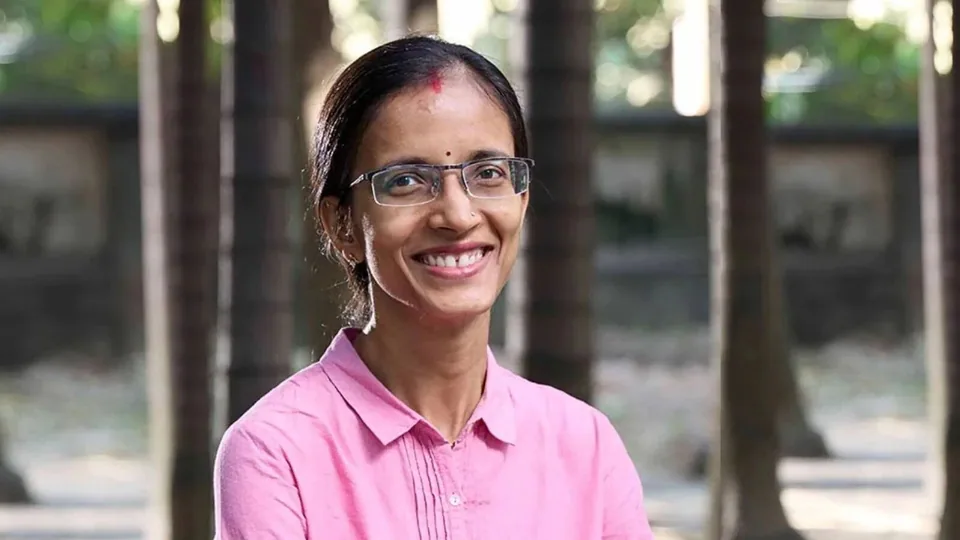
According to TIME, Gupta gained international recognition in 2014 when she resolved a version of the Zariski Cancellation Problem, a longstanding question in algebraic geometry that was first posed by renowned mathematician Oscar Zariski in 1949.
(Also read: Karnataka village boy who grew up without internet and co-founded a space startup earns TIME recognition)
Cracking a decades-old mathematical puzzle
The problem essentially asks whether two geometric objects that acquire identical structures after an additional dimension is introduced must have been identical in their original forms.
Gupta demonstrated that this assumption does not always hold true. Her research established that counterexamples exist in three or more dimensions under specific mathematical conditions known as positive characteristic.
According to the Infosys Science Foundation, her breakthrough not only addressed a longstanding mathematical problem but also uncovered unexpected connections between several concepts in algebraic geometry and commutative algebra.
The Indian National Science Academy described her solution as “one of the best works in algebraic geometry in recent years done anywhere”, according to a government press release.
From Kolkata student to internationally recognised mathematician
Gupta graduated with honours in mathematics from Kolkata’s Bethune College in 2006 before completing her postgraduate studies at the Indian Statistical Institute in 2008. She subsequently pursued a PhD at the same institution, specialising in commutative algebra under the guidance of Professor Amartya Kumar Dutta.
Before becoming a professor, she served as a visiting scientist at ISI and a visiting fellow at the Tata Institute of Fundamental Research (TIFR), according to the Press Information Bureau (PIB).
A journey marked by prestigious honours
Gupta received the Shanti Swarup Bhatnagar Prize in Mathematical Sciences in 2019. In 2021, she became only the third woman to receive the prestigious Ramanujan Prize for young mathematicians from developing countries.
She was also conferred the Nari Shakti Puraskar by then President Ram Nath Kovind on International Women’s Day in 2022 and received the Infosys Prize in Mathematical Sciences in 2024.
Gupta was subsequently selected to deliver the prestigious Emmy Noether Lecture in 2025, an honour celebrating women who have made significant contributions to mathematical sciences.
Her research has also earned praise from leading mathematicians. Chandrasekhar Khare, jury chair for the Infosys Prize in Mathematical Sciences, highlighted her achievements, saying she “is a role model for many young people wanting to pursue fundamental research in the pure sciences in the country.”





