


 Live Score
 Teams
 Players
The MS Dhoni effect: How CSK transformed struggling players into match winners
As MS Dhoni prepares to mentor CSK, the numbers show how Dube, Chahar and five others revived their IPL careers through new roles, opportunities and backing.

 Prefer HTon Google


A batter who had scored 399 runs in three IPL seasons ended up scoring 1,103 runs in the next three. A bowler who picked up only one wicket in five IPL matches bagged 32 wickets in the next 29. These are the transformations of Shivam Dube and Deepak Chahar, respectively, after they joined the Chennai Super Kings under MS Dhoni's captaincy.
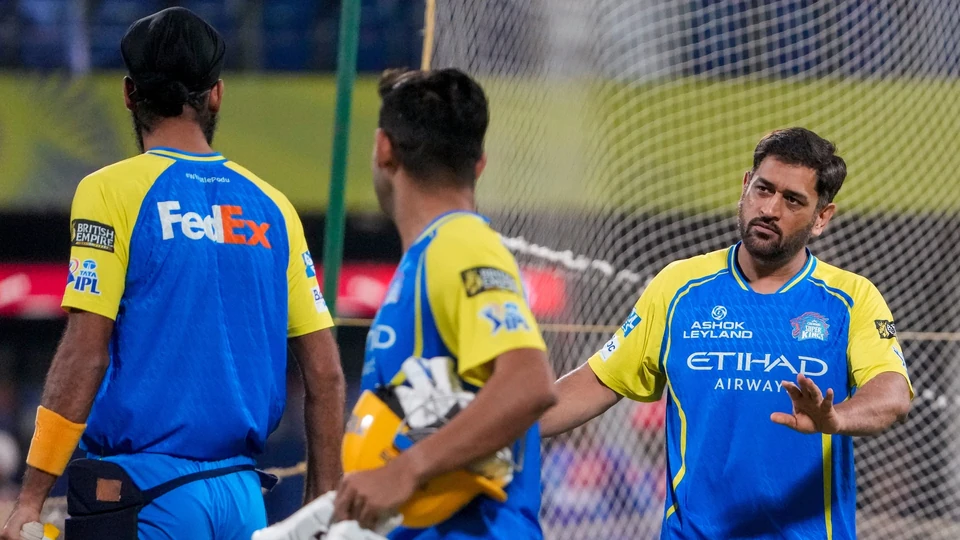
Dhoni has drawn the curtain on his playing career and will take over as mentor of the Super Kings next season. The franchise officially confirmed the appointment yesterday. However, the numbers suggest that helping players realise their true potential has long been part of Dhoni’s leadership style.
The identification of perfect roles
Dube’s transformation is particularly interesting. From IPL 2019 to 2021, he was part of RCB and the Rajasthan Royals, where he scored 399 runs at a strike rate of 120.54. But in his first three seasons for the Super Kings, he scored 1,103 runs at a strike rate of 159.16.
Dube was scoring nearly 39 more runs per 100 balls for the Super Kings than before; his runs per innings also rose from 18.1 to 28.3. This was not just an improvement in form; it reflected the team’s ability to identify his strengths and utilise them effectively. CSK recognised Dube’s prowess against spin and gave him the ideal entry point to influence a game with the bat. His performances eventually earned him a place back in India’s T20 squad.
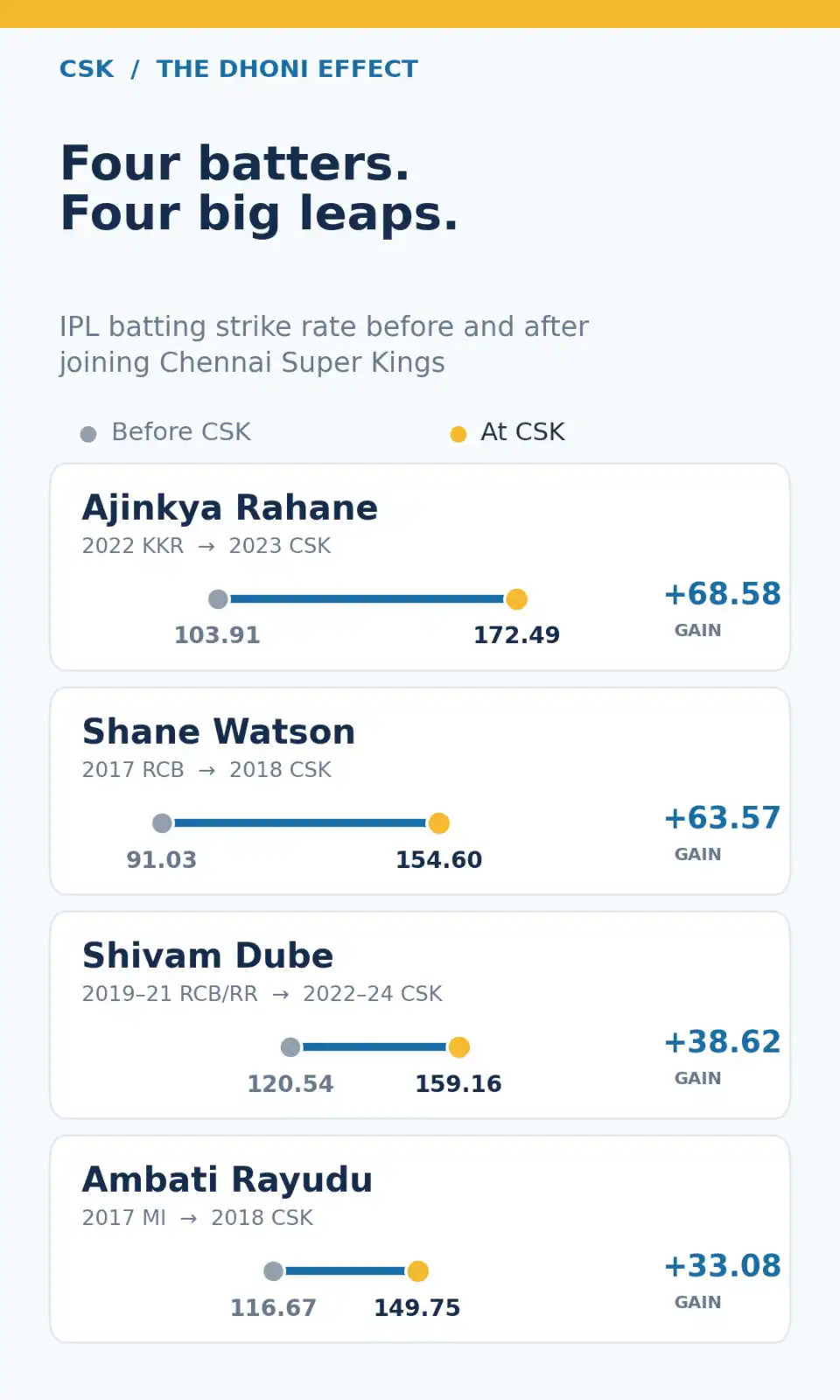
Ajinkya Rahane’s batting saw a more dramatic transition, although a less sustained one. Chennai moved the veteran batter away from his traditional anchor role, and the effect was instantly visible in his batting intent. Rahane’s strike rate rose from 103.91 for KKR in 2022 to 172.49 for CSK in 2023.
The right-hander hit 16 sixes off 189 balls during the 2023 season, compared to four off 128 balls in 2022. His six-hitting rate jumped by a factor of about 2.7. The form he showed earned him a place back in the Indian Test squad for the subsequent World Test Championship final. But his strike rate fell to 123.47 the next season, suggesting that the reinvention failed to produce consistent results.
Ambati Rayudu is another example of how changing a batter’s role can make a big difference. Batting in the middle order, Rayudu scored 91 runs at a strike rate of 116.67 for the Mumbai Indians in IPL 2017. The next season, Chennai Super Kings bought him and promoted him up the order. Rayudu amassed 602 runs that season at a strike rate of 149.75 and was central to CSK’s championship run. His performances subsequently brought him back into India’s ODI plans.
Shane Watson is one of the most impactful overseas players to have played in the league. He played a crucial role in the Rajasthan Royals’ triumph in the inaugural season. By the time he arrived at the Super Kings, however, his form had waned. Playing for RCB in IPL 2017, Watson scored 71 runs at a strike rate of 91.03.
A season later, the Australian amassed 555 runs at a strike rate of 154.60 for CSK. His two centuries, including an unbeaten 117 in the final, were instrumental in the Super Kings winning their third title. It demonstrated how much he could still contribute when entrusted with a prominent batting role.
Turning opportunities into wickets
Chahar had played only five games across two seasons for the Rising Pune Supergiants. In 2018, he joined the Super Kings, and Dhoni entrusted him with the new ball. The bowler, who had picked up just a single wicket in his five previous outings, bagged 10 wickets at an economy of 7.28 in 2018. He followed it up with 22 wickets at an economy of 7.47 in 2019. His wicket-taking increased without a significant rise in his economy rate. The right-armer went on to establish himself internationally, and his IPL valuation rose from ₹80 lakh in 2018 to ₹14 crore in 2022.
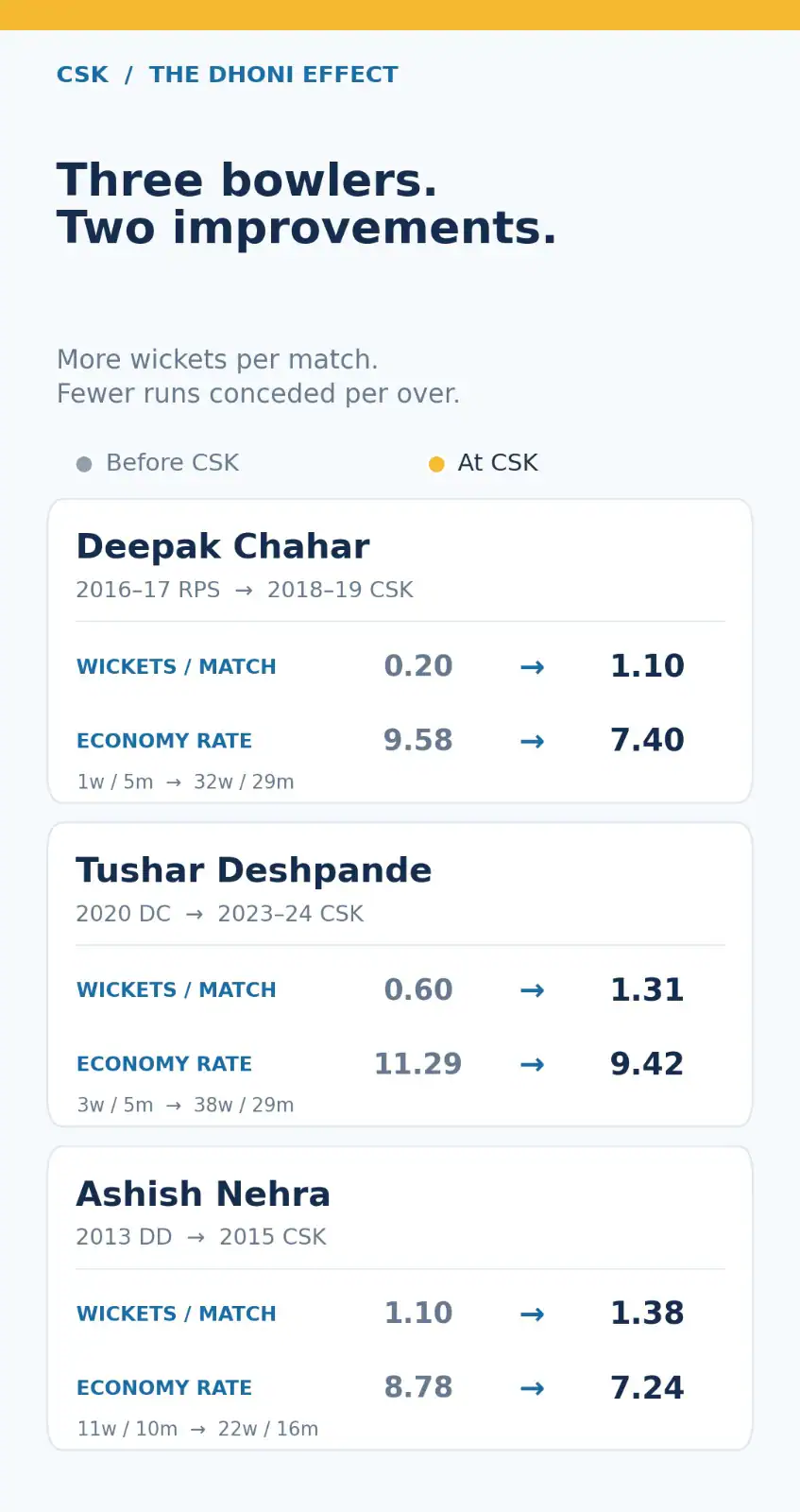
Another Indian bowler, Tushar Deshpande, followed a similar path. His five matches for the Delhi Capitals in IPL 2020 yielded only three wickets at an economy of 11.29. He then joined the Super Kings in IPL 2022. He picked up 21 wickets in 2023 at an economy of 9.92. He picked up 17 more wickets the next season at an economy of 8.83. Deshpande’s wicket-taking rate increased, while his improving economy suggested greater control over his bowling and genuine development. An international debut followed in 2024, before the Rajasthan Royals bought him ahead of IPL 2025 for ₹6.5 crore.
Even Ashish Nehra saw a late-career resurgence while playing for the Super Kings. While playing for the Delhi Daredevils in 2013, Nehra picked up 11 wickets at an economy of 8.78. In 2015, the left-armer picked up 22 wickets at the age of 36 while conceding runs at an economy of 7.24. His improved wicket-taking came with greater economy. That season saw him return to the Indian T20I squad after nearly five years.
The common thread is not just joining the Super Kings. Each of these players was given a different role based on their strengths. They received sustained backing, greater opportunities, and the flexibility to learn on the job. Of course, Dhoni was not solely responsible for their progress or revival, but his presence and the environment he created within the franchise were important parts of those stories. As a new chapter begins in MSD’s life, the challenge for him will be to produce similar results with another generation





