
The US Army has scheduled the controlled detonation of nearly 10,000 pounds of unstable lead azide at a military ammunition plant in Middletown, Iowa, for Wednesday, November 25, despite a federal appeals court order temporarily blocking the environmental permit for the operation.
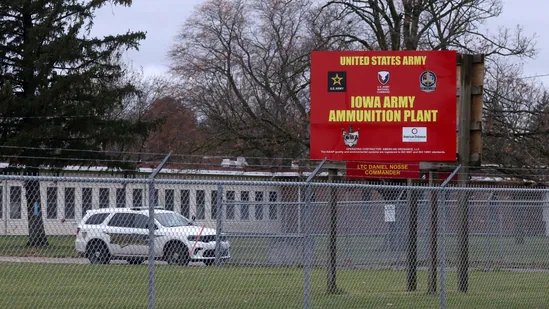
The Army announced the latest delay on Sunday, saying the revised date would allow for favourable weather conditions and time to put safety measures in place. The blast was initially planned for Friday before being postponed to Monday, making this the second change to the schedule, according to US Army's post on X.
Suggested For You
The planned operation has faced opposition from environmental groups and residents concerned about the potential spread of lead dust. The Eighth US Circuit Court of Appeals granted an administrative stay of the Environmental Protection Agency's permit late Thursday while it considers an emergency request to halt the detonation.
{{/usCountry}}The planned operation has faced opposition from environmental groups and residents concerned about the potential spread of lead dust. The Eighth US Circuit Court of Appeals granted an administrative stay of the Environmental Protection Agency's permit late Thursday while it considers an emergency request to halt the detonation.
{{/usCountry}}Also Read: Trump hopes Nvidia ‘rehires’ Jensen Huang, calls it the ‘best thing’ for chipmaker and US
Army invokes emergency powers to proceed despite court order
The Justice Department told the court on Sunday that the Army intends to move ahead under an emergency exemption to federal environmental permitting requirements, arguing that the deteriorating explosive material poses an immediate risk of an accidental detonation.
In its court filing, the government said falling temperatures could increase the danger because crystals formed in the stored lead azide could break more easily in freezing conditions. The Army maintains that controlled destruction at the site is safer than packing and transporting the material, which could trigger an unintended explosion.
Lead azide is an explosive used to initiate munitions. The material was discovered in March at the Iowa Army Ammunition Plant, where it had undergone recrystallisation. The EPA has said the process increased its sensitivity to friction and shock, making the containers dangerous to disturb.
Also Read: Jim Beam to keep Kentucky distillery closed indefinitely amid falling whiskey demand
Environmental groups warn of lead contamination
The Iowa Environmental Council and the Sierra Club's Iowa chapter have challenged the plan, arguing that the detonation could release lead particles across a wide area and expose nearby communities, livestock and wildlife.
According to their court filing, the Army's latest modelling indicates that lead dust could settle across an area about 25 miles long and five miles wide, potentially including homes and waterways. The groups have also questioned whether potentially affected communities received adequate and timely notice.
The Army has acknowledged that the controlled blasts could produce a dust plume containing lead, loud noises and ground vibrations, potentially breaking windows. Federal agencies, including the EPA and the Department of Health and Human Services, have said they are coordinating measures to reduce risks to the public.
The residents have been advised to remain indoors, close windows and doors, and bring pets and livestock inside during the operation. Some residents in Middletown have also been advised to leave temporarily.
The legal challenge remains before the appeals court as the Army prepares for the Wednesday operation.
Explore More
ABOUT THE AUTHOR
Asmi is a Senior Content Producer primarily covering stories related to NRIs, immigration, visas, citizenship and global mobility. She closely follows developments that affect Indians living, working and studying abroad, with a particular focus on translating complex policies and international developments into clear, accessible stories for readers. As part of the US Desk, Asmi also reports on a wide range of political, economic and social developments in the United States, exploring their relevance to Indian and global audiences. Her work spans breaking news, features, trends and explanatory stories, with an emphasis on accuracy, timely reporting and audience-focused storytelling. Asmi likes finding the human angle behind major developments and bringing context to stories that can often feel complicated or distant. She is especially interested in stories around immigration, life abroad, careers, education and the experiences of the Indian diaspora, while also exploring a wide range of topics that spark curiosity and conversation. Outside the newsroom, Asmi is an avid reader and loves travelling, discovering new places, experiencing different cultures and collecting stories along the way.
