
 E-Paper







Follow the latest breaking news, major developments and agenda-setting stories from India and around the world with the newsdesk at Hindustan Times. Operating round the clock, the desk brings together experienced editors, reporters and correspondents to deliver fast, accurate and contextual reporting across subjects that influence public policy, governance, business, society and international affairs. The HT News Desk covers politics, elections, government policies, the economy, business and markets, science and technology, the environment, law and order, infrastructure, education, climate issues and geopolitics, while closely tracking developments across states, institutions and global capitals. The team also leads coverage of major breaking news events, policy announcements, court proceedings, natural disasters, public emergencies and significant international developments. Reports published by the newsdesk are based on information gathered from reporters on the ground, official statements, government agencies, court records, regulatory filings, recognised institutions and other authoritative sources. Stories undergo editorial scrutiny and verification processes to ensure accuracy, fairness and relevance, and are updated as events evolve and additional information becomes available. Whether covering a key political decision in New Delhi, an economic policy shift affecting millions, a landmark court ruling or a major global event, the HT News Desk aims to provide readers with reliable, fact-based journalism that delivers not only the latest developments but also the context and analysis needed to understand their wider implications.
 Trending News
Trump says summit with North Korea’s Kim Jong Un back on for June 12 in Singapore
Donald Trump announced the summit with Kim Jong Un is back on after he received Kim Yong Chol, a former North Korean spy chief who’s been involved in decades of nuclear talks, in the Oval Office


US President Donald Trump has said his summit with North Korean leader Kim Jong-un will take place on June 12 in Singapore as scheduled, but tamped down expectations by calling it a “beginning” of a process in which follow-ups may be needed.
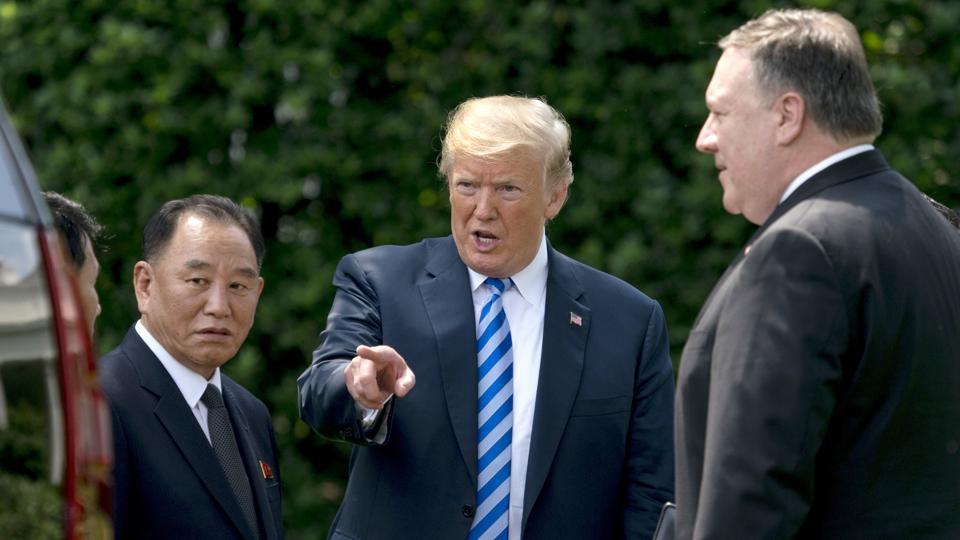
Trump had called off the talks in May, accusing Pyongyang of “tremendous anger and open hostility,” but left the door open should the North Korean leader change his mind. A flurry of diplomatic activity since then showed both sides were keen for the summit to take place.
“Now we’re going to deal, and we’re going to really start a process,” Trump told reporters after meeting Kim’s emissary Kim Yong Chol at the White House on Friday. “We’re meeting with the chairman on June 12th. And I think it’s probably going to be a very successful -- ultimately, a successful process.”
Stressing the need to dial down expectations, he added: “It will be a beginning. I don’t say and I’ve never said it happens in one meeting. You’re talking about years of hostility; years of problems; years of, really, hatred between so many different nations. But I think you’re going to have a very positive result in the end.”
The president indicated there may be more follow-up summits. “Wouldn’t it be wonderful if we walked out and everything was settled all of a sudden from sitting down for a couple of hours? No, I don’t see that happening. But I see over a period of time.”
The emissary, who is a former spy chief, also delivered Trump a letter from Chairman Kim in an outsized envelope, which the two of them posed with for pictures. Trump said it was a “very nice letter” and a “very interesting letter” but admitted he had yet to read it. Trump met the North Korean official for around 90 minutes and said they discussed a range of issues from denuclearisation to sanctions. Asked if Kim was committed to denuclearisation, Trump said, “I do think so. He’d like to see it happen. He wants to be careful. ...He’s not going to run and do things.
“But I told him, to be honest with you, look, we have sanctions on; they’re very powerful sanctions. We would not take sanctions off unless they did that.”
The two countries do not see denuclearisation the same way, and that was one reason for the rise in rhetoric recently that led to Trump calling off the summit.
American national security advisor John Bolton and Vice-President Mike Pence spoke of the model followed by Libya, which gave up its nuclear weapons programme in 2003, and its leader Muammar Gaddafi was overthrown in 2011.
An angry Pyongyang had reacted sharply to the suggestions. Notably, both Pence and Bolton were not in the meeting between Trump and Kim, the North Korean official, on Friday. Secretary of state Mike Pompeo, who has been US lead on these talks, was there.





