
 E-Paper







Follow the latest breaking news, major developments and agenda-setting stories from India and around the world with the newsdesk at Hindustan Times. Operating round the clock, the desk brings together experienced editors, reporters and correspondents to deliver fast, accurate and contextual reporting across subjects that influence public policy, governance, business, society and international affairs. The HT News Desk covers politics, elections, government policies, the economy, business and markets, science and technology, the environment, law and order, infrastructure, education, climate issues and geopolitics, while closely tracking developments across states, institutions and global capitals. The team also leads coverage of major breaking news events, policy announcements, court proceedings, natural disasters, public emergencies and significant international developments. Reports published by the newsdesk are based on information gathered from reporters on the ground, official statements, government agencies, court records, regulatory filings, recognised institutions and other authoritative sources. Stories undergo editorial scrutiny and verification processes to ensure accuracy, fairness and relevance, and are updated as events evolve and additional information becomes available. Whether covering a key political decision in New Delhi, an economic policy shift affecting millions, a landmark court ruling or a major global event, the HT News Desk aims to provide readers with reliable, fact-based journalism that delivers not only the latest developments but also the context and analysis needed to understand their wider implications.
 Trending News
Study says US should help Saudis find way out of Yemen
The group, which researches ways to end conflicts, said the United States should appoint a special envoy and suspend most arms shipments to the Saudis with a promise to resume them once the kingdom ends its four-year offensive against Huthi rebels who control much of their southern neighbour.


Saudi Arabia is looking to find a way out of its devastating war in Yemen and the United States, the kingdom’s stalwart ally, can play a critical role, the International Crisis Group said Sunday.
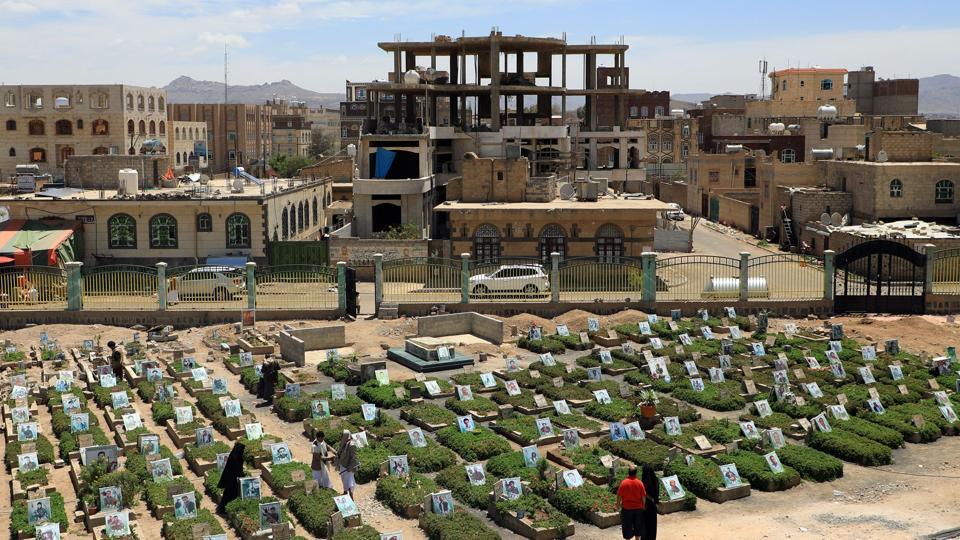
The group, which researches ways to end conflicts, said the United States should appoint a special envoy and suspend most arms shipments to the Saudis with a promise to resume them once the kingdom ends its four-year offensive against Huthi rebels who control much of their southern neighbour.
The Saudi-led coalition “needs to stop thinking about how to eke out some notional victory and instead commit itself wholly to finding a political exit, regardless of whether that means empowering the Huthis more than it is comfortable with in the short term,” the group said in a study based on interviews with current and former officials in the United States and elsewhere. “The US should lead the way by finding its own exit,” it said.
The report comes after Congress -- alarmed by persistent civilian casualties and widespread hunger in Yemen, as well as Saudi Arabia’s killing of US-based writer Jamal Khashoggi -- voted to cut off US support to the war effort.
President Donald Trump, who has closely allied himself with Saudi Arabia, has threatened to veto the bill but has not yet done so.
Democratic Senator Chris Murphy, a leading critic of the Yemen war, said that even if Trump goes ahead with his veto, Congress can serve as a “bad cop” to pressure Saudi Arabia to change course.
“This is not a question of whether or not the coalition is going to defeat the Huthis; that question has been answered,” Murphy told a briefing on the report.
“The Huthis are going to play a substantial and significant role in the future governance of Yemen, so it is a matter of deciding how the Saudis will live with that in a way that doesn’t threaten their long-term security interests.”
Trump has sided with the Saudis in part because they say they are trying to prevent a victory by rival Iran, which has supported the rebels who share religious kinship with the Shiite clerical regime in Tehran.
But the International Crisis Group said the calculation was reversed, with Iran in fact benefiting the longer the conflict persists, with the Saudis sapped of resources and reputation at a minimal investment by Tehran.
“I think they see that they need to end it (but) they don’t know how to end it,” Robert Malley, the group’s president, said of the Saudis.
The Saudis keep thinking “a little more military power and the Huthis will crack and then we’ll be able to end the war and Iran will be on its backfoot,” he said.
“But we have four years of evidence to disprove that.”





