
 E-Paper







Follow the latest breaking news, major developments and agenda-setting stories from India and around the world with the newsdesk at Hindustan Times. Operating round the clock, the desk brings together experienced editors, reporters and correspondents to deliver fast, accurate and contextual reporting across subjects that influence public policy, governance, business, society and international affairs. The HT News Desk covers politics, elections, government policies, the economy, business and markets, science and technology, the environment, law and order, infrastructure, education, climate issues and geopolitics, while closely tracking developments across states, institutions and global capitals. The team also leads coverage of major breaking news events, policy announcements, court proceedings, natural disasters, public emergencies and significant international developments. Reports published by the newsdesk are based on information gathered from reporters on the ground, official statements, government agencies, court records, regulatory filings, recognised institutions and other authoritative sources. Stories undergo editorial scrutiny and verification processes to ensure accuracy, fairness and relevance, and are updated as events evolve and additional information becomes available. Whether covering a key political decision in New Delhi, an economic policy shift affecting millions, a landmark court ruling or a major global event, the HT News Desk aims to provide readers with reliable, fact-based journalism that delivers not only the latest developments but also the context and analysis needed to understand their wider implications.
 Trending News
More protection: UN says Earth’s ozone layer is healing
The ozone layer had been thinning since the late 1970s. Scientist raised the alarm and ozone-depleting chemicals were phased out worldwide.


Earth’s protective ozone layer is finally healing from damage caused by aerosol sprays and coolants, a new United Nations report said.
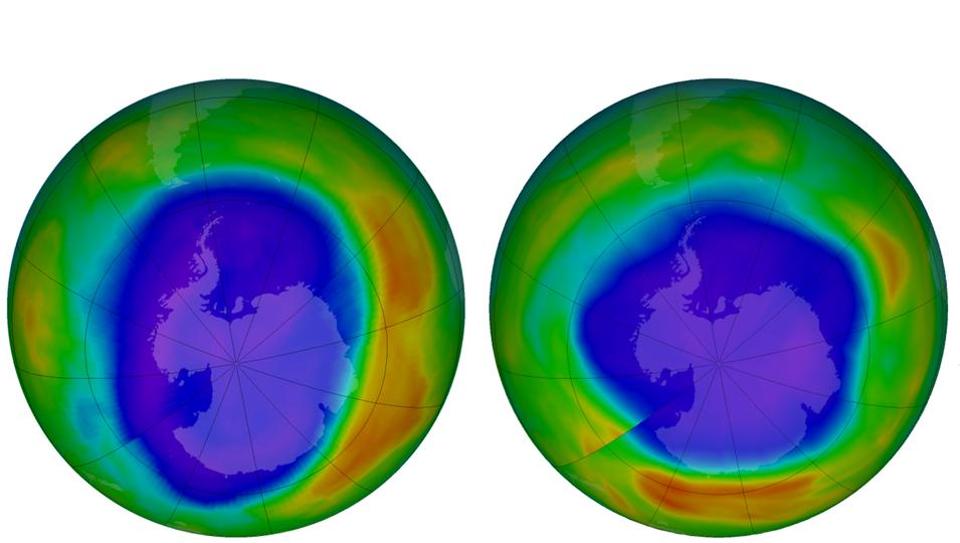
The ozone layer had been thinning since the late 1970s. Scientist raised the alarm and ozone-depleting chemicals were phased out worldwide.
As a result, the upper ozone layer above the Northern Hemisphere should be completely repaired in the 2030s and the gaping Antarctic ozone hole should disappear in the 2060s, according to a scientific assessment released Monday at a conference in Quito, Ecuador. The Southern Hemisphere lags a bit and its ozone layer should be healed by mid-century.
“It’s really good news,” said report co-chairman Paul Newman, chief Earth scientist at NASA’s Goddard Space Flight Center. “If ozone-depleting substances had continued to increase, we would have seen huge effects. We stopped that.”
High in the atmosphere, ozone shields Earth from ultraviolet rays that cause skin cancer, crop damage and other problems. Use of man-made chemicals called chlorofluorocarbons (CFCs), which release chlorine and bromine, began eating away at the ozone. In 1987, countries around the world agreed in the Montreal Protocol to phase out CFCs and businesses came up with replacements for spray cans and other uses.
At its worst in the late 1990s, about 10 percent of the upper ozone layer was depleted, said Newman. Since 2000, it has increased by about 1 to 3 percent per decade, the report said.
This year, the ozone hole over the South Pole peaked at nearly 9.6 million square miles (24.8 million square kilometers). That’s about 16 percent smaller than the biggest hole recorded — 11.4 million square miles (29.6 million square kilometers) in 2006.
The hole reaches its peak in September and October and disappears by late December until the next Southern Hemisphere spring, Newman said.
The ozone layer starts at about 6 miles (10 kilometers) above Earth and stretches for nearly 25 miles (40 kilometers); ozone is a colorless combination of three oxygen atoms.
If nothing had been done to stop the thinning, the world would have destroyed two-thirds of its ozone layer by 2065, Newman said.
But it’s not a complete success yet, said University of Colorado’s Brian Toon, who wasn’t part of the report.
“We are only at a point where recovery may have started,” Toon said, pointing to some ozone measurements that haven’t increased yet.
Another problem is that new technology has found an increase in emissions of a banned CFC out of East Asia, the report noted.
And the replacements now being used to cool cars and refrigerators need to be replaced themselves with chemicals that don’t worsen global warming, Newman said. An amendment to the Montreal Protocol that goes into effect next year would cut use of some of those gases.
“I don’t think we can do a victory lap until 2060,” Newman said. “That will be for our grandchildren to do.”





