
North Korea is unlikely to give up its nuclear weapons stockpile any time soon but could offer to allow the launch of a western hamburger franchise in Pyongyang instead as a goodwill gesture, NBC News cited a new CIA intelligence assessment as stating on Tuesday.
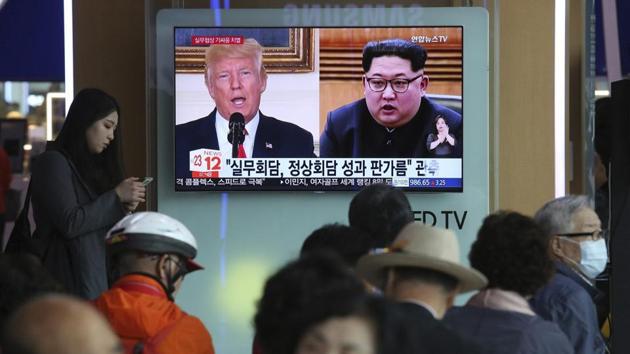
The assessment, however, did not name the brand likely to get North Korean leader Kim Jong-un’s nod. His other options could include American investments, especially in infrastructure.
Suggested For You
A hamburger franchise will be an easy give. And, as the NBC News report reminded its viewers, US President Donald Trump had expressed his desire in 2016 to talk peace with the North Korean leader while “eating a hamburger on a conference table”. And the world is aware of Trump’s love of burgers – two at a time, pushed down by a chocolate shake for dinner, while campaigning.
According to the news report, the CIA analysis further says Kim might have wanted to have an establishment up and running by the time of the talks to ensure a steady supply of burgers to the delegations involved. But there would be no shortage of the delicacy in Singapore if the southeast Asian nation does get to host the summit.
The US state department and intelligence agencies across the world are known to put together such assessments ahead of major diplomatic negotiations to explore and anticipate options likely to be touted by the other side. The intelligence assessment that Kim may not end the country’s nuclear programme is largely in accord with the assessment of North Korean watchers, who have cautioned against having high expectations.
{{/usCountry}}The US state department and intelligence agencies across the world are known to put together such assessments ahead of major diplomatic negotiations to explore and anticipate options likely to be touted by the other side. The intelligence assessment that Kim may not end the country’s nuclear programme is largely in accord with the assessment of North Korean watchers, who have cautioned against having high expectations.
{{/usCountry}}“Everybody knows they are not going to denuclearise,” an official who had read the analysis told NBC News. The report was circulated earlier this month, said an intelligence official.
It was not clear when the assessment was put together and if it had traversed through the desk of CIA director Mike Pompeo, who took over his present job at the state department in the last week of April. He is the only Trump cabinet member to have met Chairman Kim, and twice at that.
But denuclearisation of the Korean peninsula — which essentially means getting rid of North Korean nukes — is a key demand for President Trump. However, he has indicated willingness to consider a phased dismantling in recent days.
A Stanford University study has said it could take 15 years to dismantle North Korea’s nuclear weapons programme. “We’re talking about dozens of sites, hundreds of buildings and thousands of people,” lead author Siegfried S Hecker told The New York Times. He said the key to dismantling the sprawling atomic complex, begun six decades ago, “is to establish a different relationship with North Korea where its security rests on something other than nuclear weapons”.
The North Korean leader has let it be known through multiple interlocutors that he is prepared to discuss denuclearisation. But there is a wide gap between the way that term is understood in Pyongyang and Washington DC, as reflected in the angry exchange over the US suggestion of the Libyan model.
Libya had agreed to complete denuclearisation in December 2003.
Explore More
ABOUT THE AUTHOR
Follow the latest breaking news, major developments and agenda-setting stories from India and around the world with the newsdesk at Hindustan Times. Operating round the clock, the desk brings together experienced editors, reporters and correspondents to deliver fast, accurate and contextual reporting across subjects that influence public policy, governance, business, society and international affairs. The HT News Desk covers politics, elections, government policies, the economy, business and markets, science and technology, the environment, law and order, infrastructure, education, climate issues and geopolitics, while closely tracking developments across states, institutions and global capitals. The team also leads coverage of major breaking news events, policy announcements, court proceedings, natural disasters, public emergencies and significant international developments. Reports published by the newsdesk are based on information gathered from reporters on the ground, official statements, government agencies, court records, regulatory filings, recognised institutions and other authoritative sources. Stories undergo editorial scrutiny and verification processes to ensure accuracy, fairness and relevance, and are updated as events evolve and additional information becomes available. Whether covering a key political decision in New Delhi, an economic policy shift affecting millions, a landmark court ruling or a major global event, the HT News Desk aims to provide readers with reliable, fact-based journalism that delivers not only the latest developments but also the context and analysis needed to understand their wider implications.
