IT MAY SEEM obvious that courts should weigh the practical consequences of their decisions. But this was a radical idea when first espoused by Richard Posner, the influential legal scholar and judge who died on November 10th.
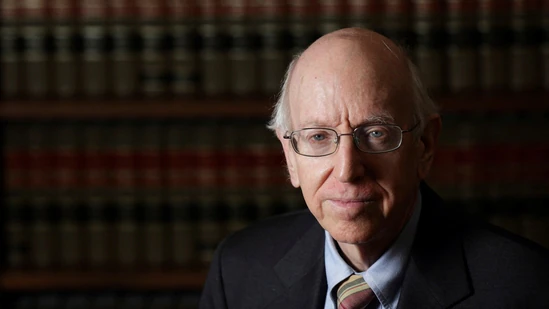
Mr Posner’s pragmatism made him a giant of American law without ever joining its highest court. It also set him apart from a legal world that has become increasingly dominated by ideology. “He didn’t care about political arguments,” says Eric Segall, a law
IT MAY SEEM obvious that courts should weigh the practical consequences of their decisions. But this was a radical idea when first espoused by Richard Posner, the influential legal scholar and judge who died on November 10th.
Mr Posner’s pragmatism made him a giant of American law without ever joining its highest court. It also set him apart from a legal world that has become increasingly dominated by ideology. “He didn’t care about political arguments,” says Eric Segall, a law professor and friend of Mr Posner. Instead, he sought to follow a maxim set out by one of his heroes, Oliver Wendell Holmes, a 20th-century Supreme Court justice, that “the life of the law has not been logic: it has been experience”.
Mr Posner came to prominence in the 1970s as part of a group of scholars who sought to use the tools of economics to study law. Surveying centuries of decisions in areas such as contracts and criminal law, Mr Posner argued that judges had developed doctrines that approximated economically efficient outcomes. He went on to venture far beyond law and economics, writing more than 500 articles, 50 books and 3,300 judicial opinions on everything from the law and sex to how judges think. A 2021 study in the University of Chicago Law Review ranked him as the most cited American legal scholar of all time, comfortably ahead of his nearest rival.
Compared with the left-leaning legal academy of the 1960s and 1970s, he was conservative. That helps explain why in 1981 Ronald Reagan, then president, nominated Mr Posner to the Seventh Circuit Court of Appeals. But although he was market-oriented, he was not motivated by ideology or arcane legal debates.
Take an opinion he wrote in 2014, striking down bans on gay marriage in Wisconsin and Indiana, the year before the Supreme Court did the same. Mr Posner argued that the bans should be judged simply on whether their benefits outweighed their harm to gay couples and their children. He concluded that they did not. He had previously opposed the idea of a constitutional right to gay marriage. But despite his forceful style, he was willing to admit being wrong. “Law is not a science,” he wrote, explaining his change of mind. “The notion that the 21st century can be ruled by documents authored in the 18th and mid-19th centuries is nonsense.”
In the last decades of his career, such views put him out of step with the conservative legal world’s love affair with originalism, a philosophy that attempts to decide cases based on the presumed intentions of the law’s authors. He was particularly critical of its greatest exponent on the Supreme Court, Antonin Scalia. In a review of the justice’s book, he criticised originalists for denying their political motivations and hiding behind semantics.
Mr Posner’s judicial doctrine was simpler, if less predictable. In 2016 he wrote that it came from a favourite poet, William Butler Yeats: “And I grew weary of the sun / Until my thoughts cleared up again, / Remembering that the best I have done / Was done to make it plain.” His decisions fill law-school casebooks, not least because they are so easy to read. “His writing was always clear and careful. It was elegant, but didn’t go for the clever quip,” says Guido Calabresi, a federal judge.
His willingness to be frank may be why he was never nominated to the Supreme Court. The contrast between his style and the justices’ was made clear during a 2019 oral argument. The case at hand concerned whether Title VII of the Civil Rights Act of 1964 covered discrimination based on sexual orientation in addition to gender. Mr Posner had concluded that it did for practical reasons: deciding otherwise would put “the entire burden of updating old statutes on the legislative branch”. The court reached the same result, but through more convoluted means.
Mr Posner may prove more influential than many Supreme Court justices. “We pay attention to the justices because their opinions matter, but very few of them have anything interesting or original to offer,” says Larry Kramer of the London School of Economics. “Dick Posner did.”
Stay on top of American politics with The US in brief, our daily newsletter with fast analysis of the most important political news, and Checks and Balance, a weekly note that examines the state of American democracy and the issues that matter to voters.
One Subscription.
Get 360° coverage—from daily headlines
to 100 year archives.
Archives
HT App & Website
