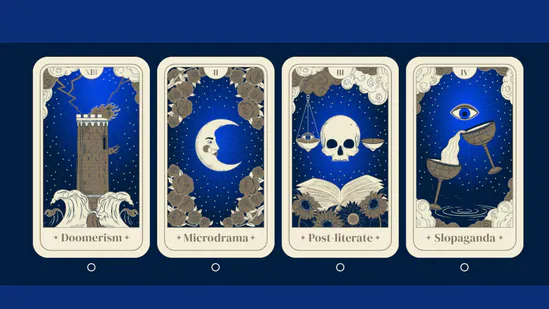
The Oxford University Press has unveiled its shortlist for Oxford Word of the Year 2026. Four words — microdrama, slopaganda, post-literate, and doomerism — make up the shortlist. Based on voting that will go on till November 24, one of these will be selected the Oxford Word of the Year 2026.
Last year, that honour went to “rage bait” — a term that describes manipulative tactics used to increase engagement on social media posts.
“2026 has been a year of uncertainty and existential self-reflection,” the Oxford University Press noted on its website while releasing the shortlist. The four shortlisted words encapsulate this feeling.
(Also read: ‘Human’ is Cambridge Dictionary’s Word of the Year, and Bill Gates explains why it matters right now)
Here’s a closer look at the shortlist for this year and what these words mean.
Doomerism
The word doomerism means “extreme pessimism, especially the view that catastrophic damage to humanity from a perceived threat such as artificial intelligence or climate change is inevitable and impossible to prevent.”
According to Oxford, it is most closely associated with two areas of concern — artificial intelligence and climate change.
{{/usCountry}}According to Oxford, it is most closely associated with two areas of concern — artificial intelligence and climate change.
{{/usCountry}}The word’s usage has been increasing since 2022, reflecting the public’s pessimism about the changes brought on by AI and climate change.
Slopaganda
The concern over artificial intelligence leads to the next word on the shortlist: slopaganda. The word, according to Oxford University Press, means “Low-quality propaganda produced using generative artificial intelligence and widely distributed online, esp. via social media.”
Oxford says that its usage has seen an increase of 1300% in relative frequency over the last one year.
The word has negative connotations, with people growing increasingly wary of AI content being used to mislead and manipulate public opinion, especially through political messaging.
Post-literate
The emergence of slopaganda ties to another word on Oxford’s shortlist — post-literate.
Post-literate designates “a period or society in which literacy and the importance of the written word have declined significantly.”
“Reports of declining reading habits have raised fears about the loss of fundamental skills like critical thinking and empathy, while certain social media influencers admitted they have never read a book, prompting anxiety about changing cultural values, attention spans, and a possible link to a rise in widespread misinformation,” OUP said.
Its inclusion in the shortlist reflects how reading has seen a decline in recent years and is increasingly being replaced by short-form video content and Al-generated material.
Microdrama
Speaking of short-form video content leads to the last and final word on Oxford Word of the Year 2026 list — microdrama.
Microdrama means exactly what it sounds like: “A drama series made up of very short episodes, presented in vertical format for viewing on a smartphone, and typically featuring a melodramatic and fast-moving plot”.
Most of us have seen these very short, highly addictive drama series while scrolling through social media. The format first appeared in China, but has since spread across the globe. The word ‘microdrama’ has seen a 3x increase in usage this year.
How are the words shortlisted?
Oxford University Press (OUP) draws up its Word of the Year shortlist by analysing how the English language has evolved over the past 12 months. Its lexicographers study language data and emerging trends to identify new words and expressions that have gained significance, as well as changes in the way existing words are being used.
The team also considers suggestions from the public and its colleagues, alongside major events and developments that have shaped the year. The resulting shortlist features terms that have had a notable impact on how people communicate and describe the world around them.
