In a remarkable scientific breakthrough, an international team of astronomers led by IIT Bombay alumnus Viraj Karambelkar has witnessed a giant star engulfing its smaller companion in the Andromeda galaxy, located approximately 2.5 million light-years from Earth.
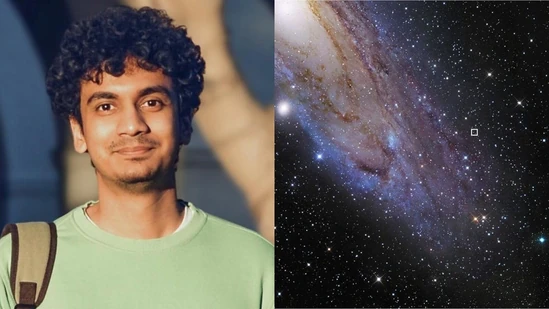
(Also read: IIT Bombay alumnus recalls leaving $8,000 a month US internship to build startup in India: ‘Bet on myself’)
According to a NASA release, the researchers used observations from several ground-based and space telescopes, including the James Webb Space Telescope, to reconstruct the cosmic event. The findings were published in the scientific journal Nature on November 18, 2026.
Karambelkar, a NASA Hubble Fellow at Columbia University in New York, is the lead author of the study.
“Stellar mergers are very, very difficult to observe in real time because they are hard to predict,” Karambelkar said, according to Columbia University.
A cosmic event that unfolded over seven years
The researchers nicknamed the two stars Big Bao and Little Bao. The larger star was approximately seven times as massive as the Sun, while its smaller companion had around 70 per cent of the Sun's mass.
{{/usCountry}}The researchers nicknamed the two stars Big Bao and Little Bao. The larger star was approximately seven times as massive as the Sun, while its smaller companion had around 70 per cent of the Sun's mass.
{{/usCountry}}According to a Nature press release, the smaller star entered the expanding outer layers of its larger companion in 2018 and gradually spiralled towards its core over the next seven years.
Karambelkar and his colleagues first noticed unusual changes in the stellar system in 2023 and continued monitoring it.
In October 2025, the system produced a powerful eruption. According to Reuters, the eruption was a million times brighter than the Sun.
“This violent collision set off a bomb inside the star, producing the bright eruption that we saw,” Karambelkar told Reuters.
Significance of the discovery
The phenomenon, known as common envelope evolution, has been theorised by astronomers for decades. However, scientists had never previously obtained direct observations of the process as it unfolded.
The discovery could help researchers better understand the formation of closely orbiting stellar systems, including those involving neutron stars and black holes.
While the observations strongly indicate that the two stars merged, further monitoring will be required to conclusively establish the outcome.
About Viraj Karambelkar
According to his official NASA Hubble Fellowship profile, Karambelkar grew up in Maharashtra's Pune and completed his bachelor's degree in engineering physics and mathematics from IIT Bombay in 2019.
He subsequently pursued doctoral studies at the California Institute of Technology (Caltech).
(Also read: ₹1.7 lakh/month job">21-year-old IIT Bombay grad builds 6 products after losing ₹1.7 lakh/month job)
According to his Columbia University profile, his research focuses on unusual cosmic explosions, changes in the brightness of stars and astronomical phenomena associated with gravitational waves. He also works on developing software to facilitate such scientific discoveries.
