
A mayoral election in Peru was decided by the toss of a coin after two candidates received exactly the same number of votes, leaving electoral authorities to rely on an unusual but legally recognised method to determine the winner.
(Also read: Peru airport security finds 3,000 tarantulas hidden in dirty socks inside three suitcases)
According to an AFP report published on November 6, the unusual contest took place in Conima, a small district in Peru's Andean highlands near Lake Titicaca.
The coin toss ultimately favoured Rubén Quispe Capajaña of the Somos Perú party, who defeated his rival Salomino Mamani Quispe of País Para Todos despite both candidates securing 671 votes each.
Coin toss settles election deadlock
The candidates had contested the municipal elections held on October 4. Official results from Peru's National Office of Electoral Processes (ONPE) showed that both secured 27.739 per cent of the valid votes, creating an exact tie.
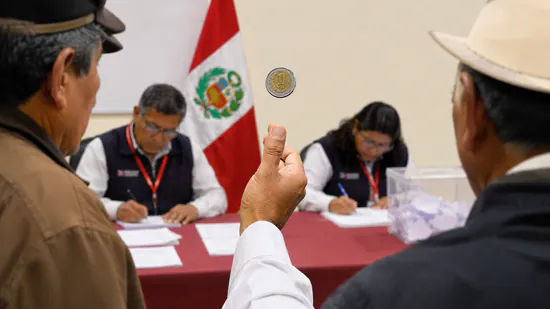
With neither candidate emerging ahead, the Special Electoral Jury (JEE) of Huancané organised a public draw on November 4 to determine the winner.
{{/usCountry}}With neither candidate emerging ahead, the Special Electoral Jury (JEE) of Huancané organised a public draw on November 4 to determine the winner.
{{/usCountry}}An electoral official tossed a one-sol coin into the air, with the result favouring Quispe, who had selected the reverse side.
Speaking after his victory, Quispe expressed gratitude for the unexpected outcome.
"I always wanted to win, and God decided it," he told reporters, according to AFP.
What does Peruvian election law say?
The procedure was not an improvised solution but a mechanism explicitly permitted under Peruvian electoral legislation.
Under Article 26, Clause 6 of Peru's Municipal Elections Law, a tie between candidates receiving an equal number of votes must be resolved through a draw.
Such draws have previously involved tossing coins or drawing balls bearing political parties' symbols.
For the 2026 municipal elections, however, Peru's National Elections Jury issued a Plenary Agreement dated October 28, standardising the procedure and requiring electoral juries to use a one-sol coin to ensure clarity and fairness.
Losing candidate questions procedure
Despite acknowledging that the method was lawful, Mamani expressed dissatisfaction with the outcome.
According to Peruvian news agency Andina, he called for electoral reforms allowing a second round of voting in tied contests rather than determining the winner by chance.
Conima, situated approximately 3,860 metres above sea level, has around 3,500 residents.
(Also read: Old video of the Red River in Peru goes viral. Watch magnificent nature)
The incident was not unprecedented. Peru's electoral authorities have previously used similar procedures, including in municipal elections in 2010, 2014 and 2022.
ABOUT THE AUTHOR
Mahipal Singh Chouhan is a Senior Content Producer at Hindustan Times Digital, with nearly five years of experience in digital journalism and content production. He primarily covers offbeat, trending and human-interest stories, with a focus on emerging social media trends, online conversations and real-world incidents that capture public attention. At Hindustan Times, Mahipal works on identifying and developing fast-moving digital stories, adding context and journalistic perspective to viral moments while maintaining accuracy, clarity and readability for online audiences. Before joining Hindustan Times Digital, he was associated with DNA India, where he gained experience in newsroom workflows and digital storytelling. He holds a degree in Journalism and Mass Communication from the Vivekananda Institute of Professional Studies, Delhi. Beyond journalism, he has a keen interest in history and sports and enjoys expanding his general knowledge.
