
Is Indian politics this season shaping up to be a contestation of ideas between machismo and mellow masculinity Before you wonder what this is about, hear me out.
Do you remember any other time when “love story” was mentioned as often in primetime analysis as this past month?
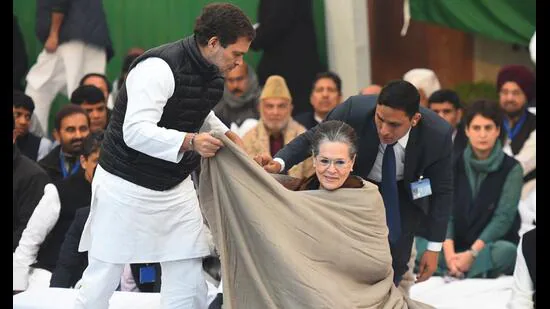
Saturation coverage of Sonia Gandhi’s blockbuster memoir, Belonging, peaked with Rahul Gandhi’s casual reference to his girlfriend (now a friend, he later clarified) and a vivid telling of “Mamma on Papa’s lap” at mealtimes in their childhood years. Whether you went “awwww” at the memory of a blissfully demonstrative happy marriage or found it TMI (too much information), it became an unending talking point. Maybe you were moved by Rahul Gandhi’s remarks on his mother’s tragic love story and also think it is healthy that our leaders are normalising speaking of personal relationships. Or maybe you found it cringe-inducing and off point. In the last week, I’ve heard both arguments.
In terms of political narratives, the Gandhi family wants to be seen as the regular, relatable, softer folks, whose love stories were star-crossed by assassination and sacrifice. Certainly, they want to speak a younger language of love and dating — hence the nonchalant public reference to an old girlfriend. And Rahul Gandhi invoked the “breathtaking beauty of love and belonging” whilst posting an image of Parvati in Shiva’s lap, calling himself a “true Hindu” in the post.
On the other side of the political trenches is the very different image of Prime Minister (PM) Narendra Modi — “a very tough man” as Trump called him — while Modi looked thoroughly unamused at their encounter in Manila this week. Modi’s meteoric rise to the national stage was on the back of a UPA-2 government whose authority had depleted with a multitude of scams, controversies and resignations. Former PM Manmohan Singh — who was correct to say that history would be kinder to him — came across in the narrative wars of 2013-2014 as a good man who was not strong enough to rein in corrupt and wayward colleagues. The India Against Corruption protests solidified that image.
{{/usCountry}}On the other side of the political trenches is the very different image of Prime Minister (PM) Narendra Modi — “a very tough man” as Trump called him — while Modi looked thoroughly unamused at their encounter in Manila this week. Modi’s meteoric rise to the national stage was on the back of a UPA-2 government whose authority had depleted with a multitude of scams, controversies and resignations. Former PM Manmohan Singh — who was correct to say that history would be kinder to him — came across in the narrative wars of 2013-2014 as a good man who was not strong enough to rein in corrupt and wayward colleagues. The India Against Corruption protests solidified that image.
{{/usCountry}}In 2014, Modi quenched the public thirst for a tough guy at the helm of government. He offered himself as the antidote to Singh. Over the years, he solidified his muscular image as the leader who gave the green signal to the surgical strikes after the Uri attack, the Balakot hit after Pulwama, and Operation Sindoor after the carnage in Pahalgam. He was the no-nonsense, unshakeable PM who abrogated Jammu and Kashmir’s special status. And that he had no picket-fence-style family portraits to share was channelled into a political virtue. Many of his voters argued that Modi worked 24x7 even though he had no children to bequeath anything to. His image became that of a spartan, industrious, and self-made leader who could be counted on in a crisis.
It mostly worked for him and the BJP politically — till 2024, when notwithstanding the Ram Mandir inauguration, BJP voters in the heartland were not as enthused as before and the BJP fell below a majority. The party expended all of its energy in compensating for this knock with big wins in the assembly elections that followed. And then came the protests over leaked medical entrance exam papers and the birth of the Cockroach Janata Party (CJP). Just like the India Against Corruption protests birthed the Aam Aadmi Party but actually benefitted the BJP and Modi, the CJP protests at Jantar Mantar have provided an inevitable burst of energy to the Rahul-Gandhi-led Opposition. The CJP opened a door and Rahul Gandhi walked right in suddenly finding a new, more willing audience for allegations he had raised earlier around vote chori.
During the protests, Modi being an astute politician, did try briefly to directly engage with young people on Instagram, softening his erstwhile image of the machismo-fuelled tough man and presenting himself more as an avuncular, forgiving family elder who wanted to be generous with the children who had lashed out against him. Most recently, he used the cult video game franchise GTA 6 to highlight the country’s progress and meme the Opposition, evidently embracing a younger language of popular culture.
But if Rahul Gandhi is exploring a “mohabbat ki dukaan” redux this election season, the BJP has yet to decide how it wants to shift gear — and if it does at all — on the branding of the PM. Party supporters argue that the election machinery of the BJP is more focused on the ground, trying to fix things ahead of the assembly elections in Uttar Pradesh, Punjab, and Uttarakhand. Rhetorical wars, they say, will prove less important than the nuts and bolts of fighting and winning elections.
There is, as political analyst Amitabh Tiwari told me, a difference between “mahaul” and “management” when it comes to elections. A narrative that seems effective online but does not convert electorally is nothing but virality within an echo chamber. Equally, every politician who has been an incumbent for a long time — and this is across parties — knows that while nothing matters more to voters than jobs and economic security, effective political communication is rooted in the art of persuasion.
Who will manage to change minds or hold onto them could decide the course of the next few years.
Barkha Dutt is an award-winning journalist and author. The views expressed are personal
ABOUT THE AUTHOR
Barkha Dutt is consulting editor, NDTV, and founding member, Ideas Collective. She tweets as @BDUTT.
