
India’s journey towards net zero presents a compelling opportunity to transform one of its most abundant resources: organic waste. Agricultural residues, cattle dung, press mud, and municipal organic waste can all be converted into a valuable domestic fuel. The case for scaling Compressed Biogas (CBG) has never been stronger. It can make India’s existing clean CNG mobility ecosystem progressively greener and, with sufficient blending, carbon-neutral on a lifecycle basis.
CNG is already an established, cleaner and affordable mobility fuel. CBG offers something further: the possibility of avoiding more greenhouse gas emissions much faster. That makes it an important part of India’s net-zero journey.
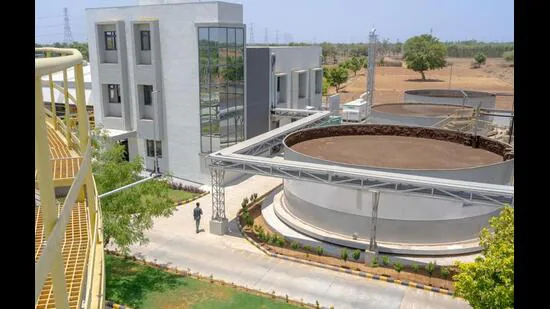
CBG is produced by processing organic waste in sealed digesters and purifying the resulting gas to meet CNG fuel-quality standards. Its climate value comes largely from what it prevents. Organic waste that decomposes without methane capture can release a greenhouse gas far more potent than carbon dioxide. Capturing that methane and using it as fuel converts a potential source of greenhouse gas emissions into useful energy.
The numbers are striking. A CII-EY analysis drawing on The Energy and Resources Institute (Teri)’s lifecycle assessment estimates that every kilogram of CBG can avoid 15.85 kg of CO2-equivalent (CO2e) emissions, based on the assessed feedstock mix, for a car delivering 23 km per kilogram. This translates into an estimated carbon-negative lifecycle footprint of about minus 689 grams of CO2e per kilometre. The same assessment puts diesel at positive 170 g/km. The distinction between tailpipe and lifecycle emissions is crucial. Tailpipe measurements capture what a vehicle emits while running.
Lifecycle assessment accounts for emissions associated with producing and supplying the fuel as well as using it. For CBG, it also captures the substantial benefit of avoiding methane releases from organic waste. NITI Aayog’s February 2026 transport study recognises CBG’s carbon-negative potential and includes CBG-based vehicles in the zero-emission vehicle category. CBG does not merely cut greenhouse gas emissions. On the lifecycle assumptions assessed, it prevents more than it adds. That is why its carbon footprint can fall below zero.
{{/usCountry}}Lifecycle assessment accounts for emissions associated with producing and supplying the fuel as well as using it. For CBG, it also captures the substantial benefit of avoiding methane releases from organic waste. NITI Aayog’s February 2026 transport study recognises CBG’s carbon-negative potential and includes CBG-based vehicles in the zero-emission vehicle category. CBG does not merely cut greenhouse gas emissions. On the lifecycle assumptions assessed, it prevents more than it adds. That is why its carbon footprint can fall below zero.
{{/usCountry}}The real power of CBG lies in blending. Because purified CBG and conventional CNG are both predominantly methane, CBG can use the established CNG distribution and refuelling network. Existing CNG vehicles can use the blended fuel without engine modifications. As the proportion of CBG rises, the lifecycle carbon footprint associated with that fuel falls.
Teri’s September 2026 report found that blending 20% CBG with CNG could make the overall fuel carbon-neutral on a lifecycle basis. The CII-EY analysis takes the calculation further: On its assessed assumptions, every additional percentage point of CBG blending reduces the conventional CNG lifecycle footprint by roughly 5–7% of the unblended baseline. The model approaches carbon neutrality at around 17% blending and turns modestly carbon-negative at 20%.
This is an unusually powerful proposition. The emissions benefit need not wait for every vehicle on the road to be replaced. It can extend across the existing CNG fleet as the blended fuel becomes available at scale.
India’s estimated CBG production potential is about 62 million tonnes a year, according to the assessment. Harnessing just a tenth of that potential could support blending of nearly 20% and create an opportunity to make CNG mobility carbon-neutral on a lifecycle basis by 2047, India’s centenary of Independence, well ahead of the national 2070 net-zero goal.
India has laid the foundation. The CBG blending obligation for city gas distribution is set at 3% in FY27, rising to 4% in FY28 and 5% from FY29. The newly launched GOBARdhan scheme, with an outlay of ₹23,731 crore, provides for assured offtake, stable pricing, capital assistance and pipeline connectivity. It aims to expand domestic CBG production nearly tenfold. Budget FY27 has also provided excise-duty relief for the CBG component of blended CNG.
The international direction is equally encouraging. At COP31 in Antalya, Turkey, a Biogas Declaration was announced, seeking cooperation on finance, market integration and common approaches to certification for biogas and biomethane. The International Energy Agency estimates that 80% of the world’s sustainable biogas potential lies in emerging economies. India, with its large agricultural and urban organic-waste resources, is well positioned to lead.
India’s mobility transition cannot rest on one technology. Electric vehicles, hybrids, ethanol-based fuels and CNG–CBG each have strengths across different vehicle segments and operating conditions. The Teri study and the CII-EY report reinforce this multi-pathway approach. CNG already benefits from an established network of more than 9,100 stations, providing an immediate platform for greater use of CBG.
India produces organic waste on a vast scale. Treated only as a disposal challenge, it represents a missed climate and economic opportunity. Treated as a resource, it can produce domestic energy, reduce lifecycle greenhouse gas emissions and create additional income opportunities for farmers. With faster plant approvals, reliable feedstock supply chains and blending targets that rise alongside production, CBG can make an already clean CNG ecosystem dramatically greener. It is a rare opportunity to advance climate action, rural prosperity and energy security together.
Rajiv Kumar is chairman, Pahle India Foundation, and former vice-chairman, NITI Aayog. The views expressed are personal
