
 E-Paper






Brajendra K Parashar is a Senior Journalist with the Hindustan Times, based in Lucknow, with nearly three decades of experience covering governance, public policy, politics and development in Uttar Pradesh. Over the years, he has reported extensively on key sectors, including energy and renewable power, mobility and transport, road safety, agriculture and allied sectors and issues related to farmers, rural development, taxation under the Goods and Services Tax (GST) and public administration. A seasoned political correspondent, Parashar closely tracks the Bharatiya Janata Party (BJP) and has covered every major election in Uttar Pradesh right from three-tier panchayat elections and urban local body polls to Assembly and Lok Sabha elections. He also reports regularly on the proceedings of the Uttar Pradesh Legislature, bureaucracy, governance, policy decisions and administrative developments with focus on their impact on public life. His reporting is known for its strong analytical approach, extensive use of official data. His areas of interests include investigative journalism, long-form political and policy analysis, data-driven reporting, elections and institutional reforms. Parashar holds a postgraduate degree in Political Science with First Division from Aligarh Muslim University (AMU), followed by a Diploma in Journalism and Mass Communication from the same university. His inclination towards journalism began during his student days, when he regularly contributed letters to editors and articles to newspapers and magazines. In the mid-1990S, his essay, “Should India Switch Over to the Presidential Form Of Government?”, published in Politics India magazine edited by noted constitutional expert Subhash C Kashyap, was adjudged the best entry in a national competition. His work has received professional recognition, including the Hindustan Times Journalist of the Month Award for an impactful series on drinking water issues during the 2010 Lok Sabha election campaign. Originally from Kasganj in western Uttar Pradesh, Parashar is currently based in Lucknow where continues to report on politics, governance and public policy.
UP govt to start doorstep delivery of food stock to ration dealers
The government has identified one block in each district for the implementation of the new scheme after the positive results of a pilot project launched in a few blocks in three districts


To check pilferage in the long supply chain, the Uttar Pradesh government is introducing a new system of doorstep delivery of food stocks directly to ration dealers under the public distribution system (PDS) from Monday.
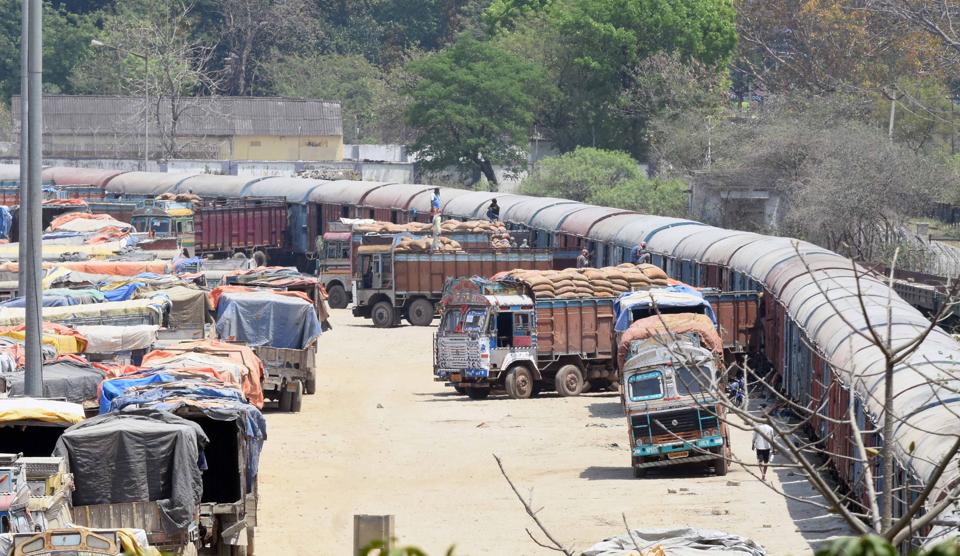
The government has identified one block in each district for the implementation of the new scheme after the positive results of a pilot project launched in a few blocks in three districts.
Also read: Odisha sarpanch alleges PDS corruption, fined Rs 1 lakh for organising protest
“We tried the pilot project in two blocks each in Prayagraj, Moradabad, and Banda. Now, after the success of the project, the government has decided to implement the scheme in one block of each district from Monday,” said AK Singh, additional commissioner, food and civil supplies.
“Later, the government may decide to replicate the model for all the blocks across the state.”
Currently, the food grains are delivered in two stages — from the Food Corporation of India (FCI) godowns to the block godowns and from block godowns to the ration dealers.
Under, the new system, the food grains will travel directly from FCI godowns to the ration dealers.
In most cases, ration dealers have to travel to block godowns to get the monthly quota while in some cases, the stock is delivered to them by the block godowns. In either case, the government used to pay the cost at the rate of Rs 15-18 per quintal, depending on the distance between a dealer’s shop and block godown.
The new system, according to officials, may be helpful for the government in saving these expenses apart from curbing leakages in the long supply chain.
The department of food and civil supplies has also prepared software to run and monitor the new system to ensure transparent transactions.
“Soon after a delivery van starts from an FCI godown, the ration dealer concerned will get a message on his registered mobile number informing him about the same including exact quantity loaded and to be delivered. The delivery man will deliver the rations to the dealer, only after he feeds the OTP sent on his cell phone,” said Singh.
The delivery vehicles, he said, have been fitted with GPS devices, through which they would be under constant vigil from the control room. “We have also mapped the routes that the delivery vehicles are supposed to take to reach ration dealers. Any route diversion for them will get detected immediately,” he said.





