
 E-Paper







Kenneth John is a seasoned journalist with over three decades of reporting experience with different national dailies. As a correspondent with Hindustan Times, he is known for his impactful grassroots journalism, focusing on stories that amplify the voices of marginalised communities and bring issues of public concern into the spotlight. Over the years, he has reported extensively on education, women and child welfare, health, crime, infrastructure, environment, human rights, rural development, poverty, and public policy. His work has consistently highlighted the challenges faced by vulnerable sections of society, particularly in rural and underserved regions. Recognised for his investigative and human-interest reporting, his notable stories include exposing severe child malnutrition in eastern Uttar Pradesh, where he documented instances of children eating mud to cope with extreme hunger. These reports drew attention to serious gaps in welfare delivery and prompted discussions on policy intervention and accountability. A keen observer of social and cultural transformations, he has covered three Mahakumbhs and two Kumbh Melas at Prayagraj’s Sangam, reporting on their religious, social, cultural, and administrative dimensions. Among his most widely discussed exclusives was the story on Uttar Pradesh’s first all-women gang, “D39,” in Kaushambi, revealing how poverty, child marriage, and domestic abuse pushed several women toward crime. His journalism continues to combine investigative rigour with deep human sensitivity.
UP Board: Examinee gets 2 marks in answer copy, 23 in marksheet
A confidential OMR sheet and the marksheet of a UP Board high school examinee have gone viral on the social media revealing discrepancy in the award of marks.


A confidential OMR sheet and the marksheet of a UP Board high school examinee have gone viral on the social media revealing discrepancy in the award of marks.
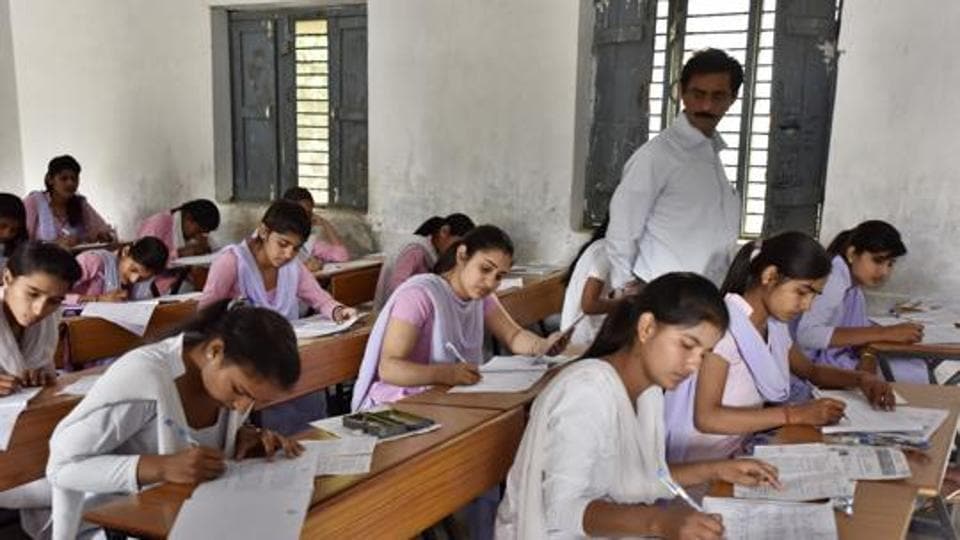
The two documents reveal that the student, who was originally awarded only two marks out of 70 in science (theory) on ‘award blank’ (the OMR sheet on which evaluators fill up the column of marks obtained by candidates), finally got 23 marks in the marksheet.

HT, however, could not independently verify the authenticity of the documents.
Secretary, UP Board, Neena Srivastava said: “It is unfortunate that confidential documents of the Board have been made public. A probe will be ordered into the matter and strict action will be taken against the guilty.”
According to UP Board moderation rules, a high school examinee can be awarded a total of 20 grace marks in proportion of 5 marks each in four different subjects, depending upon the requirement besides 5 to 8 marks of moderation.
As per rules in intermediate, a maximum of 18 grace marks can be given to a candidate failing in one subject or the same marks can be divided as per requirement in maximum of four subjects.
A UP Board official familiar with the developments said the pictures might have been clicked and uploaded on social media by some Board official.

“The authorities have taken the matter seriously. Strict action will follow,” he said.
Another Board official said in view of strict anti-copying measures, the Board authorities had been expecting a drastic decline in pass percentage in high school and intermediate examinations. “Evaluators had also confirmed a sharp decline in results as many candidates failed to perform well,” he said.
He alleged that in an attempt to improve its image, the Board authorities decided to increase marks of all examinees as part of its moderation policy while finalising the results.





