
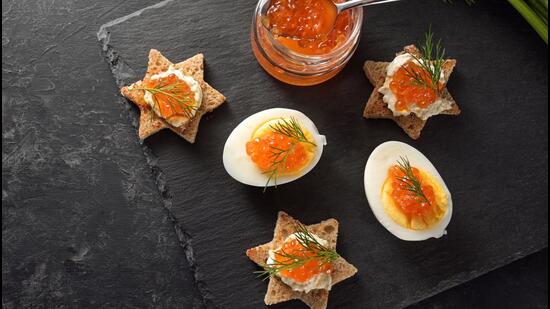
In the huge fuss over Belonging, Sonia Gandhi’s best-selling memoir, one aspect of the book has passed without much comment: The author’s love of food, and more specifically, her hatred of bad food.
There is a lot about food in the book and most of it tends to confirm my longstanding view that most Indian politicians are not foodies and eat bad food on a regular basis – because they can’t tell the difference between good food and the rubbish that gets served to them. Or because they don’t care enough.
Take Indira Gandhi. Elegant, regal, sophisticated and French-speaking, she was regarded in political circles as a gourmet. It was said that any Indian ambassador to the Soviet Union (as it was then) who brought her caviar while on a visit to Delhi would receive a delighted welcome.
I am not sure how accurate the stories about caviar were, but they were not entirely without foundation, because Pupul Jayakar, Mrs Gandhi’s great friend, does record (in a book she wrote about Indira Gandhi) a memorable dinner at the Prime Minister’s residence, where Mrs Gandhi served caviar that had been gifted to her by the Indian Ambassador to Moscow. And the diplomat SK Lambah recalls being taught how to enjoy caviar by Indira Gandhi when she was on a visit to Moscow. (She ate it with egg and onions and with lemon squeezed on it, the classic, old-fashioned method of caviar service in that era.)
I was surprised to note that the love of caviar may have been an aberration. While Sonia Gandhi clearly enjoyed the Indian food that was served at Mrs Gandhi’s house for lunch every day, she had grave reservations about the ‘Western’ food that was served at dinner time.
{{/usCountry}}I was surprised to note that the love of caviar may have been an aberration. While Sonia Gandhi clearly enjoyed the Indian food that was served at Mrs Gandhi’s house for lunch every day, she had grave reservations about the ‘Western’ food that was served at dinner time.
{{/usCountry}}Sonia had never before come across these allegedly Western dishes. For instance, Sanjay Gandhi ate something called Mutton Pozharsky nearly every night. According to Sonia, “the meat was chewy, not suited for Western preparations, so it was coarsely chopped and then shaped into a cutlet with a small bone stuck into it to look like a chop.” Because Sanjay liked it so much, the whole family had to eat it and Sonia writes, “every dinner time, I would find myself staring at that awful Mutton Pozharsky.”
I am guessing that the dish in question was an Indian adaptation of the Franco-Russian dish Côtelettes Pojarski. The original dish was made with beef or veal. Poorer Russians used minced chicken. Only in India did we make it with goat keema. Versions of this dish appeared on many Indian Continental menus in the 1960s, though people usually called it Russian Cutlet. And yes, Sonia is right. It could be disgusting.
The Indianisation of Western dishes was common in Mrs Gandhi’s home. Sonia writes that she was puzzled by a vegetable stew called Rotatobale which was a menu staple and which she had never before encountered. It was only when a European friend tried it that they guessed it was ratatouille, the well known French Provençal dish. (For all nerds: the dish may have Middle Eastern origins and when the great French chef Michel Guerard created a haute cuisine layered version he called it Confit Byaldi after a similar Turkish dish. This is the version made famous by the movie Ratatouille.)
More mysterious was a stew of keema and rajma that was called Silicon Cren. This was made by Dinabandhu, a Magh (from the area around Chittagong) cook, who made the ‘Continental’ dishes in Mrs Gandhi’s kitchen. After a little detective work, Sonia realised that what Dinabandhu intended to make was Chili Con Carne, the famous Tex Mex dish. He got it half right because Chili Con Carne is also made with rajma and keema and his choice of name demonstrated a certain originality. (Say ‘Silicon Cren’ quickly. It does sound a little like Chili Con Carne, doesn’t it?)
But obviously, his version was not very good because Sonia writes “thankfully this misspelt dish had seldom been served to visitors.” Did Mrs Gandhi not know any better?
My theory is that she did. After all, she travelled around the world and had probably eaten in every major national capital. She just did not think it was worth bothering about. The Indian food in her house was always good. (Sonia says that she still has the Arhar dal from those days made every day in her home.) And Indira did not want to bother herself too much with the lighter so-called Western food that Dinabadhu made in the evenings.
Certainly, until Sonia got there the house had no dedicated foodies. Sanjay actually liked this stuff. And, as Sonia complains in her memoir, the family had to eat a lot of eggs because both brothers were egg lovers. She suggests that this passion for eggs came from the Parsi genes they had inherited from their father.
As for Mrs Gandhi, Sonia writes that while she had a sophisticated palate and could identify ingredients easily, she often had too much on her mind to care about food. She would miss meals at home and just eat something from the Parliament canteen. Even when it was just her and Sonia dining at home, Mrs Gandhi would sometimes eat silently while reading papers or even magazines as she ate. At the beginning, Sonia thought this was rude but she got used to it.
When it comes to Western food, it is worth remembering that in the era Sonia describes most of the ingredients required for Western food were not available in India thanks to import restrictions. She taught herself to cook in Mrs Gandhi’s house and while the Indian dishes were relatively easy to make, she had difficulty making the Italian dishes she missed because the local tomatoes were often too watery, there was no rosemary to be had and Indian basil tasted different. There was no Italian style cheese and no Italian salumi. Olive oil was treated as a medical ingredient and sold in tins at pharmacies.
Eventually her mother brought seeds and saplings from Italy and they planted them in the garden at home. As she writes, she could “not have foreseen that decades later Italian food would become so popular in India and its ingredients so freely available.”
So has the food politicians eat improved from those days ? In my experience, no. Most politicians have no time for good food. Power is the fuel that keeps them going. And unlike the Gandhis, who have never served alcohol at home, Indian politicians will often choose good liquor over good food.
From HT Brunch, November 28, 2026
Follow us on www.instagram.com/htbrunch
ABOUT THE AUTHOR
Why hide the papers? Why keep the conspiracy theories related to Netaji Subhas Bose’s death alive? And why deny India the truth about the death of one of its great freedom fighters?
