
Union environment minister Prakash Javedekar on Thursday said only four per cent of Delhi’s pollution owes to stubble burning and the rest comes from local factors like dust, construction, biomass burning etc. Javadekar’s comment which blames Delhi for its pollution level sparked off a debate as Delhi environment minister Gopal Rai pointed out that the air quality index in the capital city — which encounters severe pollution problems every year during the onset of winter — was normal 15 days ago. What Delhi people did in the last 15 days to have led to the worsening air quality, the minister asked the Centre.
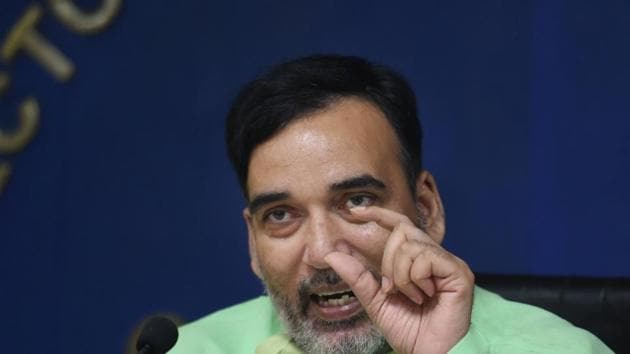
“It seems the Centre has become spokesperson of states where stubble burning takes place and is competing with Delhi. We are taking measures to fight pollution in Delhi and want cooperation from the Centre on source of pollution outside Delhi,” Rai said.
“The Union Environment Minister today said that stubble burning contributes only 4% to pollution in Delhi. Air Quality Index was normal 15 days ago, I want to ask him as to what people of Delhi did in 15 days which led to this kind of situation,” Rai said attributing the rising pollution level of the capital city to stubble burning in Punjab and Haryana.
The gains of lockdown started diminishing in the last two weeks as air quality of Delhi started to feature in ‘poor’ category. On Thursday at 11.10am, the air quality index was 315, which falls under ‘very poor’ category. On Wednesday, the overall air quality index was 276 in the “poor” category.
The AAP-led Delhi government has been taking a slew of measures to mitigate the impact of rising pollution levels. On Wednesday, the Delhi Pollution Control Committee banned the use of fuel-powered generators from October 15 under the Graded Response Action Plan, which is a set of anti-pollution restrictions that include pre-emptive measures to stop the air quality from deteriorating to emergency levels. Grap also includes severe steps like a ban on trucks, odd-even road restrictions, curbs on construction work, and an advisory to shut schools.
{{/usCountry}}The AAP-led Delhi government has been taking a slew of measures to mitigate the impact of rising pollution levels. On Wednesday, the Delhi Pollution Control Committee banned the use of fuel-powered generators from October 15 under the Graded Response Action Plan, which is a set of anti-pollution restrictions that include pre-emptive measures to stop the air quality from deteriorating to emergency levels. Grap also includes severe steps like a ban on trucks, odd-even road restrictions, curbs on construction work, and an advisory to shut schools.
{{/usCountry}}On Thursday, Delhi Chief Minister Arvind Kejriwal launched a new anti-pollution campaign under which people will be encouraged to switch engines of their vehicles off while waiting at traffic signals.
ABOUT THE AUTHOR
Follow the latest breaking news, major developments and agenda-setting stories from India and around the world with the newsdesk at Hindustan Times. Operating round the clock, the desk brings together experienced editors, reporters and correspondents to deliver fast, accurate and contextual reporting across subjects that influence public policy, governance, business, society and international affairs. The HT News Desk covers politics, elections, government policies, the economy, business and markets, science and technology, the environment, law and order, infrastructure, education, climate issues and geopolitics, while closely tracking developments across states, institutions and global capitals. The team also leads coverage of major breaking news events, policy announcements, court proceedings, natural disasters, public emergencies and significant international developments. Reports published by the newsdesk are based on information gathered from reporters on the ground, official statements, government agencies, court records, regulatory filings, recognised institutions and other authoritative sources. Stories undergo editorial scrutiny and verification processes to ensure accuracy, fairness and relevance, and are updated as events evolve and additional information becomes available. Whether covering a key political decision in New Delhi, an economic policy shift affecting millions, a landmark court ruling or a major global event, the HT News Desk aims to provide readers with reliable, fact-based journalism that delivers not only the latest developments but also the context and analysis needed to understand their wider implications.
