
 E-Paper







Follow the latest breaking news, major developments and agenda-setting stories from India and around the world with the newsdesk at Hindustan Times. Operating round the clock, the desk brings together experienced editors, reporters and correspondents to deliver fast, accurate and contextual reporting across subjects that influence public policy, governance, business, society and international affairs. The HT News Desk covers politics, elections, government policies, the economy, business and markets, science and technology, the environment, law and order, infrastructure, education, climate issues and geopolitics, while closely tracking developments across states, institutions and global capitals. The team also leads coverage of major breaking news events, policy announcements, court proceedings, natural disasters, public emergencies and significant international developments. Reports published by the newsdesk are based on information gathered from reporters on the ground, official statements, government agencies, court records, regulatory filings, recognised institutions and other authoritative sources. Stories undergo editorial scrutiny and verification processes to ensure accuracy, fairness and relevance, and are updated as events evolve and additional information becomes available. Whether covering a key political decision in New Delhi, an economic policy shift affecting millions, a landmark court ruling or a major global event, the HT News Desk aims to provide readers with reliable, fact-based journalism that delivers not only the latest developments but also the context and analysis needed to understand their wider implications.
Two kinds of alliances to remove Modi govt - total unity, possible unity: Sharad Yadav
Janata Dal leader Sharad Yadav said that the effort is for total unity but if that is not possible then there will be possible unity to remove the Modi government.


There will be two kinds of alliances -- “total unity” and “possible unity” -- across states to reach the opposition goal of removing the Narendra Modi government, said Janata Dal leader Sharad Yadav.
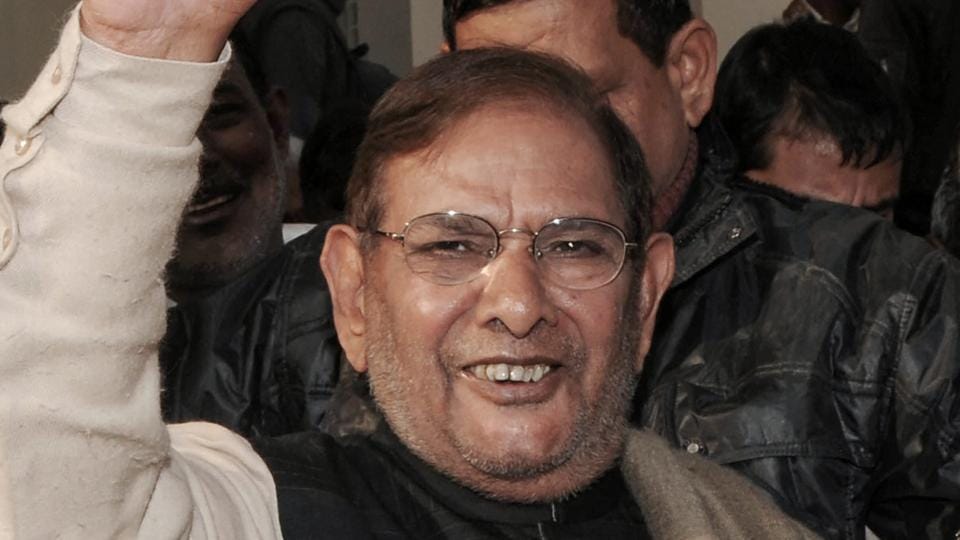
Yadav, 71, who has been instrumental in bringing various opposition parties on an anti-Bharatiya Janata Party (BJP) platform, told IANS in an interview that the name of the Prime Minister of a coalition government has in the past emerged mostly after the Lok Sabha elections and it will also be the case in the coming polls.
Yadav, who is counted among the senior most opposition leaders, said it is a pan-India opposition alliance does not seem workable and there will be state specific agreements.
“There will be ‘sampurn ekta’ (total unity) and ‘sambhav ekta’ (possible unity). The effort is for total unity but if that is not possible, then there will be possible unity,” Yadav told IANS.
He admitted that there was difficulty in achieving total unity in several states due to competing claims of opposition parties.
Yadav, a former union minister who has won Lok Sabha elections from three states, described the Samajwadi Party (SP)-Bahujan Samaj Party (BSP) alliance in Uttar Pradesh as a “right step.”
“It is a step towards giving a strong challenge (to the BJP),” he said.
The SP and BSP have left Congress out of the alliance which sends 80 MPs to the Lok Sabha.
Yadav said that there was difficulty in achieving total unity in states such as West Bengal and Kerala but irrespective of the outcome in such scenarios, the opposition parties will come together to keep the BJP out.
He said there will not be any difficulty in achieving “total unity” among opposition parties in states such as Gujarat, Maharashtra, Tamil Nadu, Bihar and Jharkhand.
Yadav, a seven-time member of Lok Sabha and four-time of the Rajya Sabha, said people have made up their minds to defeat the BJP in the coming elections.
“The first priority is to defeat the BJP. Formation of government will be decided later,” he said.
Citing instances of coalition and other governments formed in 1977, 1990, 1996 and 2004, he said the prime ministerial candidate was not known.
He said once the BJP is defeated, choosing a candidate in the post poll scenario will not be difficult.
Asked about Prime Minister Modi’s assertion that the choice in the Lok Sabha polls was between a “majboot sarkar” (strong government) and “majboor sarkar” (weak government), he said such slogans were meaningless.
“People were the ultimate sovereign authority.”
Yadav said there was no use of a government which calls itself strong but “does not work in the parameters of the Constitution”.
Yadav accused the Modi government of creating divisions among the people, causing communal polarisation and failing to deliver on its promises to various sections of people.
A founding member of the Janata Dal-United, Yadav has also been a convenor of the National Democratic Alliance (NDA). The JD-U ended its alliance with the BJP in 2013 after 17 years.
However, when Bihar Chief Minister Nitish Kumar returned to the NDA in 2017, Yadav parted ways with him.
The Loktrantrik Janata Dal is part of the Grand Alliance in Bihar.





