
 E-Paper







Leena Dhankhar is Senior Editor and Bureau Chief, Gurugram, at Hindustan Times, where she has spent over 17 years chronicling the transformation of one of India's fastest-growing urban regions. From starting her career as a crime reporter to leading the Gurugram bureau, her journalism has been defined by investigative reporting, in-depth storytelling and an unwavering focus on public interest. Over nearly two decades, she has reported extensively across crime, politics, civic governance, elections, real estate, environment, courts, sports, education and entertainment, covering Gurugram, Faridabad, Nuh and Palwal. Her reporting has exposed several major scams and systemic failures, including insurance frauds, waste management irregularities, illegal arms manufacturing units in Nuh, illegal mining in the Aravallis, organised crime networks and governance lapses affecting millions of residents. Known for her investigative work and exclusive stories, Leena has reported on high-impact national issues, including the Nicaragua charter flight carrying Indian migrants that was turned back amid allegations of human trafficking, exposing the growing network of illegal immigration rackets. Her work has also focused on gang wars, prison administration, juvenile crime, women and child protection systems, the functioning of the Juvenile Justice Board and Child Welfare Committee, and environmental challenges such as pollution, waterlogging and deteriorating civic infrastructure. Beyond hard news, Leena has extensively documented Haryana's rich heritage, forests and wildlife, bringing attention to the state's historical landmarks, biodiversity, conservation efforts and ecological challenges through immersive reportage and feature writing. Her journalism has consistently gone beyond breaking news. She has documented Gurugram's rapid urbanisation through long-form narratives and enterprise reporting on issues ranging from pothole-ridden roads, flooding and waste management to the changing social fabric of India's Millennium City. She also writes widely read feature columns, including The Outsider, Changemaker, and Concern for Gurugram, profiling people, places and ideas shaping the city's identity. Leena is the author of Gurugram School Murder, published by Juggernaut Books, a deeply reported account of one of India's most high-profile school murder investigations. She is currently working on her second book, an investigative work exploring some of India's most significant scams and fraud investigations. Beyond print journalism, she has expanded her storytelling through public speaking and digital media. She is a TEDx speaker and has produced podcasts exploring Gurugram's transformation, civic challenges and untold stories. Her work reflects a commitment to narrative journalism that combines rigorous reporting with compelling storytelling. A law graduate with an MBA in Human Resources, Leena brings a multidisciplinary perspective to her reporting, particularly on governance, public policy and legal affairs. She has travelled extensively across India to pursue investigative assignments, often reporting from remote locations and conflict-prone areas in search of stories that matter.
To check fatalities on flooded roads, police temporarily fix 150 potholes in Gurugram
The decision to fill potholes was taken after the June 13 road safety meeting, in which experts identified potholes as among the prime reasons for road fatalities in the city.


The traffic police and Haryana Vision Zero (HVZ), a team of experts working with the state government to reduce road fatalities, have started repairing over 250 potholes that threaten commuters’ safety on Gurugram roads.
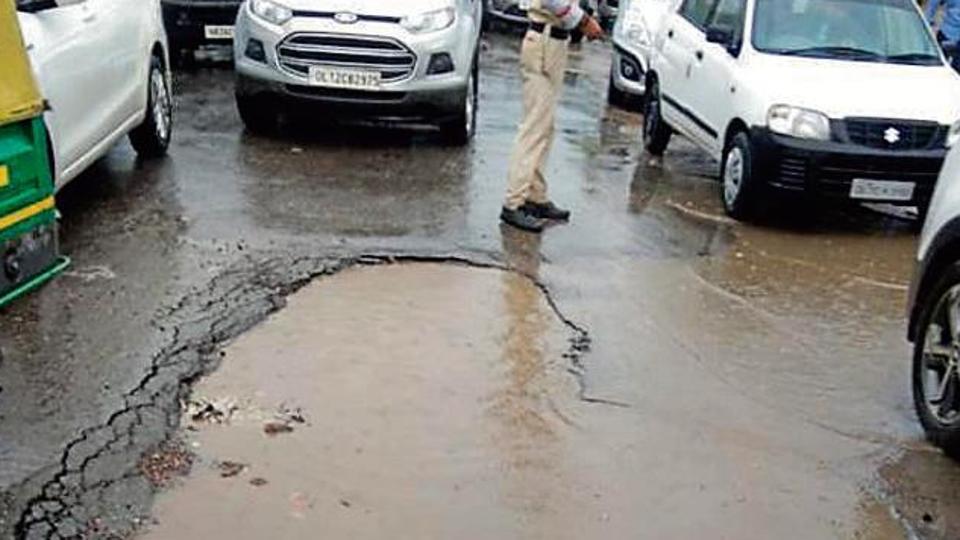
The decision to fill potholes was taken after the June 13 road safety meeting, in which experts identified potholes as among the prime reasons for road fatalities in the city. However, the police and HVZ, in collaboration with private companies, took the onus of temporarily filling potholes after the agencies responsible said they would only be able to undertake the task after the monsoon.
“The traffic police, in collaboration with private companies, will temporarily fix these potholes within a few weeks’ time to make the roads safer,” police commissioner Muhammad Akil said, adding that the initiative was taken to make the city roads safer during monsoons.
“Since January this year, we have written to the MCG at least thrice asking them to fill potholes. After the June 13 meeting, we realized that road fatalities would increase if these potholes, which usually get inundated because of waterlogging and cannot be seen, were not filled before the rain starts,” Akil said, adding that till now, they have fixed around 150 potholes.
“After pedestrians, two-wheelers are the most vulnerable road users and a lot of them are impacted due to poor quality of roads due to potholes,” Sarika Panda, associate director of Nagarro and HVZ programme coordinator, said.
Data shared by the HVZ reveals that there’s been a 10% drop in the number of accidents. The police, however, said that about 38% of them were caused by potholes.
“Potholes’ locations are reported to a common WhatsApp group of traffic police officials,” Akil said, adding that potholes ranging from four square feet to as large as 25 square feet on many roads, especially in the city’s fringe areas.
The traffic police identified spots from where accidents were reported because of potholes. These areas are mostly in Palam Vihar, Golf Course Extension Road, Sohna Road, Shankar Chowk, MG Road, internal sector roads, Sidhrawali and Bajghera.
Bhawna Yadav, a resident of Tulip Orange in Sector 70, said she has had to get her vehicle repaired twice so far this year as the road leading to her condominium is riddled with potholes. “I find it difficult to balance while navigating the uneven stretch. Further, the road has hardly any streetlights, making driving at night risky. To add to our plight, scores of overloaded trucks carrying construction material drive rashly, leading to accidents,” she said.
Meanwhile, on Monday, state public works department minister Rao Narbir Singh called a meeting of all stakeholders and directed them to start repairing the stretches starting September 15. “I have assigned the task to the concerned officials to collate data and submit the report to me. Once the monsoon is over we will start resurfacing roads across the city,” he said.
Though MCG chief and deputy commissioner Amit Khatri could not offer any explanation for why the civic body did not repair the roads earlier, he said the agency was duty-bound for roads under its jurisdiction and to address problems flagged by corporators, through the Harpath app and suo motu cognizance.
NHAI project director, Delhi-Jaipur Highway, NN Giri said, “We have allotted work to repair the Kherki Daula-Dharuhera stretch. If there is any critical spot needing emergency attention then we can be informed and the work will be done immediately.”
GMDA chief engineer Jitender Mittal also said they repair potholes in their jurisdiction within 24 hours. “We are not aware of this initiative taken by the police,” he said.





