The Supreme Court on Friday permitted the lighting of the 'Karthigai Deepam' at the disputed stone pillar, or ‘deepathoon’, atop the Thirupparankundram hill in Tamil Nadu's Madurai on November 24. It stayed the operative portions of the Madras high court's January 6 judgment, saying that its permission would not establish any customary right to perform the ritual at the site in subsequent years.
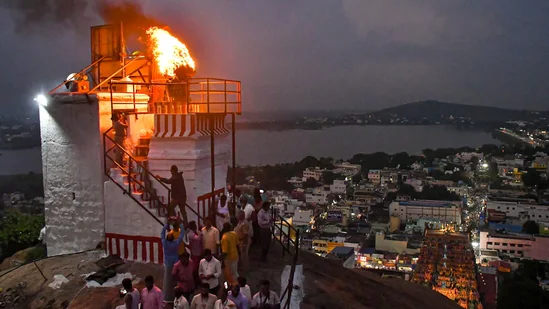
A bench of Justices Aravind Kumar and Vipul M Pancholi directed that an authorised team will light the ceremonial lamp at the stone pillar "identified as the deepathoon" in the high court's January 6 judgment.
It clarified that the order and the consequent arrangement were "a one-time measure" for this year's festival. The bench said it should not be "construed as an endorsement of the reasoning adopted by the high court or as a final determination of the competing claims over the disputed site."
“At this stage, it is neither necessary nor appropriate to express any opinion on the competing claims,” the bench said. It added that it was leaving open questions concerning the customs, the legal character of the disputed site and the statutory authority of the institution concerned for consideration at a later stage.
The bench noted that the Karthigai Deepam festival is to be held on November 24. In its present order, thus, it was "mindful" that a ceremony, once permitted, could not subsequently be undone and if permission was not granted now, no subsequent relief for this year's festival would be possible.
{{/usCountry}}The bench noted that the Karthigai Deepam festival is to be held on November 24. In its present order, thus, it was "mindful" that a ceremony, once permitted, could not subsequently be undone and if permission was not granted now, no subsequent relief for this year's festival would be possible.
{{/usCountry}}The bench said the circumstances warranted an interim arrangement, but added that it was strictly limited to this year's festival. It directed that paragraphs 1 to 140 of the high court division bench's January 6 order would remain stayed until further orders.
The Supreme Court issued directions to the local administration and the Union government to step in if needed, to ensure strict safeguards for the lamp-lighting ceremony. It directed the temple executive officer, Madurai district collector, police commissioner, and the Archaeological Survey of India to decide the composition and strength of the team authorised to conduct the ceremony.
It said the Union government must deploy the Central Industrial Security Force (CISF) if required. The bench asked the district collector and police commissioner to put in place adequate security arrangements to ensure the peaceful ritual.
The bench said the public and other individuals will not be permitted at the site. It added that no demonstrations or processions will be allowed. The bench said only authorised persons and officials required for the ceremony, security and supervision will be permitted access. It added that the district administration will determine the timing and duration of the lighting ceremony, keeping in mind the need to maintain public order and peace.
The bench directed that no articles or installations should be left behind at the site after the ceremony. It added that no excavation, construction, structural alteration, or damage to the site will be permitted. The bench ordered that access to the adjoining dargah and other religious institutions should not be interfered with.
The bench reiterated that its directions were founded on an independent examination of the circumstances arising from the imminent festival and were not intended to settle any underlying disputes. “All questions on essential religious practices, customs, titles are left open,” the bench said. The court observed that the temporary arrangement was made because the dispute remained to be adjudicated.
The matter will be heard next in February.
The Supreme Court has been hearing appeals against the high court orders permitting the lighting of the lamp near the Hazrat Sultan Sikandar Badusha Dargah.
On Thursday, senior advocate P Valliappan, appearing for Rama Ravikumar, the original petitioner before the high court, opposed the state's contention that the pillar was merely a survey stone with no religious significance.
He pointed to photographs of the structure and told the bench that unlike ordinary survey stones, the pillar had a hollowed-out depression designed to hold a lamp.
The submissions came after the Tamil Nadu government and the Dargah management's opposition to the high court directions. They contended there was no established custom of lighting the lamp and that the traditional lamp was lit near the Uchi Pillaiyar temple.
The management disputed the temple's claim over the site, relying on a 1923 decree to contend that the hillock belonged to it. The dispute concerns Hindu devotees' demands to light the 'Karthigai Deepam' at a stone pillar approximately 50 metres from a dargah.
The litigation originated from a petition filed alleging that police prevented devotees from lighting the lamp at the site despite their claim that the practice had traditionally been followed.
In December 2025, a single-judge bench of Justice GR Swaminathan allowed the petition. It directed the temple authorities to light the lamp, holding that the pillar stood on temple land.
The Tamil Nadu government opposed the plea, citing apprehensions of law and order problems and disputing the existence of a customary practice at the location.
The litigation escalated into contempt proceedings after the authorities failed to implement the high court's directions. Justice Swaminathan permitted devotees to light the lamp with CISF protection and quashed the prohibitory orders imposed.
In January, a division bench of the high court upheld the single judge's decision, rejecting the state's concerns over possible communal tensions and the contention that the deepathoon was merely a survey stone.
The Tamil Nadu government approached the Supreme Court challenging the high court orders.
