
 E-Paper







Jasjeev Gandhiok is an Assistant Editor with Hindustan Times, where he covers environment, climate change, the clean energy transition and wildlife at the National Bureau. Gandhiok has over a decade of experience in journalism and is based in Delhi. He has reported extensively on Delhi and the National Capital Region (NCR). This includes the region's air pollution woes, a polluted Yamuna and on urban wildlife still thriving in the region. He joined HT in October 2021. Prior to that, he had five-year stint at The Times of India in Delhi, where he also covered Delhi, with a focus on environment and wildlife. Gandhiok has covered some recent events around the Capital too, ranging from the farmers' protests, the northeast Delhi riots and the CAA-NRC protests, reporting from the ground on all of these. He also travels across the country to report on how environment and climate change impact everyday life, while also writing on endangered species. His reports in 2019 on toxic leachate from Delhi's landfills led to the National Green Tribunal (NGT) taking suo motu cognisance and ultimately asking the state government to start bio-mining to flatten and remove all three landfills in the capital. He also closely tracks the implementation of government policies on climate, renewable energy and environmental protection. His focus remains on impactful, public-interest journalism which explains how environmental decisions affect people's everyday lives.
‘Kept in dark about elephant relocation’: Congress MLA Nayana Motamma on resignation
Congress MLA Nayana Motamma said the forest department had initiated the elephant-driving operation without consulting the elected representatives


Congress MLA Nayana Motamma, who submitted her resignation to the Karnataka Assembly Speaker’s Office on Monday, protesting the alleged forcible movement of wild elephants from Hassan district into her Mudigere constituency in Chikkamagaluru district, said she is willing to reconsider her decision if the state government halted the operation. HT’s Jasjeev Gandhiok spoke to Motamma about her decision, the concerns surrounding elephant relocation and the government’s response. Edited excerpts:
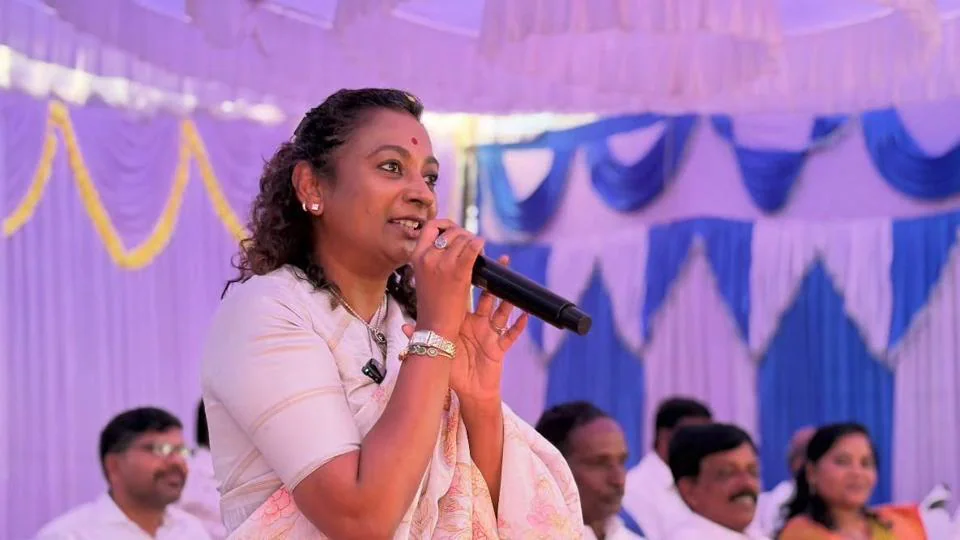
What prompted you to submit your resignation? Was it the decision to move the elephants or the manner in which it was being carried out without consulting you?
About a week ago, a herd of 56 elephants appeared in a neighbouring constituency in Hassan district, resulting in two human deaths. Following this, there was considerable backlash, and the district in-charge minister, Shivlinge Gowda, made a statement about relocating the elephants to Bhadra Tiger Reserve.
The reserve is located in areas adjoining four constituencies in Chikkamagaluru district, including mine. All four of us MLAs immediately objected to the proposal and wrote to the forest minister, asking the government not to go ahead with it. We were subsequently told that a meeting between the Hassan and Chikkamagaluru district MLAs would be convened. Initially scheduled for November 25, it was later postponed to November 30.
Also Read: Supreme Court seeks DNA profiling, welfare of captive elephants
However, two nights ago, while I was in my constituency, I was informed that the operation to drive the elephants towards Bhadra Tiger Reserve had already begun, starting from my constituency. There was no consultation with us, and none of the public representatives had been informed. We had specifically objected to the proposal. I immediately contacted the forest minister and senior forest officials, telling them that the operation should not proceed without taking us into confidence.
You said assurances were given that the operation would be stopped. What happened subsequently that made you decide to resign?
Following our objections, we were given assurances by the deputy chief minister, the additional chief secretary and other senior officials that the operation would be stopped. We were also orally informed by forest officials that the drive would be halted that night.
However, the operation continued. On Monday, the tahsildar of my taluk issued a notice listing villages through which the elephants were being driven and prohibiting public gatherings in these areas under Section 163 of the Bharatiya Nagarik Suraksha Sanhita (BNSS).
This indicated that the operation was continuing despite the assurances given to us. I called the additional chief secretary, the deputy chief minister and the district in-charge minister and informed them that I would submit my resignation. I then went to the Speaker’s Office and insisted that my letter be received.
I have made two conditions for reconsidering my decision: first, I want written confirmation that the operation has been stopped until further discussions; and second, the elephants must be driven back to where they were before the operation began.
What exactly are your objections to moving the elephants to Bhadra Tiger Reserve? Is there an alternative route or location that you would support?
We do not want the elephants to be driven to Bhadra Tiger Reserve like this. Our demand was always to soft launch (them). Our original demand as Chikkamagaluru MLAs was that as and when there is a capture, you will release it into the Bhadra Tiger Reserve. We were then told that since it is a tiger reserve so a soft release of elephants would not be possible and that an alternative location within the district had been identified for a soft release.
Also Read:Uttarakhand govt raises compensation for man-wildlife conflict deaths to ₹10 lakh
Now, however, we are being told that this is not a soft release and that the elephants are simply being driven into the reserve.
There is a complete lack of transparency. Neither the farmers’ groups nor the planters’ associations have been taken into confidence. Who will be responsible if there is a loss of human lives or livelihoods during this operation?
Have you received any communication from the Congress leadership, either at the state or national level, following your decision? Are the other nearby MLAs also considering resigning?
From what I understand, the general secretary in charge had spoken to the Chikkamagaluru MLAs after one of them raised the issue. We were told that he had spoken to the forest minister and that the operation would be put on hold. But that is not what appears to have happened. Nobody from the state leadership has reached out to me following my resignation. As for the other MLAs, I cannot speak on their behalf.
There has been speculation about political reasons behind your resignation, including your appearance at a Hindu Mahasabha event last year and your earlier remarks in August about the lack of women ministers in the Karnataka cabinet. Did any of these factors contribute to your decision?
It was not a Hindu Mahasabha event. It was a Ganpati celebration which happens in the heart of Mudigere, my constituency, where I attended in my capacity as the working president of the festivities. I went there in that capacity.
Similarly, the issue of women ministers in the cabinet is a separate matter. My resignation is entirely about the government’s failure to consult Chikkamagaluru MLAs and other stakeholders before undertaking this elephant-driving operation. This is purely about the government not listening to us.
Would you change your mind and take back your resignation if this drive is stopped?
Yes, that is exactly what I want to do. What I want the state to do. That is what my demand is.
Karnataka has reported a high number of elephant deaths and human-elephant conflict incidents over the years. What, in your view, needs to change in the state’s approach to managing the conflict?
I have been fortunate that there have been no elephant deaths in my constituency in the past two years. In my first year as an MLA, there were four elephant deaths in quick succession. Subsequently, the forest department adopted newer methods, including maintaining a particular passage or corridor through which elephants could move safely, and that helped contain the deaths.
Also Read:Outside tiger reserves: Fresh drive in UP to reduce man-animal conflict
But there needs to be a better approach. The government must involve local people, sensitise them and adopt better methods of managing the situation. At the end of the day, all public representatives are answerable to voters. We have to coexist with wildlife. But coexistence cannot come at the cost of people’s lives and livelihoods.





