
 E-Paper







Follow the latest breaking news, major developments and agenda-setting stories from India and around the world with the newsdesk at Hindustan Times. Operating round the clock, the desk brings together experienced editors, reporters and correspondents to deliver fast, accurate and contextual reporting across subjects that influence public policy, governance, business, society and international affairs. The HT News Desk covers politics, elections, government policies, the economy, business and markets, science and technology, the environment, law and order, infrastructure, education, climate issues and geopolitics, while closely tracking developments across states, institutions and global capitals. The team also leads coverage of major breaking news events, policy announcements, court proceedings, natural disasters, public emergencies and significant international developments. Reports published by the newsdesk are based on information gathered from reporters on the ground, official statements, government agencies, court records, regulatory filings, recognised institutions and other authoritative sources. Stories undergo editorial scrutiny and verification processes to ensure accuracy, fairness and relevance, and are updated as events evolve and additional information becomes available. Whether covering a key political decision in New Delhi, an economic policy shift affecting millions, a landmark court ruling or a major global event, the HT News Desk aims to provide readers with reliable, fact-based journalism that delivers not only the latest developments but also the context and analysis needed to understand their wider implications.
Jammu and Kashmir, Ladakh to come into existence on October 31 after President Ram Nath Kovind’s nod
The Parliament had earlier this week given its nod to the legislation for bifurcating the state, a bold and far-reaching decision that seeks to redraw the map and future of a region at the centre of a protracted militancy movement.


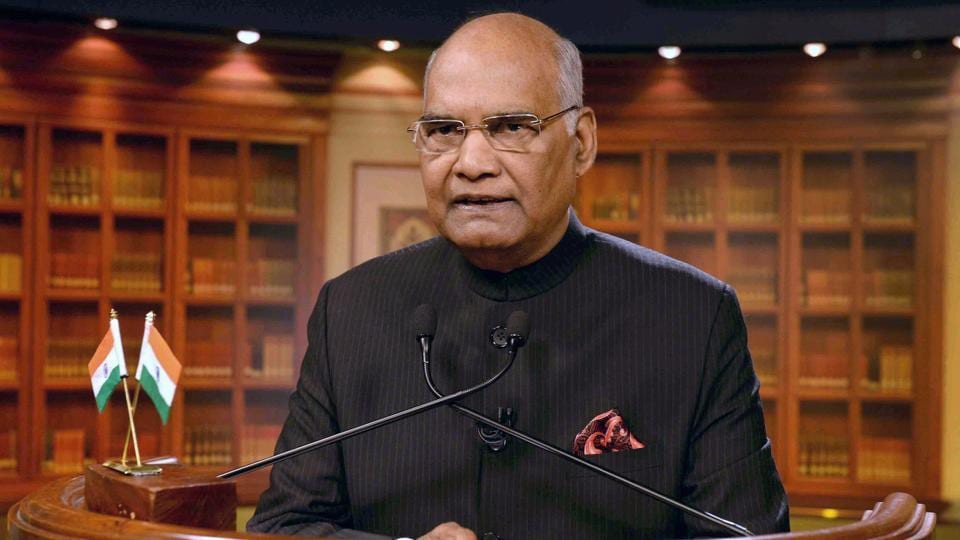
President Ram Nath Kovind on Friday gave assent to a legislation for bifurcation of Jammu and Kashmir, and two Union Territories -- Jammu and Kashmir, and Ladakh -- will come into existence on October 31.
The Parliament had earlier this week given its nod to the legislation for bifurcating the state, a bold and far-reaching decision that seeks to redraw the map and future of a region at the centre of a protracted militancy movement.
The President has given assent to the Jammu and Kashmir Reorganisation Act, 2019, a home ministry official said.
“In exercise of the powers conferred by clause (a) of section 2 of the Jammu and Kashmir Reorganisation Act, 2019 (34 of 2019), the Central Government hereby appoints the 31st day of October, 2019, as the appointed day for the purposes of the said Act,” a home ministry notification said.
Three days after the far-reaching decision to abrogate the special status given to Jammu and Kashmir under Article 370 and bifurcate the state, Prime Minister Narendra Modi, in a nearly 40-minute televised address to the nation on Thursday, sought to assuage concerns of the people saying Jammu and Kashmir will not remain Union Territory for long.
Opinion | Article 370 fallout: Marginalisation of the Kashmiri mainstream
Watch | ‘Article 370 abrogation our internal matter’: India’s message to Pakistan
“As Jammu and Kashmir will see more and more development, I do not think it will remain Union Territory for long. Ladakh will remain a Union Territory,” Modi said. According to the legislation, the Union Territory of Jammu and Kashmir will have a legislature like Puducherry and Ladakh will be a UT like Chandigarh, without legislature.
In both the Union Territories, key subjects such as law and order will be with the Centre.
The UT of Jammu and Kashmir will have a Lieutenant Governor and the maximum strength of its assembly will be of 107 which will be enhanced to 114 after a delimitation exercise. Twenty-four seats of the Assembly will continue to remain vacant as they fall under Pakistan-occupied Kashmir (PoK).
The current effective strength of the Jammu and Kashmir Assembly is 87, including four seats falling in Ladakh region, which will now be a separate UT without a legislature.
Also read | China refers to UN, bilateral agreement after Pak pitches for help in Kashmir
The UT of Ladakh will have Kargil and Leh districts.
The Act said Jammu and Kashmir UT will have reservation in the assembly seats.
The Lieutenant Governor of the successor UT of J-K may nominate two members to the Legislative Assembly to give representation to women, if in his opinion, women are “not adequately” represented in the Legislative Assembly.
It also said that the Lok Sabha will have five seats from the UT of J-K, while from Ladakh the Lower House of Parliament will have one seat.
Also read | Key events in Kashmir since British rule ended in 1947





