
India on Friday responded to the International Court of Justice (ICJ)’s ruling that Myanmar committed genocide against the Rohingya by saying that it had consistently backed the displaced minority’s return to Rakhine state.
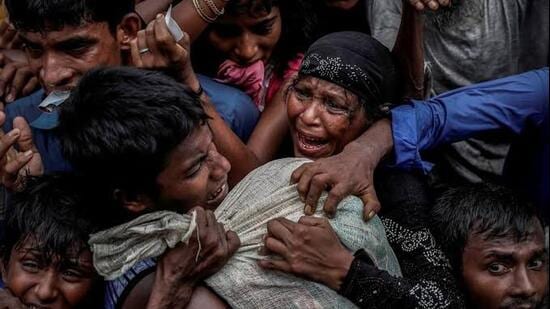
The ruling by the United Nations’ top court in The Hague came after seven years of deliberations and investigations, and has been viewed as historic as it is the first genocide verdict pronounced by the court since it was established in 1945.
“We have taken note of the verdict,” external affairs ministry spokesperson Randhir Jaiswal told a regular media briefing when he was asked about the ruling.
Deep Dive
What is India’s position on the return of Rohingya refugees to Myanmar?
What did the ICJ rule about Myanmar and the Rohingya?
What did the ICJ order Myanmar to do after its Rohingya genocide ruling?
“India has consistently supported safe, speedy and sustainable return of the displaced Rohingya people from the Rakhine state,” he said.
“To this end, we had supported Rohingya camps in Bangladesh with relief supplies in five tranches under Operation Insaniyat. We have also supported the Rakhine state development programme in Myanmar for this purpose.”
About 1.2 million Rohingya refugees are currently living in cramped camps in Bangladesh, and more than 500,000 continue to be trapped and targeted in Myanmar. The ruling came after the Rohingya had endured decades of persecution, torture and killing at the hands of the Myanmar military in Rakhine state.
{{/usCountry}}About 1.2 million Rohingya refugees are currently living in cramped camps in Bangladesh, and more than 500,000 continue to be trapped and targeted in Myanmar. The ruling came after the Rohingya had endured decades of persecution, torture and killing at the hands of the Myanmar military in Rakhine state.
{{/usCountry}}The ICJ ruled by nine votes to six that Myanmar’s campaign against the Rohingya in 2017 amounted to genocide. The court found that Myanmar’s government forces killed thousands of Rohingya civilians, committed widespread sexual violence, inflicted violence on children, and attacked Rohingya people fleeing towards Bangladesh.
In view of all this evidence, the ICJ concluded that the “only reasonable inference” was the Myanmar government’s intention to destroy a substantial part of the Rohingya population in Rakhine state.
ABOUT THE AUTHOR
Rezaul Hasan Laskar is Foreign Editor with the Hindustan Times, which he joined in 2015. He began as a journalist in his hometown of Shillong in northeast India and has worked in newspapers and wire services over the years. He moved to New Delhi in 1997 and initially focused on defence, national security, Jammu and Kashmir and the northeast, while also working of foreign policy and international relations. He has been part of the media delegation accompanying PMs on foreign visits and has reported from destinations ranging from Tibet to Ukraine. Between 2007 and 2013, he was the Press Trust of India correspondent in Pakistan, one of only two Indian journalists allowed to report from the country. He extensively covered Pakistan’s domestic politics and the life of the common people, as well as the fallout of the 2008 Mumbai attacks on India-Pakistan relations and the subsequent trial in Pakistan of the suspects involved in the attack. As part of his reportage in Pakistan, he travelled the breadth of the country, from the Swat Valley to Balochistan. Reza’s first gig in journalism was writing a weekly music column, and music – especially classic rock – remains a keen interest. He is also a movie buff and a keen photographer.
