
A spell of heavy rainfall that threw traffic out of gear in several areas of the National Capital Region on Monday had a far more devastating impact on other parts of north India, killing at least 11 people in the past 24 hours across three states and triggering flash floods and landslides in the hill states of Himachal Pradesh and Jammu and Kashmir.
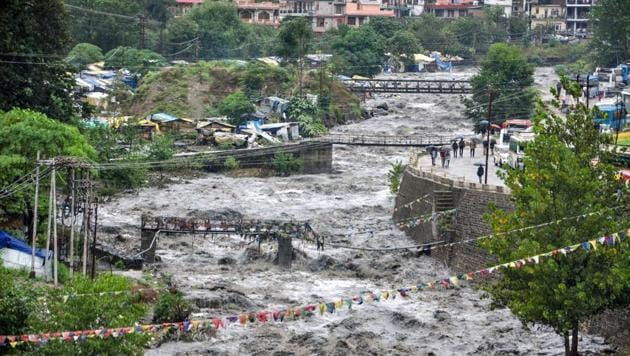
Five people, including a girl, died and as many were injured in separate rain-related incidents in Kullu, Kangra and Chamba districts in Himachal Pradesh, officials told news agency Press Trust of India (PTI). In Haryana’s Ambala, a 45-year-old man died when the roof of his house collapsed due to heavy rains, police told PTI. In Jammu and Kashmir, five members of a family, including three minors, were killed after their house was buried under debris following a landslide in Doda district.
An alert was issued in Punjab, where educational institutes will be closed on Tuesday. Himachal Pradesh, too, announced the closure of educational institutions in Chamba, Kullu, Sirmaur, Kangra and Hamirpur districts till Tuesday.
In Delhi, three days of rain cleaned up the air and brought down the maximum temperature to 27.8 degrees Celsius, which was six degrees below normal on Monday. The weather department said the skies were likely to start clearing up from Tuesday. “We are expecting sporadic incidents of very light rain in isolated parts...This was the last monsoon rain in Delhi,” said BP Yadav, deputy director general of the India Meteorological Department (IMD).
Traffic snarls and waterlogging were reported in Delhi and neighbouring Gurugram, where a slow drainage system made vehicles crawl in arterial roads.
{{/usCountry}}Traffic snarls and waterlogging were reported in Delhi and neighbouring Gurugram, where a slow drainage system made vehicles crawl in arterial roads.
{{/usCountry}}In a statement, IMD said monsoon rains were likely to start withdrawing from the north-west from Saturday. The monsoon usually starts withdrawing from the region in the first week of September, but this year it was delayed by nearly four weeks, said IMD scientist Charan Singh.
The weather department said this year’s monsoon rainfall, the lifeblood of India’s farm sector, was 9% lower than normal, but a detailed report was expected in the first week of October. The deficit, and now the heavy rain, raised concerns over the production of Kharif, or summer-sown, crops.
Himachal Pradesh’s Kullu, a popular tourist destination, was one of the worst-affected districts in the recent showers. The government in Punjab, which has been facing heavy showers for the past two days, asked all district authorities to remain vigilant.
“Punjab and Haryana are likely to be dry by September 28, so will be parts of west Rajasthan,” said IMD’s Singh.
Weather officials said the region was getting a “double dose” of rainfall because westerly winds were “hooking” most winds over central India caused by Cyclone Daye, towards the north.
The IMD forecast also warned of heavy rain at isolated places over Tamil Nadu, Karnataka, Kerala, which is still reeling from the recent floods, Arunachal Pradesh, Assam and Meghalaya between September 25 and September 28.
ABOUT THE AUTHOR
Follow the latest breaking news, major developments and agenda-setting stories from India and around the world with the newsdesk at Hindustan Times. Operating round the clock, the desk brings together experienced editors, reporters and correspondents to deliver fast, accurate and contextual reporting across subjects that influence public policy, governance, business, society and international affairs. The HT News Desk covers politics, elections, government policies, the economy, business and markets, science and technology, the environment, law and order, infrastructure, education, climate issues and geopolitics, while closely tracking developments across states, institutions and global capitals. The team also leads coverage of major breaking news events, policy announcements, court proceedings, natural disasters, public emergencies and significant international developments. Reports published by the newsdesk are based on information gathered from reporters on the ground, official statements, government agencies, court records, regulatory filings, recognised institutions and other authoritative sources. Stories undergo editorial scrutiny and verification processes to ensure accuracy, fairness and relevance, and are updated as events evolve and additional information becomes available. Whether covering a key political decision in New Delhi, an economic policy shift affecting millions, a landmark court ruling or a major global event, the HT News Desk aims to provide readers with reliable, fact-based journalism that delivers not only the latest developments but also the context and analysis needed to understand their wider implications.
