
 E-Paper






Follow the latest breaking news, major developments and agenda-setting stories from India and around the world with the newsdesk at Hindustan Times. Operating round the clock, the desk brings together experienced editors, reporters and correspondents to deliver fast, accurate and contextual reporting across subjects that influence public policy, governance, business, society and international affairs. The HT News Desk covers politics, elections, government policies, the economy, business and markets, science and technology, the environment, law and order, infrastructure, education, climate issues and geopolitics, while closely tracking developments across states, institutions and global capitals. The team also leads coverage of major breaking news events, policy announcements, court proceedings, natural disasters, public emergencies and significant international developments. Reports published by the newsdesk are based on information gathered from reporters on the ground, official statements, government agencies, court records, regulatory filings, recognised institutions and other authoritative sources. Stories undergo editorial scrutiny and verification processes to ensure accuracy, fairness and relevance, and are updated as events evolve and additional information becomes available. Whether covering a key political decision in New Delhi, an economic policy shift affecting millions, a landmark court ruling or a major global event, the HT News Desk aims to provide readers with reliable, fact-based journalism that delivers not only the latest developments but also the context and analysis needed to understand their wider implications.
Govt data shows steep decline in groundwater levels
Out of 6,584 blocks assessed in the country, 1,034 are in the over-exploited category, 253 in the critical category, 681 in the semi-critical category, 96 in the saline category, and 4,520 in the safe category.


Tamil Nadu has the highest number of blocks in the over-exploited category – 358 -- due to groundwater extraction, according to data released by Rattan Lal Kataria, minister of state for Jal Shakti, in the Lok Sabha on Thursday. About 52% wells being monitored in the country are recording declining groundwater levels, he said.
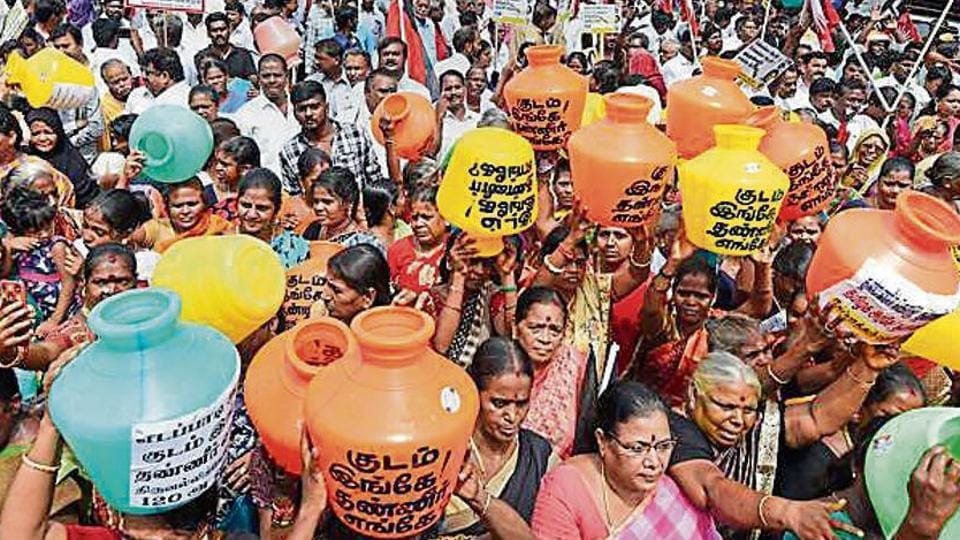
Out of 6,584 blocks assessed in the country, 1,034 are in the over-exploited category, 253 in the critical category, 681 in the semi-critical category, 96 in the saline category, and 4,520 in the safe category. Kataria was answering a question seeking details of the districts or blocks identified and marked as dark zones by the Central Ground Water Board (CGWB), particularly in Aurangabad district of Maharashtra.
“Groundwater levels in various parts of the country are declining because of continuous withdrawal due to reasons such as increased demand for fresh water for various uses, vagaries of rainfall, increased population, industrialization and urbanization…” Kataria said.
The CGWB carries out groundwater monitoring four times a year across the country. To assess groundwater-level trends on a long-term basis, pre-monsoon groundwater data for 2018 has been compared with the decadal average (2008 to 2017).
“Analysis of the data indicates decline in groundwater level in about 52% of the wells being monitored,” Kataria said.
In Maharashtra, out of a total of 353 talukas or blocks, nine have been categorized as over-exploited. But Tamil Nadu has the highest number of talukas in the over-exploited category (358), followed by Rajasthan (164), Uttar Pradesh (113)and Punjab (105).
However, Tamil Nadu has a very large number of blocks that have been assessed, while in the rest of the states, fewer blocks have been assessed but a relatively large number has been f found to be in the over-exploited category. In reply to another question on groundwater levels, Kataria said out of 14,243 wells analysed in the country, 52% or 7,412 are showing a declining trend while 6,786 are showing a rising trend. The categorization of blocks was conducted in 2013 but comparative data is being shared only now, while the trend analysis was done by CGWB in 2018. The comparative data is relevant because Tamil Nadu is experiencing one of its worst water crises in years. The state repealed the Tamil Nadu Groundwater (Development and Management) Act, 2003 -- meant to ration and regulate groundwater extraction -- in 2013 on protests from farmers. It was never replaced by another law.
“It was not the right move. Groundwater extraction is extremely high in rural areas. The crops we grow are extremely water-intensive like sugarcane and paddy. Repealing the act may have aggravated the problem,” said retired IAS officer Santha Sheela Nair, the municipal administration and water supply (MAWS) secretary in 2003 who was instrumental in making rainwater harvesting mandatory in Tamil Nadu.





