
 E-Paper







Follow the latest breaking news, major developments and agenda-setting stories from India and around the world with the newsdesk at Hindustan Times. Operating round the clock, the desk brings together experienced editors, reporters and correspondents to deliver fast, accurate and contextual reporting across subjects that influence public policy, governance, business, society and international affairs. The HT News Desk covers politics, elections, government policies, the economy, business and markets, science and technology, the environment, law and order, infrastructure, education, climate issues and geopolitics, while closely tracking developments across states, institutions and global capitals. The team also leads coverage of major breaking news events, policy announcements, court proceedings, natural disasters, public emergencies and significant international developments. Reports published by the newsdesk are based on information gathered from reporters on the ground, official statements, government agencies, court records, regulatory filings, recognised institutions and other authoritative sources. Stories undergo editorial scrutiny and verification processes to ensure accuracy, fairness and relevance, and are updated as events evolve and additional information becomes available. Whether covering a key political decision in New Delhi, an economic policy shift affecting millions, a landmark court ruling or a major global event, the HT News Desk aims to provide readers with reliable, fact-based journalism that delivers not only the latest developments but also the context and analysis needed to understand their wider implications.
Constricted lanes hinder rescue ops in Mumbai
The vehicles carrying equipment for disaster control could not pass through the narrow lanes and debris had to be cleared manually.


Narrow lanes and overcrowding proved to be major challenges for the fire brigade and National Disaster Response Force (NDRF) while rescuing those stuck under the debris of Kesarbai building in Dongri area of south Mumbai on Tuesday. Ten people died and nine were injured in the incident.
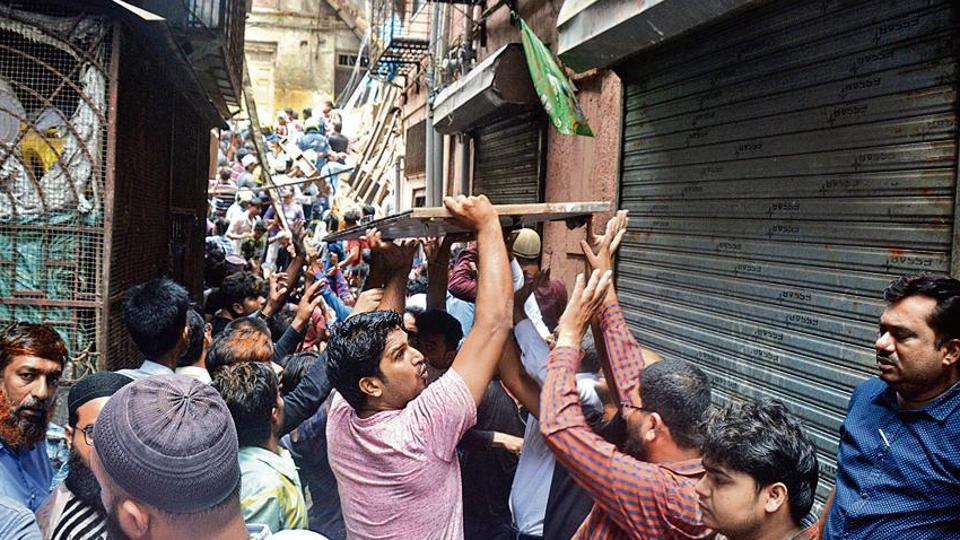
Fire brigade officials reached the spot around 11.55 am. But the vehicles carrying equipment for disaster control could not pass through the narrow lanes. Consequently, debris had to be cleared manually. A senior officer of the Mumbai fire brigade said, “Getting access was a big challenge. Unable to carry any machinery, we have to do all the work – from clearing debris to cutting iron girders – manually.”
Local residents formed a human chain from the spot to the lane outside in order to pass the debris quickly.
More than 94 NDRF personnel and some fire officials were deployed at the spot. “As these are old buildings that were renovated at some point, iron rods were put up around the structure. This made rescuing those stuck in the debris tough. Only if we could take a JCB inside, all debris would have been cleared,” said the fire official. Local residents also helped carry victims on stretchers for at least 400m, the distance to the main road, as the ambulance could not enter the lanes. While four people held the stretcher, four others supported the victims so they didn’t fall. In the absence of machinery, sniffer dogs were used for the operation.
Anupam Srivastava, a commandant of NDRF, said, “We had three important equipment to detect life. One was through heartbeats, thumping or vibrations and detecting location...locals had overcrowded at the spot...So we proceeded with the operations by sending sniffer dogs.”





