
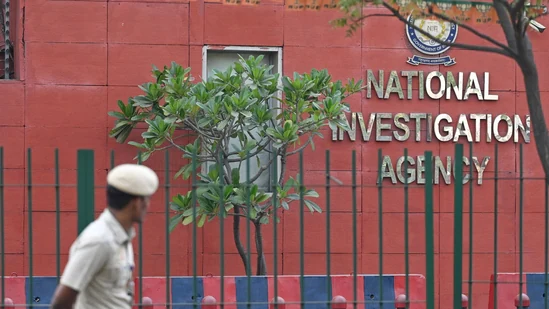
A Chennai court last week granted “A” class facilities inside the prison to an accused in the 2022 Coimbatore car bomb blast case, as it accepted his claim that his educational qualification and lifestyle entitled him to a superior category of accommodation in judicial custody and rejected the National Investigation Agency (NIA) objection.
An explosion occurred outside an ancient temple, “Arulmigu Kottai Sangameshwarar Thirukovil”, on Eswaran Kovil Street, Ukkadam, Coimbatore, on October 23, 2022. The vehicle-borne Improvised Explosives Device (V-IED) driven by the bomber Jamesha Mubeen exploded in front of the temple. Mubeen was killed in the blast.
Co-accused Navas was arrested in the case in October 2024 and is currently lodged at Central Prison, Coimbatore. He moved the special NIA court in Chennai under the New Tamil Nadu Prison Rules, 2024, seeking a direction to the Superintendent of Prisons, Central Prison, Coimbatore, to classify and provide him 'A' class facilities.
Under the New Tamil Nadu Prison Rules, 2024, a Class ‘A’ prisoner gets a better diet, bedding, books to read, newspapers, magazines, etc.
According to the November 17 court order, reviewed by HT, Navas argued that he is a graduate and an income tax assessee, and that he has completed the Master of Business Administration at Bharathiar University, Coimbatore, in April 2020.
{{/usCountry}}According to the November 17 court order, reviewed by HT, Navas argued that he is a graduate and an income tax assessee, and that he has completed the Master of Business Administration at Bharathiar University, Coimbatore, in April 2020.
{{/usCountry}}He submitted that under Rule 804 of the Tamil Nadu Prison Manual (The new Tamil Nadu Prison Rules 2024), undertrial prisoners shall be of two classes: special and ordinary. The special class, he argued, citing the rule, shall consist of those who by special status, education and habit of life have “been accustomed to a superior mode of living”.
Navas told the court that he is “accustomed to a superior mode of living” and that he “shall be eligible for ‘A Class’ (Special Class) by social status, education or habit of life”.
The NIA opposed his plea, saying he attempted to mislead the court by submitting income-tax payment receipts to establish his eligibility for special-class facilities. It pointed out that Navas had paid only ₹1,000 in tax for each of the assessment years 2025-26 and 2026-27 and that he had not disclosed his source of income. The agency argued that merely being an income-tax assessee doesn’t entitle Navas to special-class facilities.
The judge, however, rejected the NIA’s objections. Citing Navas’s educational qualification certificates, the judge stated:...it is evident that Navas is having education and habit of life accustomed to a superior mode of living”.
“Considering his superior mode of living, Navas is eligible for Special Class in the prison,” the court said.
Investigations revealed that the blast was carried out by an Islamic State-inspired module comprising Jameesha Mubeen, Mohammed Azarudeen, Umar Faaruq, Sheikh Hidayathullah and Sanofer Ali. The accused persons conspired to carry out a series of suicidal terror attacks in Coimbatore city following a conspiracy hatched in the forested area of the Sathyamangalam region in Erode district of Tamil Nadu.
Mubeen was allegedly inspired by the bayans (sermons) of Zahran Hashim, a radical Islamic cleric of Sri Lanka, who masterminded the Easter serial suicide bomb attacks in 2019, killing around 260 people. Mubeen wanted to orchestrate a similar kind of attack against the ‘kafirs’ in India.
ABOUT THE AUTHOR
Neeraj Chauhan is a senior journalist with Hindustan Times and an investigative reporter specialising in national security, terrorism, organised crime, narcotics, corruption, financial crime and complex investigations. With over 21 years of experience across Hindustan Times, The Times of India, The Indian Express and The Pioneer, he has built deep expertise in India’s internal security and law-enforcement landscape. Neeraj has extensively covered India’s principal investigative, intelligence and security agencies, including the NIA, CBI, ED, IB, R&AW, MHA and other central security forces. His work has included deeply reported investigations into terrorism, terror financing, cross-border crime, narcotics trafficking, cybercrime, financial fraud and political and corporate corruption. He has reported on some of the most significant terror attacks and security developments in India over the past two decades, including the Delhi serial blasts, the 26/11 Mumbai attacks, the 2019 Pulwama terror attack and the recent Pahalgam attack. His reporting has also chronicled the rise and decline of the Indian Mujahideen, the activities and subsequent crackdown on the Popular Front of India (PFI), Islamist extremist networks, the conflict in Jammu and Kashmir, insurgencies in the Northeast and Maoist violence. Some of Neeraj’s major breaking stories are in Aryan Khan drug case, Sushant Singh Rajput suicide, interception of a 3,000-kg Afghan heroin consignment worth about ₹21,000 crore at Mundra port, Sri Lanka easter bombings, Aarushi-Hemraj murders in Noida, 2G scam, coal block allocation scam, AgustWestland VVIP chopper deal and major bank frauds and extradition cases involving Mehul Choksi, Nirav Modi and Vijay Mallya. His reporting is marked by an ability to cultivate sources, analyse confidential and complex documents, and follow investigations over several years—from the initial breakthrough to chargesheets, trials and international legal proceedings. He specialises in making complicated security and investigative developments accessible while examining their wider implications for governance and public policy. A Chevening South Asia Journalism Programme Fellow at the University of Westminster, Neeraj also spent time at the Financial Times as part of the fellowship. He was also a Robert Bosch Media Ambassadors India-Germany Fellow, studying at the University of Tübingen and working with Der Tagesspiegel in Berlin. He has previously taught investigative journalism and crime reporting as a guest faculty member at the Times School of Journalism. Over more than two decades, Neeraj has established himself as an authoritative voice on India’s national security and investigative landscape, with his reporting closely followed by officials, investigators, lawyers, policymakers and readers seeking insight into some of the country’s most complex and consequential developments.
