
The National Disaster Management Authority (NDMA) on Thursday issued an avalanche warning for Uttarakhand till 5pm on Friday.
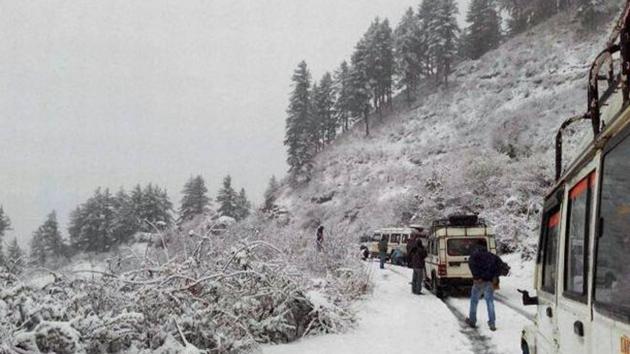
The warning, of danger level 2, has been issued for areas above 2500 metres in Uttarkashi, Chamoli, Rudraprayag, Pithoragarh and Tehri Garhwal districts of Uttarakhand. A warning has been issued for Jammu and Kashmir and Himachal Pradesh as well.
Avalanche risk is depicted on a scale of 1 to 5, starting from low risk, to moderate to considerable to high to very high risk. Danger level 2 indicates moderate risk.
The India Meteorological Department (IMD) has also forecast very light to light rainfall or snowfall at a few places in the hills in Uttarakhand.
Munsiyari town in Pithoragarh district has been in the grip of extreme weather conditions for 11 days now. With sub-zero temperatures leading to road closure and a virtual shutdown, the people have been grappling with a shortage of groceries and other essential commodities, apart from the biting cold.
“This year, in January itself, we have had snowfall on nine days, repeating a 2005-like situation when 3.6 feet of snow was recorded in six days,” said Puran Pandey, a local businessman.
KN Swami, sub-divisional magistrate of Munsiyari, said snow-cutters were at work on a 14km stretch from Ratapani to Munsiyari. “We hope the road can be reopened in another two days,” he said.
{{/usCountry}}KN Swami, sub-divisional magistrate of Munsiyari, said snow-cutters were at work on a 14km stretch from Ratapani to Munsiyari. “We hope the road can be reopened in another two days,” he said.
{{/usCountry}}The IMD has predicted widespread, and even heavy, snowfall in some parts of the western Himalayan region on January 31 and 1.
There could also be rain and thundershowers in some parts of the northwestern plains during this period.
In its bulletin, the IMD said a “western disturbance with its induced cyclonic circulation” was the likely cause of the fresh spell of snowfall. This could also cause light rain over isolated places in Uttar Pradesh on Friday, leading to dense fog over the northern plains on February 2 and 3 after the western disturbance passes.
IMD scientists said there may be a “temporary fall” in temperature on February 2 and 3 by about 2-3 degrees.
Another western disturbance is likely to bring widespread snowfall over the western Himalayan region on and after February 4. This will lead to widespread rainfall over the northern plains from February 5 to 7.
“We are not expecting a major fall in temperature in Delhi and the National Capital Region due to the western disturbance. Nights will be relatively warm, days will be chilly. The fall in temperature will be temporary. But there may be heavy snowfall in many parts of Uttarakhand, Jammu and Kashmir and Himachal Pradesh on January 31 and February 1,” said M Mohapatra, director general of meteorology at IMD.
The minimum temperature on January 31 in Delhi was 8.2 degrees.
ABOUT THE AUTHOR
Follow the latest breaking news, major developments and agenda-setting stories from India and around the world with the newsdesk at Hindustan Times. Operating round the clock, the desk brings together experienced editors, reporters and correspondents to deliver fast, accurate and contextual reporting across subjects that influence public policy, governance, business, society and international affairs. The HT News Desk covers politics, elections, government policies, the economy, business and markets, science and technology, the environment, law and order, infrastructure, education, climate issues and geopolitics, while closely tracking developments across states, institutions and global capitals. The team also leads coverage of major breaking news events, policy announcements, court proceedings, natural disasters, public emergencies and significant international developments. Reports published by the newsdesk are based on information gathered from reporters on the ground, official statements, government agencies, court records, regulatory filings, recognised institutions and other authoritative sources. Stories undergo editorial scrutiny and verification processes to ensure accuracy, fairness and relevance, and are updated as events evolve and additional information becomes available. Whether covering a key political decision in New Delhi, an economic policy shift affecting millions, a landmark court ruling or a major global event, the HT News Desk aims to provide readers with reliable, fact-based journalism that delivers not only the latest developments but also the context and analysis needed to understand their wider implications.
