
 E-Paper







Follow the latest breaking news, major developments and agenda-setting stories from India and around the world with the newsdesk at Hindustan Times. Operating round the clock, the desk brings together experienced editors, reporters and correspondents to deliver fast, accurate and contextual reporting across subjects that influence public policy, governance, business, society and international affairs. The HT News Desk covers politics, elections, government policies, the economy, business and markets, science and technology, the environment, law and order, infrastructure, education, climate issues and geopolitics, while closely tracking developments across states, institutions and global capitals. The team also leads coverage of major breaking news events, policy announcements, court proceedings, natural disasters, public emergencies and significant international developments. Reports published by the newsdesk are based on information gathered from reporters on the ground, official statements, government agencies, court records, regulatory filings, recognised institutions and other authoritative sources. Stories undergo editorial scrutiny and verification processes to ensure accuracy, fairness and relevance, and are updated as events evolve and additional information becomes available. Whether covering a key political decision in New Delhi, an economic policy shift affecting millions, a landmark court ruling or a major global event, the HT News Desk aims to provide readers with reliable, fact-based journalism that delivers not only the latest developments but also the context and analysis needed to understand their wider implications.
As employment opportunities dry up, migrants leave Valley
Migrant workers have been leaving the Valley in large numbers because of loss of work and the prevailing tense situation.


Mohammad Arshad, a 45-year-old goldsmith from Calcutta who has been working for a local trader in Srinagar for the past 10 years, has decided to leave Kashmir along with his family.
He is trying to convince a tempo driver near Barbarshah Bridge to ferry his family and some friends from the interiors of downtown at Saraf Kadal to a convenient location. The area has been under restrictions all week since the nullification of Article 370 and the carving up of the state into two Union territories.
“We are a group of 28 people, including women and children. Some of us have managed to walk to this place but our families can’t walk. The driver is fearful the forces may not allow him to enter downtown or his vehicle may get caught in stone-pelting if he enters downtown,” Arshad says.
“There is no work to do now till the situation improves. So I have decided to go to my home in Calcutta,” he adds.
Migrant workers have been leaving the Valley in large numbers because of loss of work and the prevailing tense situation. Curfew-like restrictions were imposed across Kashmir on Sunday night, hours before Union home minister Amit Shah first announced the momentous decision on J&K in the Rajya Sabha.
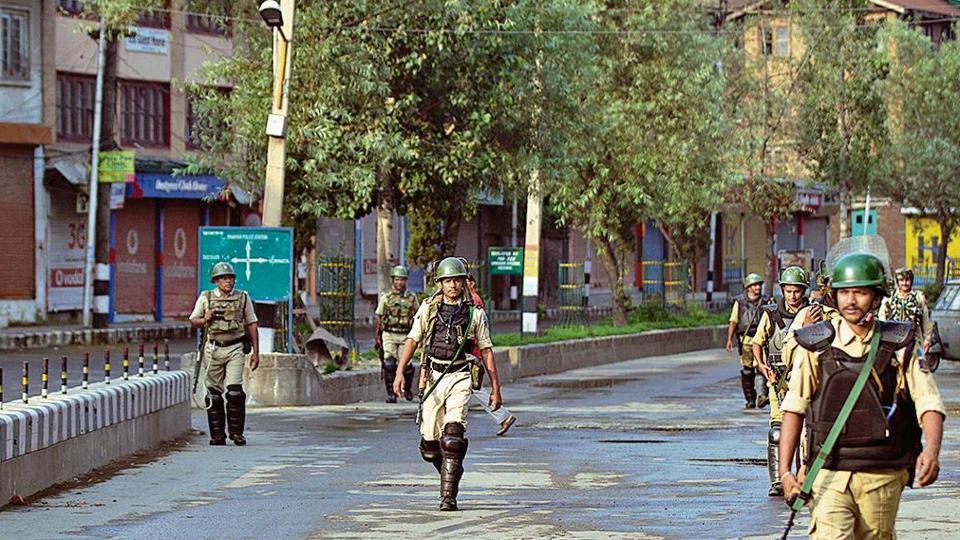
Thousands of CRPF personnel, paramilitary forces and police have been deployed in Kashmir to prevent protests and violence, giving it the look of a fortress. Businesses, markets, offices and educational institutions are closed. Road blocks and concertina wires dot the roads and the movement of people is strictly restricted.
Last week, official orders urged all non-Kashmiris to leave, citing security concerns. The state government sent buses, immediately after the advisory was issued, to different tourist destinations to bring the visitors back to Srinagar.
According to government estimates, some 400,000 migrant workers have been working in Kashmir.
Mohammad Salman, a painter from Uttar Pradesh, said, “We are becoming the target of anger among Kashmiris...youths are telling us to leave. A police officer told us they can’t assure our safety,” said Salman.





