
The Bharatiya Janata Party (BJP) and the Shiromani Akali Dal (SAD) have reunited, reviving a political partnership that lasted nearly 24 years before falling apart over the Centre's farm laws in 2020. The two parties announced the revival of their alliance on Tuesday, ending a six-year break and coming together for the 2027 Punjab assembly elections.
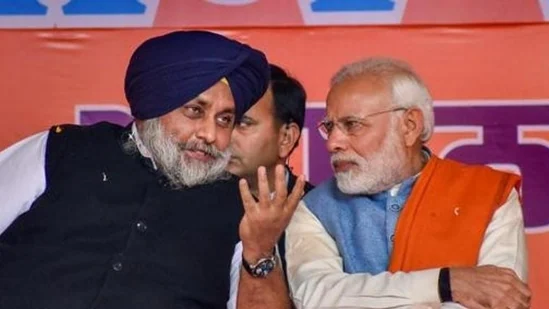
Union home minister Amit Shah, BJP president Nitin Nabin and SAD president Sukhbir Singh Badal made the announcement at a joint press conference at the BJP headquarters in New Delhi. The announcement coincided with Guru Nanak Jayanti, marking the 557th birth anniversary of Guru Nanak Dev Ji.
Thirty years after they first fought an assembly election together, the SAD and BJP will contest the Punjab polls together for the sixth time. They fought together in 1997, 2002, 2007, 2012 and 2017, winning three of those five elections and governing Punjab for 15 years.
ALSO READ | Six years after split, BJP, Akali Dal revive alliance for 2027 Punjab elections
The only assembly election they did not contest together during the past three decades was in 2022, when both parties fought separately and were reduced to the margins. Leaders from both sides have described the reunion as an effort to restore a partnership built around Punjab's peace and stability, rather than merely an alliance for power.
{{/usCountry}}The only assembly election they did not contest together during the past three decades was in 2022, when both parties fought separately and were reduced to the margins. Leaders from both sides have described the reunion as an effort to restore a partnership built around Punjab's peace and stability, rather than merely an alliance for power.
{{/usCountry}}Featured Video
The reunion could reshape the contest in Punjab, where the Aam Aadmi Party (AAP), Congress and BJP are preparing for the next assembly elections.
A history of the BJP-SAD alliance
The BJP and the SAD's formal pre-poll alliance took shape ahead of the 1997 Punjab assembly elections. The partnership was forged in the mid-1990s, after decades of militancy and political instability in Punjab.
At the SAD's Moga convention in February 1996, the party broadened its political identity from one centred on the Sikh community and the Panth to an inclusive regional force representing all Punjabis. The declaration was framed around the slogan 'Punjab, Punjabi and Punjabiyat'.
The Moga Declaration projected Punjabiyat, rather than religion or caste, as the basis of the party's political identity. It also laid the foundation for the SAD's partnership with the BJP, which was aimed at challenging Congress in the state.
ALSO READ | AAP to launch Punjab 2027 poll campaign with Moga rally on November 26
Former chief minister Parkash Singh Badal, the key architect of the alliance, would often describe the relationship as 'Nau-Maas da Rishta', or a relationship akin to that between a mother and her child.
The alliance delivered its first major electoral success a year later. In the 1997 Punjab assembly election, it won 93 seats, with the SAD securing 75 and the BJP 18. Congress was reduced to 14 seats, and Parkash Singh Badal became chief minister again.
In the 1998 Lok Sabha election, the two parties won all 11 Punjab seats they contested, with the SAD winning eight and the BJP three. The SAD became one of the oldest members of the BJP-led National Democratic Alliance (NDA).
The alliance lost the 2002 state election to Congress but returned to power in 2007, winning 67 seats. It won again in 2012, marking the first time a government in Punjab was re-elected to office after the state's 1966 reorganisation.
The alliance's fortunes declined in 2017, when Congress won 77 seats under Captain Amarinder Singh. AAP won 20 seats and became the main opposition party. The SAD fell to 15 seats and the BJP to three.
ALSO READ | Punjab polls: AAP drops minister, 6 other MLAs in second list of 31 candidates
In the 2019 Lok Sabha election, the two parties agreed to divide Punjab's 13 seats, with 10 allocated to the SAD and three to the BJP. Each party won two seats, while Congress won eight.
There were strains in the alliance, though. In January 2020, the SAD briefly sat out the Delhi election after a dispute over the citizenship law, before backing the BJP days later.
How the BJP-SAD alliance fared
Why the alliance broke
The relationship ended in September 2020 over the three farm laws introduced by the Narendra Modi government. The legislation triggered protests by farmers, particularly in Punjab and Haryana. Farmers' organisations argued that the laws threatened the existing agricultural marketing system and minimum support price (MSP) protections, HT reported earlier.
The SAD, which had initially supported the legislation, came under growing pressure in Punjab to oppose it. On September 17, 2020, SAD leader and Union minister Harsimrat Kaur Badal resigned from the Union Cabinet in protest against the farm bills.
Nine days later, on September 26, the SAD announced that it was quitting the NDA. Sukhbir Singh Badal said the decision was taken over the Centre's refusal to provide statutory guarantees for MSP and its alleged insensitivity towards farmers and Punjab's interests.
The government withdrew the laws in November 2021, but the parties remained apart.
BJP-SAD alliance: A look at the numbers
The alliance's strongest electoral performances came in 2007 and 2012, when it won consecutive assembly elections. The SAD secured 48 seats and the BJP 19 in 2007. In 2012, their tallies stood at 56 and 12, respectively.
Their fortunes declined sharply in 2017 and worsened after the split. By the 2022 elections, the SAD was down to three seats and the BJP to two.
The 2022 election saw AAP sweep Punjab, winning 92 of 117 seats. The SAD, which contested in alliance with the Bahujan Samaj Party (BSP), won three seats. The BJP, which fought alongside the Punjab Lok Congress and SAD (Sanyukt), won two.
In the 2024 Lok Sabha election, the parties contested separately again. The BJP fought all 13 seats on its own, significantly increasing its vote share but failing to win any. The SAD also contested all 13 seats independently and won only Bathinda.
Together, the BJP and SAD secured a combined vote share of 31.98% in 2024, higher than Congress's 26.30% and AAP's 26.02%. Yet, separately, they managed to win only one seat between them.
That gap between their combined vote share and their individual electoral performance is among the key arguments for the reunion. Both parties hope that a renewed alliance will help convert votes into seats in the 2027 assembly election.
The first test without Parkash Singh Badal
The 2027 assembly election will be the first joint contest without Parkash Singh Badal, who died in April 2023.
All five previous joint assembly elections were fought under his influence, whether as SAD president, chief ministerial face or the key link between the Akali Dal and BJP leaders such as Atal Bihari Vajpayee and LK Advani.
The next election will be led on the SAD side by Sukhbir Singh Badal. The BJP, meanwhile, is expected to have a greater say in the alliance's seat-sharing arrangement and power structure than it did in the past.
A new seat-sharing formula
For much of the alliance's history between 1997 and 2017, the SAD was the senior partner, contesting the larger share of seats, while the BJP remained the junior partner with a stronger presence in urban constituencies.
The traditional arrangement was based on the SAD contesting 94 seats and the BJP 23 in Punjab's 117-member assembly. The SAD primarily contested rural constituencies, while the BJP focused on urban seats.
That balance is now expected to change. Sources in both parties said the BJP is likely to contest 47-48 seats in the 2027 Punjab assembly election, nearly double its previous share. The broad division of constituencies is expected to remain the same, with the BJP focusing on urban seats and the SAD on rural areas.
The proposed change reflects the BJP's increased vote share in Punjab and the altered political realities since the alliance broke up in 2020.
Why Gurpurab
The announcement of the alliance revival came on Guru Nanak Jayanti, the 557th birth anniversary of Guru Nanak Dev Ji.
In Punjab, Gurpurab has often been a significant occasion for political outreach to the Sikh community by the Centre, particularly during periods of strained relations.
The Kartarpur Corridor was inaugurated on November 9, 2019, on the eve of the 550th birth anniversary of Guru Nanak. The project fulfilled a long-pending demand for visa-free access to Gurdwara Darbar Sahib at Kartarpur in Pakistan.
Two years later, on November 19, 2021, also on Gurpurab, Prime Minister Narendra Modi announced the repeal of the three farm laws in a televised address and urged protesting farmers to return home.
Deep Dive
Why did the BJP and Shiromani Akali Dal split in 2020?
What have the BJP and SAD agreed to ahead of the 2027 Punjab elections?
How did the BJP and SAD perform separately in the 2022 Punjab election?
ABOUT THE AUTHOR
Anita Goswami is a Senior Content Producer at Hindustan Times, where she primarily covers Indian and international news. With four years of industry experience, she has led coverage of Indian General elections, Assembly elections, and national polls in the United States, Canada, Bangladesh, and Nepal. Her reporting covers global wars and major events, including Operation Sindoor, Sheikh Hasina's ouster and the Mahakumbh Mela. She verifies facts and uses clear sources to ensure accurate reporting. As former Chief Copy Editor at Storytailors, she managed teams to produce top-quality content for networks like NDTV, Profit, CNBC-TV18, Upstox and News18. Her work is featured in NDTV, Meaww, and Global Pulse. Throughout her tenure, Anita has collaborated with and been mentored by top industry experts. When not reading, Anita can be found outdoors or at a bakery. Fields of interest: Indian political history, international elections, historical policy analysis, global conflicts, cultural events, Formula 1, art, media ethics and reporting on socio-political change over time.
