
 E-Paper







Abhishek Jha is Assistant Editor-Data at Hindustan Times. He uses statistical programming to generate newsworthy insights from large datasets. He is part of the team that produces Number Theory, a daily data story feature of the paper’s print edition. Since March 2024, he has been writing Weather Bee, a weekly column for the Hindustan Times website. He is a chemical engineer by training, who specialises in stories related to weather, climate, and the environment. Jha has been at HT since 2018, where he offers data-driven perspective and analysis on politics, environment, weather, climate, economy and society. His work includes data coverage of elections in India and abroad, including the 2019 and 2024 Lok Sabha elections; the disasters and extreme weather resulting from changing climate, such as floods, droughts, heat waves, cold waves, and dwindling snow cap in the Himalayas; the factors that drive poor air quality in northern India; the changing patterns of land use; the Covid-19 pandemic and its impact on labour market conditions; the changing pattern of consumer spending seen in the new consumer spending surveys; and social norms seen in the surveys such as the National Family Health Survey.
2026 is now closing in on becoming the warmest year on record | Weather Bee
Global temperatures hit a record 1.98°C above pre-industrial levels in the first 21 days of November, narrowing the gap between 2026 and 2024.


Global temperatures have surged to unprecedented levels in November, narrowing the gap between 2026 and 2024, the warmest year on record, and raising the possibility that the two years could end in a tie, an analysis of Copernicus data by Hindustan Times shows.

The average global temperature in the first 21 days of November was 1.98°C above the pre-industrial average in the ERA5 dataset of the Copernicus Climate Change Service (C3S), 0.21°C higher than the previous record for the same period, set in 2023. Even if this average falls by a few hundredths of a degree by the end of the month, November 2026 is likely to set a new record for the highest temperature deviation from the pre-industrial average, besides becoming the warmest November on record.
The surge has pushed the average temperature deviation for 2026 to 1.55°C as of November 21, up from 1.52°C on October 31. At the end of August, the average stood at 1.48°C, compared with 1.59°C for the same period in 2024, which remains the warmest year on record. The gap between the two years has therefore narrowed, making it possible for 2026 to catch up with 2024 by the end of the year.
The pace of this increase is particularly striking when compared with the earlier months of the year. While it took 49 days for the average temperature deviation to rise by 0.03°C, from 1.48°C on August 31 to 1.51°C on October 19, it took just 22 days for it to climb by the same margin, from 1.52°C on October 28 to 1.55°C on November 19.
The sharp rise in temperatures between October, which was itself the warmest October on record, and November has changed the outlook for the year. For 2026 to match 2024 as the warmest year on record, it would now need to sustain an average temperature deviation similar to the 1.98°C recorded during the first 21 days of November for the rest of the year.
The ongoing El Niño could further push up temperatures in the coming weeks. El Niño is a periodic warming of the central and eastern equatorial Pacific Ocean that contributes to higher global temperatures. Its impact on air temperatures typically emerges with a lag of two to four months. The phenomenon did not appear to have peaked by November 21, leaving open the possibility of further warming through the rest of the year.
At the end of August, the prospect of 2026 overtaking 2024 had appeared remote. The year had averaged 1.48°C above the pre-industrial level, against 1.59°C for 2024 at the same point. With four months remaining, 2026 would have needed to average more than 1.8°C of warming for the rest of the year to close the gap.
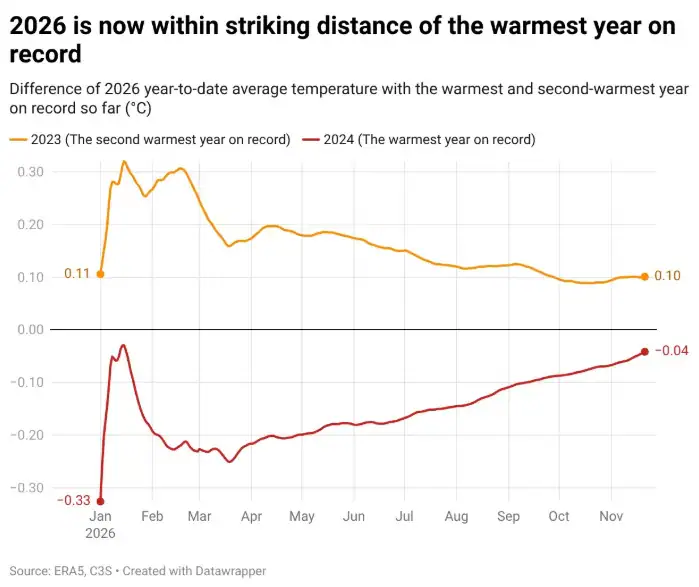
That appeared unprecedented at the time. The highest monthly deviation recorded up to then was 1.78°C, in December 2023, during the peak of an El Niño event. November’s temperatures have now brought such levels of warming within reach, making a tie between 2026 and 2024 by December 31 a possibility.
The figures are based on ERA5 data from the Copernicus Climate Change Service. Data for November 21 is provisional, and the monthly and annual averages may change as more observations become available.





