
 E-Paper







Follow the latest breaking news, major developments and agenda-setting stories from India and around the world with the newsdesk at Hindustan Times. Operating round the clock, the desk brings together experienced editors, reporters and correspondents to deliver fast, accurate and contextual reporting across subjects that influence public policy, governance, business, society and international affairs. The HT News Desk covers politics, elections, government policies, the economy, business and markets, science and technology, the environment, law and order, infrastructure, education, climate issues and geopolitics, while closely tracking developments across states, institutions and global capitals. The team also leads coverage of major breaking news events, policy announcements, court proceedings, natural disasters, public emergencies and significant international developments. Reports published by the newsdesk are based on information gathered from reporters on the ground, official statements, government agencies, court records, regulatory filings, recognised institutions and other authoritative sources. Stories undergo editorial scrutiny and verification processes to ensure accuracy, fairness and relevance, and are updated as events evolve and additional information becomes available. Whether covering a key political decision in New Delhi, an economic policy shift affecting millions, a landmark court ruling or a major global event, the HT News Desk aims to provide readers with reliable, fact-based journalism that delivers not only the latest developments but also the context and analysis needed to understand their wider implications.
11 die in Vizag factory gas leak, hundreds evacuated
The incident prompted the Union government to issue an advisory to chemical plants to take extra precautions while restarting their operations from what will be more than a month’s halt due to the nationwide shutdown in place to reduce the spread of the coronavirus disease (Covid-19).


At least 11 people died, 25 were left critically ill, and close to 1,000 were affected after a chemical from a factory leaked and hung as smog over nearby villages in Visakhapatnam district in the early hours of Thursday, jolting awake hundreds of residents who choked due to the toxic gas before they could flee the area.
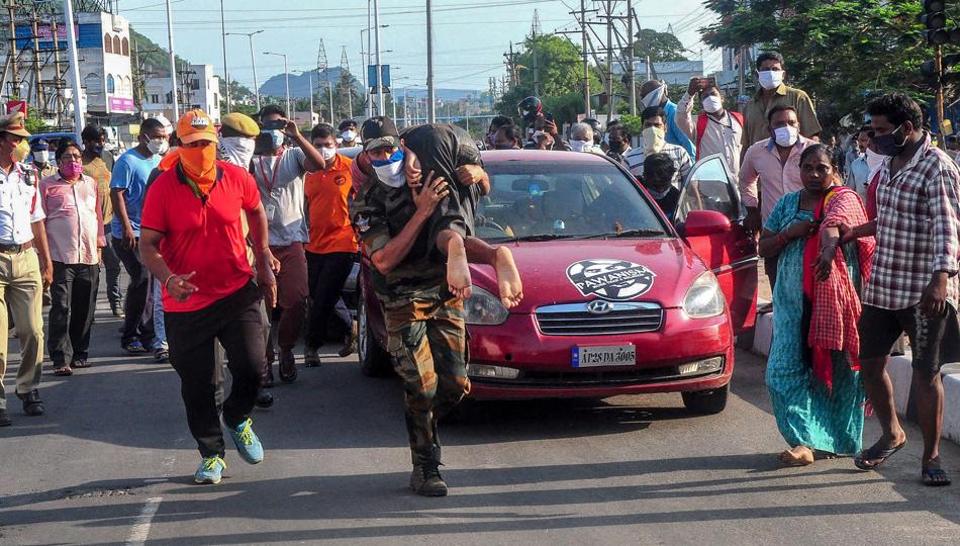
State authorities and officials from LG Polymers said they were investigating what caused the leak but a preliminary situation report by district officials said the trigger was a malfunction in equipment, which caused the temperature to rise and the organic compound styrene – normally a liquid – to vaporise.
The incident prompted the Union government to issue an advisory to chemical plants to take extra precautions while restarting their operations from what will be more than a month’s halt due to the nationwide shutdown in place to reduce the spread of the coronavirus disease (Covid-19).
“About 20km from Visakhapatnam, styrene gas, which is toxic and injurious to human health, was leaked. Nearly 1,000 people living around the area may have been impacted and have been evacuated,” said National Disaster Management Authority member Kamal Kishore at a press briefing in New Delhi.
Videos and photos from the area showed men, women and children unconscious in the streets, some lying next to fallen motorcycles. The scene evoked memories of the 1984 Bhopal Gas Tragedy that left at least 4,000 people dead and another 500,000 injured when methyl isocyanate leaked from a Union Carbide pesticide plant in the Madhya Pradesh capital.
Styrene can affect people’s breathing and brain function, All India Institute of Medical Sciences (AIIMS) director Randeep Guleria said the briefing, adding: “Some may have trouble breathing and may need a ventilator. We have to monitor their oxygen levels, respiratory rate and in case of a bronchospasm, they may need steroids.”
However, the illness is not universally fatal, he added.
According to Andhra Pradesh director general of police Gautam Sawang, two of the fatalities were caused when people collapsed while running from the site. The others died because they were exposed to toxic levels of the gas.
A chemical disaster response team was dispatched to the area and Prime Minister Narendra Modi said he had spoken to officials of the ministry of home affairs and the NDMA to take stock of the situation. Andhra Pradesh chief minister YS Jaganmohan Reddy has ordered a probe into the matter, Sawang added.
According to a preliminary report prepared by district officials, Thursday’s incident was triggered by a malfunction in the refrigeration unit that was meant to keep the styrene at below 20°C.
“Styrene monomer is normally in a liquid state and is safe below a temperature of 20 degrees Celsius. But, because of the malfunctioning of the refrigeration unit, the chemical started gasifying,” said district collector V Vinay Chand, quoting the report submitted by the Factories Department, PTI reported.
The leak was so intense that it turned into a fog and “only around 9.30am could we understand what exactly it was as the thick fog that formed in the area cleared,” Chand added.
LG Chem Ltd, which owns LG Polymers, is South Korea’s largest chemical company and is part of the LG Corp conglomerate. The company said it is cooperating with Indian authorities to help residents and employees.
LG polymers produces synthetic materials known as polystyrene and engineering plastic compounds. Styrene is a hydrocarbon that is used as a precursor -- an ingredient -- in the making of these products.
“The gas leakage is now under control, but the leaked gas can cause nausea and dizziness, so we are investing every effort to ensure proper treatment is provided swiftly,” LG Chem said in a statement.
Experts warned the incident, and two others that took place on Thursday – an explosion in a boiler unit of a factory in Tamil Nadu and a toxic gas leak at a paper mill in Chhattisgarh – underscore the need to reopen industries carefully. In the other two incidents, 14 people were left ill with no fatalities.
“Three industrial accidents have happened today coincidentally when factories are reopening after relaxations from Covid-19 lockdown. One of the commonalities among these incidents has been poor operational and maintenance practises during the lockdown and other is shortage of skilled staff for maintenance work. Maintaining power stations or any industries with less staff is a risk and such incidents in this scenario are not surprising,” said Nivit K Yadav, industries researcher at Centre for Science and Environment (CSE).
“It is clear industries are in haste to restart operation post lockdown which could be detrimental to worker’s safety and safety of the neighbourhood. CSE recommends better operational guidelines be given to the plants which will be restarting post lockdown,” he added.
(With agency inputs)





