
The gathering of the leaders of India, the US, Japan, and Australia in Manila on November 17, 2026, for the 7th Quad Leaders’ Summit marked a decisive moment in contemporary Indo-Pacific diplomacy. Held alongside the 49th ASEAN Summit and the East Asia Summit, this conclave was the first in-person meeting of the four heads of government since the Wilmington summit in September 2024, breaking a two-year hiatus caused by domestic political transitions and trade friction. Returning to the very city where the Quad was revived nearly a decade ago in 2017, Prime Minister (PM) Narendra Modi, US President Donald Trump, Japanese PM Sanae Takaichi, and Australian PM Anthony Albanese signalled that despite global distractions and shifting political winds, the quadrilateral coalition remains an indispensable anchor of regional stability. By situating their summit immediately adjacent to Southeast Asia’s premier multilateral forums, the four democracies deliberately underscored their respect for ASEAN centrality while demonstrating their collective resolve to preserve a free, open, and rules-based maritime order.
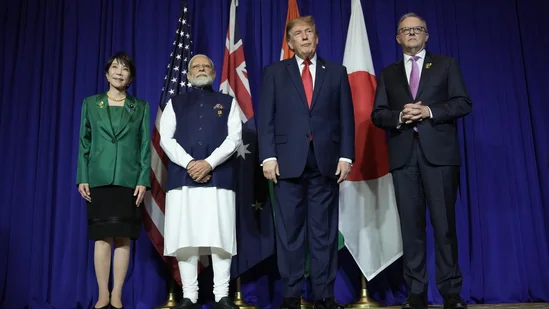
In the fragmented and volatile present world order, the relevance of Quad has evolved far beyond its early image as a tentative diplomatic consultative group. Today, the international system is strained by simultaneous geopolitical shocks, from active hostilities in West Asia threatening energy chokepoints like the Strait of Hormuz to renewed great-power bargaining in Eurasia and persistent grey-zone coercion across the South China Sea and the Taiwan Strait. Against this backdrop of weaponised supply chains, arbitrary export controls on critical minerals, and assertive unilateralism, traditional global governance institutions often appear paralysed. Quad fills this strategic void not as a formal military alliance bound by mutual defence treaties, but as an agile, networked coalition of capable maritime democracies. Its enduring relevance lies in its ability to bridge hard security deterrence with tangible public goods, offering smaller Indo-Pacific nations credible alternatives in infrastructure, digital connectivity, energy security, and disaster resilience without forcing them into binary Cold War-style alignments.
The Manila summit fundamentally reshapes the trajectory of Quad by transitioning its ambitious pledges into operational, institutional reality. Over the past few years, critics frequently questioned whether the grouping could survive leadership changes in Washington and Tokyo or move past declaratory diplomacy. Manila answered those doubts with five concrete deliverables that embed quadrilateral cooperation into the daily operational fabric of the Indo-Pacific. Foremost among these is the operationalisation of the Indo-Pacific Maritime Surveillance Collaboration, which moves beyond passive satellite data-sharing toward active interoperability, highlighted by the scheduling of the first-ever Quad joint maritime patrol exercise involving P-8 and P-3C surveillance aircraft in 2027. Simultaneously, the expansion of the Quad Partnership for Cable Connectivity and Resilience and enhanced cybersecurity frameworks reflect an acute awareness that modern geopolitics is contested beneath the ocean floor and across digital networks just as fiercely as on the high seas.
{{/usCountry}}The Manila summit fundamentally reshapes the trajectory of Quad by transitioning its ambitious pledges into operational, institutional reality. Over the past few years, critics frequently questioned whether the grouping could survive leadership changes in Washington and Tokyo or move past declaratory diplomacy. Manila answered those doubts with five concrete deliverables that embed quadrilateral cooperation into the daily operational fabric of the Indo-Pacific. Foremost among these is the operationalisation of the Indo-Pacific Maritime Surveillance Collaboration, which moves beyond passive satellite data-sharing toward active interoperability, highlighted by the scheduling of the first-ever Quad joint maritime patrol exercise involving P-8 and P-3C surveillance aircraft in 2027. Simultaneously, the expansion of the Quad Partnership for Cable Connectivity and Resilience and enhanced cybersecurity frameworks reflect an acute awareness that modern geopolitics is contested beneath the ocean floor and across digital networks just as fiercely as on the high seas.
{{/usCountry}}Equally transformative for Quad’s future is its decisive pivot toward geo-economics and frontier technology. By launching the Quad Business Leaders’ Forum and operationalising the Quad AI Accelerator alongside cooperation on superintelligence and critical minerals, the leaders recognised that State-led diplomacy alone cannot outcompete coercive economic models. Mobilising private capital, securing rare-earth processing chains, and setting shared standards for trusted artificial intelligence ensure that Quad’s architecture is future-proofed against technological monopolies. Furthermore, the explicit strengthening of counterterrorism cooperation condemning cross-border terrorism and violent extremism broadens the grouping’s security lens to incorporate continental and transnational threats alongside maritime challenges, giving Quad a more balanced and durable strategic mandate.
For India, the outcomes of the Manila summit carry profound strategic and economic consequences. As the only Quad member sharing a contested land border with China while simultaneously serving as the primary resident power in the Indian Ocean Region, New Delhi has always sought a formula that maximises security and development without compromising its cherished strategic autonomy. The Manila framework validates India’s preferred model of issue-based plurilateralism. Enhanced real-time maritime domain awareness directly bolsters India’s capacity as a net security provider across the Indian Ocean, enabling the Indian Navy and its Information Fusion Centre to track illicit fishing, dark shipping, and coercive grey-zone activity with unprecedented clarity. At the same time, cooperative frameworks on undersea cables, cybersecurity, and critical minerals directly reinforce India’s domestic priorities, from safeguarding its booming digital public infrastructure to securing raw materials for its semiconductor, clean energy, and manufacturing ambitions. Moreover, hosting the inaugural Quad Business Leaders’ Forum in Mumbai in early 2027 positions India’s commercial capital at the heart of Indo-Pacific supply-chain diversification, helping translate geopolitical goodwill into foreign direct investment and industrial partnerships.
Looking ahead, India is uniquely positioned to play the role of strategic bridge and agenda-setter within Quad. Because New Delhi maintains independent diplomatic channels with the Global South, Russia, and West Asian powers while deepening its strategic convergence with Washington, Tokyo, and Canberra, India prevents Quad from being perceived in Southeast Asia and the Pacific Islands as an exclusionary western security bloc. By championing initiatives like the Seafarers’ Safety Initiative and aligning Quad infrastructure and digital projects with the ASEAN Outlook on the Indo-Pacific, India can ensure that quadrilateral initiatives remain inclusive, demand-driven, and sensitive to regional anxieties. As India prepares to host the next Quad Leaders’ Summit and the inaugural Mumbai business conclave, New Delhi’s primary task will be to maintain steady diplomatic momentum, smooth over bilateral trade frictions with Washington, and steer Quad toward delivering visible, timely development outcomes across the Indo-Pacific. If Manila proved that Quad has endured its toughest political tests, the coming year will demonstrate how effectively India can lead this vital coalition into its second decade of consequential action
(The views expressed are personal)
This article is authored by Gunwant Singh, scholar, international relations and security studies, Jawaharlal Nehru University, New Delhi.
