They came, they met and nothing much happened; at least that’s what media will report, with the major ones ignoring it altogether. After all, there is the far more exciting news relating to the trilateral between Russia, China and Trump. Nothing much is expected to be announced at that either, but there every word, body language and gestures will be analysed down to the last detail. Not so with Quad. With only 55 minutes allotted to the Summit, most people saw it as arriving dead in the water. But for India is matters, in multiple ways.
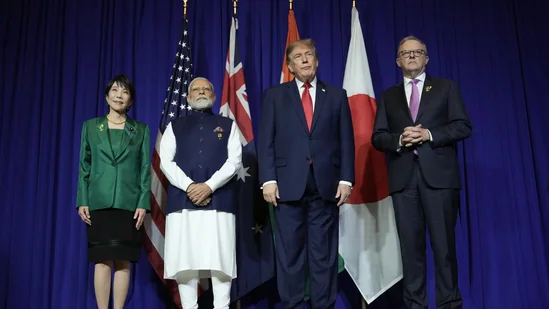
Here’s the thing about Quad. At this point of time, just the decision to hold the ‘summit’, that too in an ASEAN State just before the Trilateral was sending a message from a less than super power US to the others; which was that we have friends in Asia. Remember that the new theatre of gray zone warfare and competition in Asia. In other words, its China’s backyard that’s at stake. And that Beijing hates Quad, is proof enough, that it translates into power politics. The trouble is whether Quad will actually become more than a negotiation counter in the days to come. While Trump even formally called the summit with Xi as a G2 (group of 2) meet, the possibility that the Department of Defence will tamely give up on Quad in the days to come seems remote. The US Indo Pacific Command in particular is gung ho about the Quad. Admiral Samuel Paparo, in his April 2026 Congressional testimony, stressed expanding not just broad maritime cooperation, but also interoperability and most vitally logistics cooperation. He noted that a strong and capable India—in durable partnership with the US--can help provide security and deter conflict in the Indo-Pacific. In October, he was in Delhi to meet top Indian military officials including the Chief of Defence Staff Gen Raja Subramani. The military here rather like it as well. It delivers in multiple ways that are useful to a relatively small force, in terms of keeping its hand in the game.
The doubts about Quad are obvious. The present summit lasted about an hour or less, which essentially meant that much that was agreed upon by ministers earlier, was brought into the Joint Statement. But then, that’s the purpose of ministers meeting anyway. That includes the AI Accelerator announced at the Foreign Ministers meeting in Atlanta that basically set the agenda for the Manila meeting, Surveillance Collaboration, announced in Delhi at the Foreign Minister event, the Cable connectivity and Resilience established in 2023, but now expanded to include electricity cable connection – which impinges into energy security, as is the cyber Security cooperation which is to be enhanced at a time when the US mainland seems to be under repeated threat, though the exact cause and source is unclear. It could even be an intrusive or runaway AI system. But there is considerable scope for working together. For India however, the big takeaway is the scheduled P-8 and P-3C patrol aircraft maritime exercise in 2027 for the first time in a Quad context. That’s real and that interoperability. There’s more. The agreement reached in 2024 to cooperate on logistics--the backbone of any operation--has since been operationalised through a series of table top exercises, including on this September hosted by Japan, as well as agreement on SOPs (Standard Operating Procedures) which is the foundation for any common operations in future. Earlier read outs of Quad meetings stressed this as necessary for disaster management and so on. True that the Quad does stress this as necessary for disaster management, a very real issue at a time of severe climate change. But the Manila Joint statement also says that the group intends to “ensure open, safe, and resilient maritime transit corridors in the Indo-Pacific”. In simple words, earlier initiatives are coming together on the ground. That’s focus.
{{/usCountry}}The doubts about Quad are obvious. The present summit lasted about an hour or less, which essentially meant that much that was agreed upon by ministers earlier, was brought into the Joint Statement. But then, that’s the purpose of ministers meeting anyway. That includes the AI Accelerator announced at the Foreign Ministers meeting in Atlanta that basically set the agenda for the Manila meeting, Surveillance Collaboration, announced in Delhi at the Foreign Minister event, the Cable connectivity and Resilience established in 2023, but now expanded to include electricity cable connection – which impinges into energy security, as is the cyber Security cooperation which is to be enhanced at a time when the US mainland seems to be under repeated threat, though the exact cause and source is unclear. It could even be an intrusive or runaway AI system. But there is considerable scope for working together. For India however, the big takeaway is the scheduled P-8 and P-3C patrol aircraft maritime exercise in 2027 for the first time in a Quad context. That’s real and that interoperability. There’s more. The agreement reached in 2024 to cooperate on logistics--the backbone of any operation--has since been operationalised through a series of table top exercises, including on this September hosted by Japan, as well as agreement on SOPs (Standard Operating Procedures) which is the foundation for any common operations in future. Earlier read outs of Quad meetings stressed this as necessary for disaster management and so on. True that the Quad does stress this as necessary for disaster management, a very real issue at a time of severe climate change. But the Manila Joint statement also says that the group intends to “ensure open, safe, and resilient maritime transit corridors in the Indo-Pacific”. In simple words, earlier initiatives are coming together on the ground. That’s focus.
{{/usCountry}}There’s another constant refrain. That is, that Quad is not sufficiently ‘strong’ on China. But then it has never ever been framed as anti-China, and for a very good reason. India is uncomfortable with it for obvious reasons. Delhi is treading a very fine line, and even while doing everything possible on the ground, has no intention of publicly naming China as an enemy. Besides, what few realise is that much of what Quad needs is done bilaterally. Lacking a formal secretariat, India has adopted a 2+2 Framework, where the foreign and defence ministers meet to iron out some quiet initiatives. The next meeting with Japan for instance, follows hard on the heels of the Manila, with defence minister Rajnath Singh due to go to Tokyo. Separately, both have a series of bilateral military exercises including one between coast guards, and multilateral ones including Quad. An overlay on all this is the “Special Strategic and Global Partnership” based on converging strategic interests building on the agreement signed during Shinzo Abe’s time. This layered format is how Quad works for Delhi. The others are already treaty partners, where the Quad is a subset. It needs reiteration that the Quad is India specific. It’s all about the ‘Indo’ in the Pacific. And Beijing realises that too.
Finally, it is as well to carefully note that the reference in the Joint Statement to “concerns about economic coercion, including through arbitrary export restrictions” equally applies to the US. This is the world now, where the whole narrative of democracies naturally banding together, is a thing of the past. Trump is just more aggressive in saying it. But it was already part of the plot during an earlier presidency. In fact, Quad might well rely more on its Australia and Japanese legs, with additional countries like Vietnam or South Korea likely to be more interested in adding on with quiet capabilities. But make no mistake. The US would have to literally reverse everything it has stood for since it was created, to actually gang up with China against the rest. Given that reality, every little bit matters. And the quieter the cooperation, the better for India.
(The views expressed are personal)
This article is authored by Tara Kartha, former director, National Security Council Secretariat, New Delhi.
