
 E-Paper







Leena Dhankhar is Senior Editor and Bureau Chief, Gurugram, at Hindustan Times, where she has spent over 17 years chronicling the transformation of one of India's fastest-growing urban regions. From starting her career as a crime reporter to leading the Gurugram bureau, her journalism has been defined by investigative reporting, in-depth storytelling and an unwavering focus on public interest. Over nearly two decades, she has reported extensively across crime, politics, civic governance, elections, real estate, environment, courts, sports, education and entertainment, covering Gurugram, Faridabad, Nuh and Palwal. Her reporting has exposed several major scams and systemic failures, including insurance frauds, waste management irregularities, illegal arms manufacturing units in Nuh, illegal mining in the Aravallis, organised crime networks and governance lapses affecting millions of residents. Known for her investigative work and exclusive stories, Leena has reported on high-impact national issues, including the Nicaragua charter flight carrying Indian migrants that was turned back amid allegations of human trafficking, exposing the growing network of illegal immigration rackets. Her work has also focused on gang wars, prison administration, juvenile crime, women and child protection systems, the functioning of the Juvenile Justice Board and Child Welfare Committee, and environmental challenges such as pollution, waterlogging and deteriorating civic infrastructure. Beyond hard news, Leena has extensively documented Haryana's rich heritage, forests and wildlife, bringing attention to the state's historical landmarks, biodiversity, conservation efforts and ecological challenges through immersive reportage and feature writing. Her journalism has consistently gone beyond breaking news. She has documented Gurugram's rapid urbanisation through long-form narratives and enterprise reporting on issues ranging from pothole-ridden roads, flooding and waste management to the changing social fabric of India's Millennium City. She also writes widely read feature columns, including The Outsider, Changemaker, and Concern for Gurugram, profiling people, places and ideas shaping the city's identity. Leena is the author of Gurugram School Murder, published by Juggernaut Books, a deeply reported account of one of India's most high-profile school murder investigations. She is currently working on her second book, an investigative work exploring some of India's most significant scams and fraud investigations. Beyond print journalism, she has expanded her storytelling through public speaking and digital media. She is a TEDx speaker and has produced podcasts exploring Gurugram's transformation, civic challenges and untold stories. Her work reflects a commitment to narrative journalism that combines rigorous reporting with compelling storytelling. A law graduate with an MBA in Human Resources, Leena brings a multidisciplinary perspective to her reporting, particularly on governance, public policy and legal affairs. She has travelled extensively across India to pursue investigative assignments, often reporting from remote locations and conflict-prone areas in search of stories that matter.
GMDA to use technology to check pilferage, sabotage: CEO Umashankar
The GMDA hopes that beginning July, it will be able to address within hours cases of water theft and pipeline sabotage by the mafia.


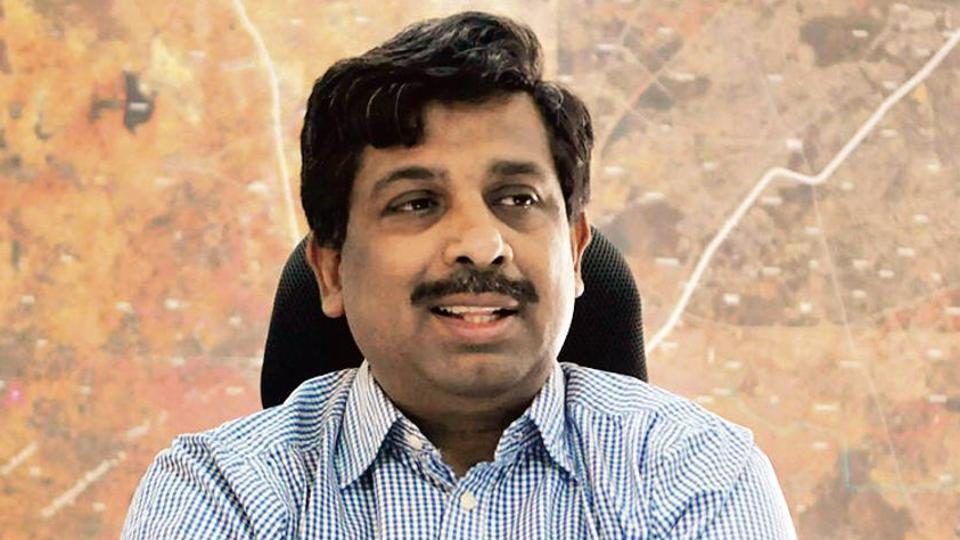
The Gururgam Metropolitan Development Authority (GMDA) is employing a surveillance system based on Geographic Information System (GIS) mapping technology, a citywide network of fibre optic cables running parallel to its water pipelines and close-circuit television cameras (CCTVs). The GMDA hopes that beginning July, it will be able to address within hours cases of water theft and pipeline sabotage by the mafia. Hindustan Times spoke to GMDA CEO V Umashankar to understand how the authority plans to rein in the water mafia.
Tell us about the current water supply infrastructure in the city
GMDA is the master water supplier to the city. It has sufficient capacity to supply the present demand of water which is about 410MLD. Bulk water supply from treatment plants in Chandu Budhera and Basai is 450-480 MLD. The water supply to sectors 58 to 67 was commissioned on May 1 this year, and will reach other sectors starting July. We are also supplying water to MCG, which is making it available for residents in its own jurisdiction. Presently, colonies on the outskirts and new licenced colonies in areas like Gwal Pahari and Ghata are facing some technical problems and are depending on tanker supply. But, our aim is to eventually integrate them as well.
Water mafia is a big threat to the supply infrastructure. How do you plan to rein them in?
The district administration has appointed teams of officials drawn from different departments to crack down on the water mafia. These teams submit regular reports. They even met the Gurugram police commissioner, Muhammad Akil, on May 15 and gave a representation, demanding police action against those who damaged the master water pipeline near Pioneer Park in Sector 61, thrice in May. The police have also increased vigilance in these areas, and the water supply has been running smoothly for the last one month with no complaints received.
Which areas are the worst affected by the mafia?
We had only received complaints from Sector 61 and we had roped in the police. Since then, no incident has been brought to our notice. This activity may be prevalent in areas where there is a shortage of water.
What steps has GMDA taken to protect water supply infrastructure in such areas?
Our staff is patrolling the area and teams are sent on the spot from where we receive regular complaints. We are in the process of setting up an extensive GIS-based surveillance at our upcoming Integrated Command and Control Centre (ICCC) in Sector 44, which is expected to be inaugurated in July. The system will consist of a network of CCTVs and sensors that will transmit real time visual feeds and data to a dashboard dedicated to water supply at the command centre. The work of augmentation of water supply in Sector 58-115 is being taken up in three phases. In phase 1, sector 58 to 67 was commissioned. In phase 2, from sector 99 to 115 was partly commissioned. In phase three, pipeline work is in progress between sector 69 and 98. It is likely to be completed by end of this year.





