
 E-Paper






Kimaya Boralkar is a Pune-based journalist with Hindustan Times. Her forte is everything education in Pune and across Maharashtra, from schools and universities to entrance exams, government policies, and student issues.A graduate of the Asian College of Journalism,When she's not on the education beat, you'll find her reporting on human-interest stories, science and research, and cultural events, always looking for stories worth telling.
Education increasingly out of reach for poor, says Javed Akhtar
Educational opportunities are becoming increasingly inaccessible to children from economically weaker sections, says writer and poet Javed Akhtar
Published on: Nov 29, 2026, 07:43:10 IST


Share via
Copy link
PUNE: India is a country of immense talent and intelligence, but educational opportunities are becoming increasingly inaccessible to children from economically weaker sections, legendary writer and poet Javed Akhtar said on Saturday.
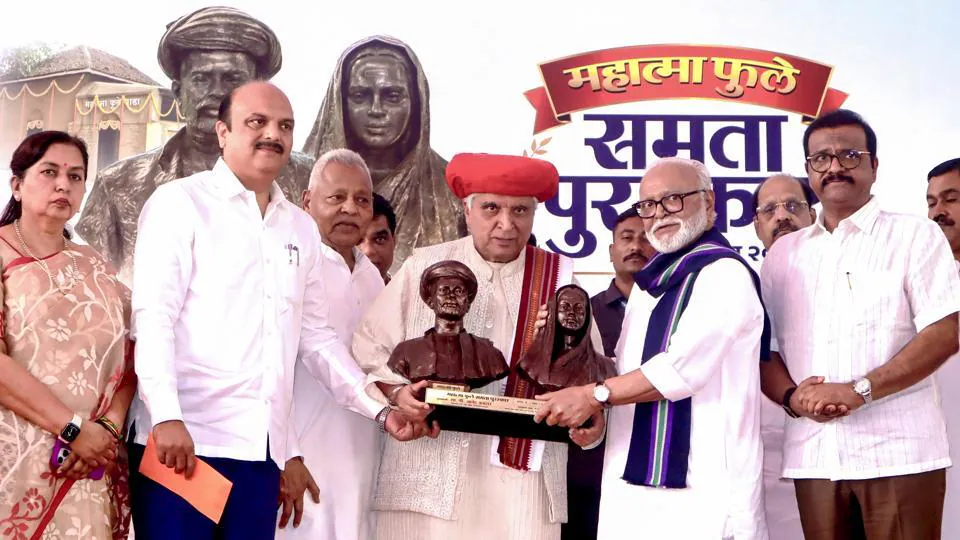
He was speaking after receiving the Mahatma Phule Samata Award 2026 from Maharashtra minister and Nationalist Congress Party (NCP) leader Chhagan Bhujbal at a function organised by the Akhil Bharatiya Mahatma Phule Samata Parishad in the city to mark the death anniversary of social reformer Mahatma Jyotiba Phule.
“An ordinary person can achieve a great deal if given an opportunity, but even basic educational opportunities are being denied to many,” Akhtar said, adding that rising education costs had made quality education affordable only to a particular section of society.
“If there are no public schools, where will a rickshaw puller’s child study? Schools with poor-quality education lack good teachers, proper systems and a good curriculum,” he said.
He criticised the tendency to brand those questioning examination irregularities as anti-national. “If you care about the country, let anyone call you anti-national. Consider it an honour, like the Padma Bhushan,” he told the youth.
Linking India’s technological lag after the Industrial Revolution to the caste system, Akhtar said the denial of education to people engaged in physical labour had restricted the country’s technological development. The closure of government schools, originally established to educate children from poor families, was once again placing education in the hands of privileged sections, he added.
Questions delimitation exercise
Akhtar expressed concerns over the Centre’s proposed delimitation exercise and its implications for the allocation of Lok Sabha seats among states. He questioned the criteria for increasing constituencies and linking women’s reservation with delimitation, arguing that the two issues should be addressed separately.
He questioned whether states that had successfully implemented family planning policies would be disadvantaged in seat allocation compared with those that had not.
The Union Cabinet has cleared three revised draft legislations, including the Constitution (132nd Amendment) Bill, 2026, and the Delimitation (Second) Bill, 2026. The Bills are scheduled to be taken up during the special session of Parliament beginning November 30.
Paying tribute to Mahatma Jyotiba Phule and Savitribai Phule, Akhtar said their contribution to education and social reform was extraordinary. He said he did not consider himself worthy of an award bearing Mahatma Phule’s name.
Meanwhile, Bhujbal highlighted government initiatives for OBC students, including the construction of 72 hostels across 36 districts on land provided at a nominal rate of ₹1. He also announced plans to provide residential NDA training to 200 girls through Mahajyoti at Naigaon.
The government has approved ₹200 crore for the expansion of Phule Wada and the Savitribai Phule memorial, with the work targeted for completion by February 2027. Technologies such as holography and virtual reality will be incorporated to familiarise younger generations with the Phule couple’s contributions, Bhujbal said.
(With agency inputs)





