
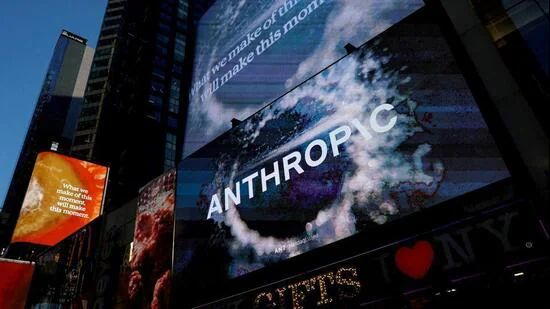
MUMBAI: On Thursday, Anthropic, the company that makes Claude, listed on Nasdaq. It was the largest public offering in history. By the closing bell, investors valued a company founded less than six years ago at $1.76 trillion. To place that in perspective, every listed company in India, put together, is worth a little over $5 trillion.
So how did it get valued so high? Well, there are ways. The number analysts quote is its revenue run rate: $81 billion a year. How do you get there? Take what customers paid to subscribe over the last four weeks. Assume they will pay exactly that, every four weeks, for the next year.
This is where the problem lies. You spend more on Diwali—not every day. But here, it’s assumed, every day is Diwali. The thing is, it’s not just Anthropic, every fast-growing company believes it will be adopted by people like its Diwali every day of the year. There’s only one way to go – up.
It was inevitable, then, that my mind went back to a dinner in Mumbai. The restaurant was full. I was surprised nobody looked up at me because I was with Jerry Yang – the founder of Yahoo! This was the peak of the dot-com boom and Yahoo! was the biggest name on the internet. It was his first visit to India and after saying all the polite things visiting chief executives say about India, he wanted to unwind. For some reason, both of us bonded well during the press briefing and caught up later. I don’t remember what we talked of then.
What I was certain of was Yahoo! would only go one way. Up.
{{/usCountry}}What I was certain of was Yahoo! would only go one way. Up.
{{/usCountry}}Why am I telling you this now? Because last night, I was preparing to moderate a panel for a room full of fund managers. That is when I asked Seemant Shukla, CEO of Quantum Mutual Fund, one of the other panelists, how he thinks the way markets are thinking now will impact the future. “Linearity,” he said, “is the most stupid thing going around.”
He has a point. Look at what happened to my certainty.
Yahoo, once valued at more than $100 billion, sold its core business to Verizon in 2017 for $4.48 billion. Google, which I hadn’t heard of at that dinner, happened instead. I hadn’t imagined ChatGPT. Nor did anyone think Anthropic, which did not exist six years ago, would get to where it is now.
Nobody had drawn a line to it. It was non-linear.
But the line bends both ways. Google was caught napping when AI arrived. It still had the money and the years to build Gemini and get back in the race.
That is when my mind went to Rajesh Jain. In the late-1990s, as a young journalist wet behind the ears, I would visit him to understand the internet. And then, in November 1999, Satyam Infoway, a company in Ramalinga Raju’s group, agreed to pay ₹499 crore, about $115 million, for his IndiaWorld. It had 20 employees and revenue of ₹1.3 crore. My jaw dropped. A decade later, Satyam and Raju collapsed.
Jain’s own line did something stranger. After the sale, he went back to Netcore, a small software company he had set up in 1997. Many wondered why a man who had just sold a portal for a fortune would bother with something so unglamorous. Between 2000 and 2007, by his own telling, it barely grew, stuck at about $200,000 in revenue. He calls them “sort of the failed years.” Draw a line from there, and you write him off. He kept going anyway and worked on the business. It now has about $100 million in annual recurring revenue.
Sandeep Bagla, who runs Trust Mutual Fund, has a way of explaining this. Everyone knows the fable of the hare and the tortoise, he says, and everyone takes the wrong lesson from it.
Slow and steady is not why the tortoise wins. The tortoise wins because it lives longer. A hare gets a dozen years or so. A tortoise can see a hundred. The race goes to whoever is still around at the end. That is Netcore. It did not out-think the market. It outlived it.
Put Shukla and Bagla together and you get something more useful than either of them said alone: If you cannot predict where the curve bends, make sure you are still alive when it does. Which is why, chances are, who knows what follows the trillion dollars? Somewhere, someone may be thinking very differently from Anthropic. They will not draw straight lines.
This year, Netcore renamed itself Netcore.ai. The tortoise from 1999 has just entered the AI race, 26 years after the hare left the track. Nobody at Thursday’s celebrations noticed. That is usually how you can tell it’s a tortoise.
Stay updated with all the Breaking News and Latest News from Mumbai. Click here for comprehensive coverage of top Cities including Bengaluru, Delhi, Hyderabad, and more across India along with Stay informed on the latest happenings in World News.
Stay updated with all the Breaking News and Latest News from Mumbai. Click here for comprehensive coverage of top Cities including Bengaluru, Delhi, Hyderabad, and more across India along with Stay informed on the latest happenings in World News.
