
 E-Paper






Brajendra K Parashar is a Senior Journalist with the Hindustan Times, based in Lucknow, with nearly three decades of experience covering governance, public policy, politics and development in Uttar Pradesh. Over the years, he has reported extensively on key sectors, including energy and renewable power, mobility and transport, road safety, agriculture and allied sectors and issues related to farmers, rural development, taxation under the Goods and Services Tax (GST) and public administration. A seasoned political correspondent, Parashar closely tracks the Bharatiya Janata Party (BJP) and has covered every major election in Uttar Pradesh right from three-tier panchayat elections and urban local body polls to Assembly and Lok Sabha elections. He also reports regularly on the proceedings of the Uttar Pradesh Legislature, bureaucracy, governance, policy decisions and administrative developments with focus on their impact on public life. His reporting is known for its strong analytical approach, extensive use of official data. His areas of interests include investigative journalism, long-form political and policy analysis, data-driven reporting, elections and institutional reforms. Parashar holds a postgraduate degree in Political Science with First Division from Aligarh Muslim University (AMU), followed by a Diploma in Journalism and Mass Communication from the same university. His inclination towards journalism began during his student days, when he regularly contributed letters to editors and articles to newspapers and magazines. In the mid-1990S, his essay, “Should India Switch Over to the Presidential Form Of Government?”, published in Politics India magazine edited by noted constitutional expert Subhash C Kashyap, was adjudged the best entry in a national competition. His work has received professional recognition, including the Hindustan Times Journalist of the Month Award for an impactful series on drinking water issues during the 2010 Lok Sabha election campaign. Originally from Kasganj in western Uttar Pradesh, Parashar is currently based in Lucknow where continues to report on politics, governance and public policy.
One-fourth buses unfit, scrap them if owners fail to make amends: UP CS
One-fourth of buses in Uttar Pradesh lack valid road worthiness certificates.


Almost one-fourth of the total buses registered in Uttar Pradesh are without a valid road worthiness certificate, according to a government order issued by chief secretary Manoj Kumar Singh, who has directed commissioners, district magistrates and other officials to ensure these vehicles are scrapped if their owners do not legalise their papers.
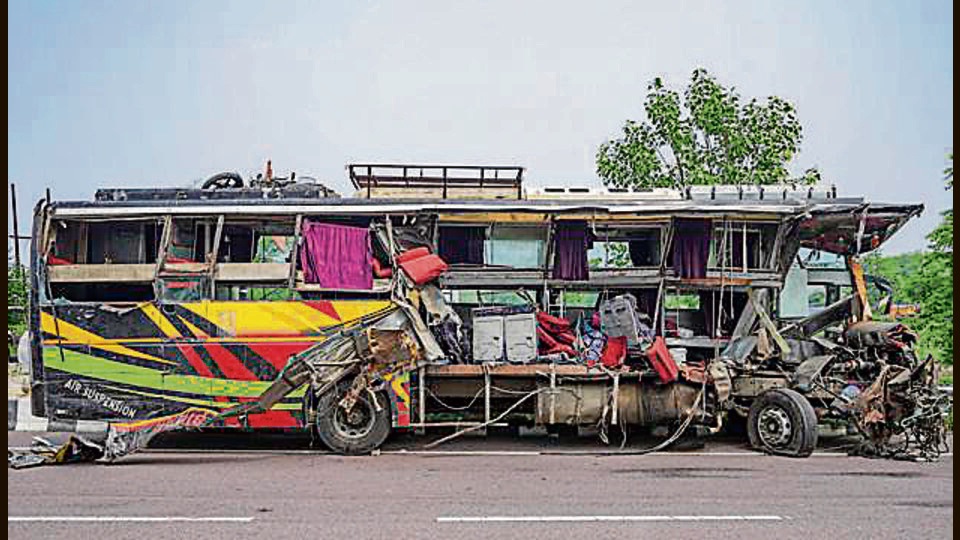
The fresh directions come in the wake of the bus-tanker collision in which at least 18 people were killed in Unnao on July 10.
The double-decker bus involved in the accident was found without any valid documents with regard to registration, fitness, insurance and tax.
In view of recent road accidents in the state involving buses operating without valid documents, chief minister Yogi Adityanath recently directed officials to take effective action against unauthorised passenger buses.
The government order says that according to the information received from the vehicle portal as of July 22, 2024, the total number of registered passenger buses in the state is 62,841, out of which 49,186 vehicles have valid registration/fitness certificate/insurance.
The remaining 13,661 vehicles have expired registration/fitness certificate/insurance papers.
“It is also worth mentioning that road safety campaigns have been conducted in the state from time to time, along with drives against unauthorised passenger buses. However, from the result point of view, as such campaigns have not been as effective as expected, the operation of unauthorised passenger buses continues unabated. As a result, the expected reduction in road accidents is also not visible,” the government order issued on Tuesday said.
The order further said that first, the transport officer/other officer concerned of each district should obtain details of passenger buses with permits from the vehicle portal whose registration/fitness/insurance validity period has expired in their district.
Thereafter, by conducting a marked/special campaign against each passenger bus operating without valid documents (permit/fitness/license/insurance and tax payment certificate/record) in their district, and by communicating/meeting with the owners of passenger buses and various organizations and their officials associated with the transport sector, make them aware not to operate passenger buses in an unauthorized manner and ensure necessary action in light of relevant rules/provisions in such a way that by August 15, 2024, the owners of passenger buses in each district shown on the vehicle portal with expired registration/fitness/insurance validity period obtain the required valid documents as per rules and operate their vehicles only after that.
“Otherwise, ensure scrapping action through RVSF (Registered Vehicle Scrapping Facility) as per rules against unauthorised passenger buses operating without valid documents, so that the number of passenger buses shown on the vehicle portal operating without valid documents can be reduced to zero,” the chief secretary told district magistrates and others through the government order.





