
The Lucknow Municipal Corporation (LMC) is set to revolutionise its urban greenery initiatives by shifting from external procurement to an in-house production model. A high-tech nursery in Basaha is nearing completion, poised to become a game-changer for the city’s environmental footprint.
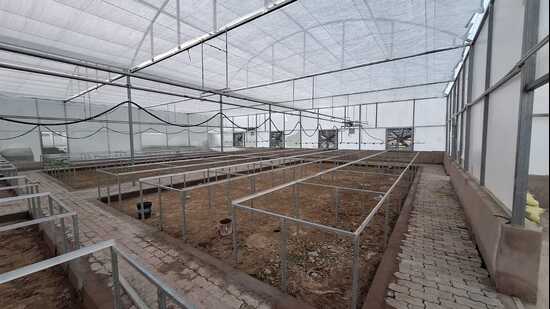
The facility will initially produce around two lakh seedlings a month, reducing the civic body’s dependence on private nurseries across Uttar Pradesh for plants used in parks, along roadsides and in plantation drives.
The nursery, spread across 1.2 hectares along Kursi Road, is expected to become operational by November-end. With a capacity of 40 lakh seedlings, it will initially produce two lakh plants monthly. The LMC will also set up eight outlets across the city to sell seedlings directly to residents.
LMC additional municipal commissioner Arvind Kumar Rao said the project, initiated over three years ago, has gathered pace, with nearly 90% of the construction work completed.
“The automated seeding machine has arrived and is being installed. The nursery will operate round the clock, producing various varieties of vegetable and flower seedlings. The plants will be sold by the LMC at rates yet to be finalised. Eight sale points are also planned across the city,” he said.
The nursery will use imported machinery to automate seed sowing, irrigation, shading and plant care. It will have two 500-square-metre glasshouse chambers for germination and hardening, along with two poly-tunnels, a green shade-net house and a 0.7-hectare open-field demonstration area fitted with micro-irrigation.
{{/usCountry}}The nursery will use imported machinery to automate seed sowing, irrigation, shading and plant care. It will have two 500-square-metre glasshouse chambers for germination and hardening, along with two poly-tunnels, a green shade-net house and a 0.7-hectare open-field demonstration area fitted with micro-irrigation.
{{/usCountry}}Apart from vegetable and flower seedlings, the nursery will raise mother plants of fruit-bearing varieties such as mango, litchi and jamun, which will also be available for sale.
The LMC plans to sell the nursery’s produce through eight outlets across Lucknow, allowing residents to purchase seedlings at rates that the civic body will finalise.
The complex will also have interlocking pathways, a storeroom and a modern restroom block. A 20-kW solar power plant would also be installed to support its electricity requirements. Once operational, the nursery will give the LMC greater control over plant production and availability.
ABOUT THE AUTHOR
Animesh Mishra is a Correspondent with Hindustan Times, based in Lucknow, where he covers urban governance, civic administration, and infrastructure development in Uttar Pradesh's capital. His reporting spans key institutions, including the Lucknow Development Authority (LDA), Lucknow Municipal Corporation (LMC), the Uttar Pradesh Excise Department, and the Uttar Pradesh Housing and Development Board (Awas Vikas Parishad). Through his coverage, he closely tracks policy decisions, urban planning initiatives, housing projects, municipal governance, and infrastructure development, while delivering exclusive reports on issues that shape the city's growth and administration. Driven by a commitment to public-interest journalism, his work combines on-the-ground reporting with careful analysis to explain the impact of government policies and administrative decisions on residents. He has a particular interest in investigative journalism, off-beat stories, and human-interest features that bring attention to underreported issues and amplify the voices of ordinary citizens. Known for his fact-based and reader-focused approach, Animesh strives to present complex governance and development issues in a clear and accessible manner. His reporting seeks to promote accountability, encourage informed public discourse, and provide readers with meaningful insights into the challenges and opportunities shaping Lucknow's rapidly evolving urban landscape.
