
 E-Paper






Brajendra K Parashar is a Senior Journalist with the Hindustan Times, based in Lucknow, with nearly three decades of experience covering governance, public policy, politics and development in Uttar Pradesh. Over the years, he has reported extensively on key sectors, including energy and renewable power, mobility and transport, road safety, agriculture and allied sectors and issues related to farmers, rural development, taxation under the Goods and Services Tax (GST) and public administration. A seasoned political correspondent, Parashar closely tracks the Bharatiya Janata Party (BJP) and has covered every major election in Uttar Pradesh right from three-tier panchayat elections and urban local body polls to Assembly and Lok Sabha elections. He also reports regularly on the proceedings of the Uttar Pradesh Legislature, bureaucracy, governance, policy decisions and administrative developments with focus on their impact on public life. His reporting is known for its strong analytical approach, extensive use of official data. His areas of interests include investigative journalism, long-form political and policy analysis, data-driven reporting, elections and institutional reforms. Parashar holds a postgraduate degree in Political Science with First Division from Aligarh Muslim University (AMU), followed by a Diploma in Journalism and Mass Communication from the same university. His inclination towards journalism began during his student days, when he regularly contributed letters to editors and articles to newspapers and magazines. In the mid-1990S, his essay, “Should India Switch Over to the Presidential Form Of Government?”, published in Politics India magazine edited by noted constitutional expert Subhash C Kashyap, was adjudged the best entry in a national competition. His work has received professional recognition, including the Hindustan Times Journalist of the Month Award for an impactful series on drinking water issues during the 2010 Lok Sabha election campaign. Originally from Kasganj in western Uttar Pradesh, Parashar is currently based in Lucknow where continues to report on politics, governance and public policy.
Ill-fated bus did not check all boxes, was running despite 80 challans
The bus’s fitness certificate expired on January 1, 2021, its tax validity on Nov 30, 2023, insurance on Feb 13, 2024, permit on Jan 2, 2024, and pollution certificate on Apr 15, 2024


LUCKNOW The deadly bus crash on the Agra-Lucknow Expressway in Unnao, which claimed 18 lives early on Wednesday morning, brought to fore severe lapses in traffic and safety regulations. The transport department’s preliminary inquiry reveals that the bus regularly flouted traffic laws, operating without valid documents for months. Despite 80 challans issued for various offences, the vehicle was never seized by authorities.
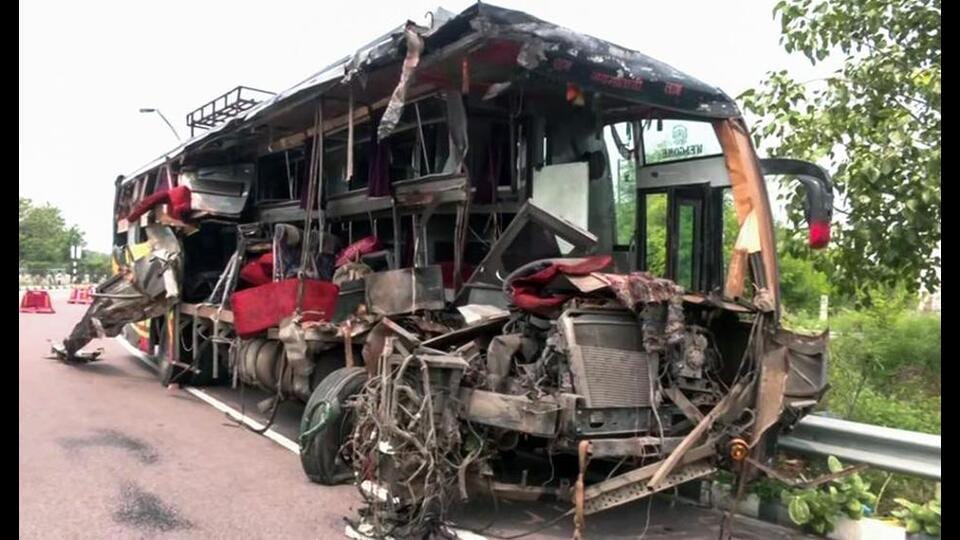
The double-decker bus (UP 95 T4729), speeding from Bihar’s Sitamari to Delhi, hit a milk tanker while trying to overtake it. Registered under KC Jain Travels in Mahoba, Uttar Pradesh, the vehicle is part of a fleet owned by a Rajasthan businessman.
The sleeper bus, registered in the name of a person who passed away during Covid-19 pandemic, was being operated by the travel agency in Delhi’s Pahadganj, despite being registered with the RTO in Mahoba, said police officials.
Prashant Kumar (II), IG Lucknow range, said an FIR had been registered against the travel agency with Behta Mujawar police. Additional road transport officer Arvind filed the case under sections 101 (1), 125 (1), 125 (b), 285 and 289 of BNS.
The bus’s fitness certificate expired on January 1, 2021, its tax validity on November 30, 2023, insurance on February 13, 2024, permit on January 2, 2024, and pollution certificate on April 15, 2024.
The milk tanker, registered in Kanchan Singh’s name at RTO Prayagraj, also had expired documents, including tax validity on May 31, 2024, and insurance on April 4, 2024.
The bus had to cross several police check posts, traffic barriers and RTOs in three states of Bihar, Delhi and UP, and so did the tanker in UP, but no enforcement agency checked and caught them.
Investigation revealed that the bus was violating its permit conditions by operating as a stage carriage while holding a contract carriage permit. This violation highlights a significant oversight in regulatory enforcement that allowed the bus to continue its operations unchecked.
Minister of state for transport (independent charge) Daya Shankar Singh admitted to serious lapses by the bus owner without RTOs being able to catch the bus that crossed their regions.
“We have lodged an FIR and also issued notices to RTOs concerned, asking them as to how they allowed a bus without legal papers to operate in their regions,” he told HT. He said it was surprising that the bus had 80 challans against it and was still on the road.
The minister said the government would now make stringent rules to ensure that any such vehicle was deregistered after three consecutive challans.
Transport commissioner CB Singh said the Banda ARTO office issued notice to the bus owner thrice asking him to get the fitness of the vehicle renewed but he never showed up.
“No doubt, the bus was operating on the road without any valid papers, and we have taken this issue seriously,” he said.
Initial investigation confirmed that the bus was driving at break-neck speed.
Passengers told the police that the driver had taken three halts during the journey. The last stop was between Gorakhpur and Basti at a dhaba where he was seen sitting with his co-driver. The police were looking into whether he consumed alcohol before embarking upon the journey.
The tragic accident, certainly not the first of its kind in UP, brought to light the urgent need for stricter enforcement of vehicle regulations and more vigilant monitoring by enforcement agencies to prevent such avoidable losses of life in future.
Authorities are now facing pressure to address these lapses and ensure that vehicles with expired documents are taken off the road promptly.
The transport department announced a three-member committee to investigate the case. The committee comprises Surendra Kumar, deputy transport commissioner (zone) Lucknow, Sandeep Pankaj, regional transport officer (enforcement) Lucknow, and Krishna Kumar Yadav, regional inspector (technical) Unnao.
“They have been instructed to thoroughly investigate all aspects of the incident and submit their findings to me as early as possible,” transport commissioner CB Singh said.
For this accident, Save Life Foundation, New Delhi, and stakeholder departments - superintendent of police, chief executive officer, UPIDA, Agra Expressway, chief medical officer, assistant regional transport officer (enforcement), Unnao, have been instructed to conduct a scientific crash investigation.
The assistant RTO (enforcement) and regional inspector had also been instructed to inspect the bus involved in the accident based on the bus body code AIS-119.
“Based on the investigation, if the bus body code is found to be different from AIS-119, a recommendation for action against the officers concerned will be sent to the government. Similarly, based on the recommendations made in the investigation on other points such as rumble strips, traffic calming measures, overspeeding, etc, the departments concerned will also complete the improvement actions to prevent accidents in the future,” Singh said. Inputs from HTC, Kanpur





