
Mandi House is an old neighbourhood. Once the royal residence of the Raja of Mandi, this part of New Delhi possibly has some of the best examples of Delhi Modernism. One could even call it the Old Broadway of the city. Triveni Kala Sangam, Lalit Kala Akademi, Kamani Auditorium, the National School of Drama, the Shri Ram Centre for the Arts and so many more little galleries, arts institutions and auditoriums are tucked around the Gol Chakkar of Mandi House. It is a neighbourhood where, even today, one can walk into an evening of theatre, stumble upon an art opening or find oneself sitting through an unfamiliar classical music performance.
But before it became the cultural address of the Capital, Mandi House had a rather different life. The area takes its name from the palace of the Raja of Mandi, a princely state in what is now Himachal Pradesh. The estate once stood amidst a beautiful garden, and an ornate gate, still visible near Doordarshan Bhawan, is one of the few reminders of its royal past. Old maps of New Delhi show that this part of the city was once a landscape of villages, gardens, ruins and brick kilns. The transformation came after Independence, when Jawaharlal Nehru and his cultural policymakers began imagining a new capital that would have its own institutions for art, theatre, music and literature. Mandi House became the setting for this ambition. The national akademis, Rabindra Bhawan and a series of performing arts institutions gave the neighbourhood an identity that was quite different from the ceremonial grandeur of Lutyens’ Delhi.
Imagine an evening in this neighbourhood, after the office traffic clears: women in high buns and glossy sarees with short pallahs, trotting along the pavements to catch the evening art openings after the plays; gentlemen carefully parking their Fiats and Amabassadors; a quick paanwallah chai over a cigarette. Actors, artists, bureaucrats and the occasional university student sharing the same pavement. There was something particularly democratic about this cultural geography. You did not necessarily need to belong to an institution to participate in its life. You simply needed to turn up.
{{/usCountry}}Imagine an evening in this neighbourhood, after the office traffic clears: women in high buns and glossy sarees with short pallahs, trotting along the pavements to catch the evening art openings after the plays; gentlemen carefully parking their Fiats and Amabassadors; a quick paanwallah chai over a cigarette. Actors, artists, bureaucrats and the occasional university student sharing the same pavement. There was something particularly democratic about this cultural geography. You did not necessarily need to belong to an institution to participate in its life. You simply needed to turn up.
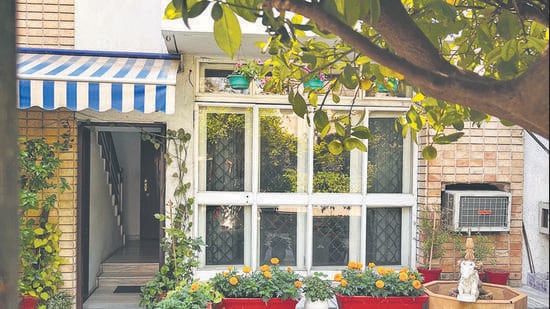
{{/usCountry}}The residential architecture around Mandi House seems to have inherited something of this character. Most houses blended into the brutalism of the neighbourhood. Either it was grey tones or white concrete jaalis that gave a layer of privacy to houses that tried to hide along the wide boulevards of Cultural Delhi. There is a certain modesty to these buildings. They were not designed to announce themselves from the street, but to reveal their personalities slowly, through a balcony, a staircase, a planted courtyard or the pattern of a boundary wall.
Indra Haveli, a nearly century-old structure in a late-modernist style, was renovated in the 1990s. Named after the couple who first built it, the house has seen more than two generations pass through its rooms. Its façade is grit-wash concrete, a common and durable choice. This rough, textured finish, strong against dust and weather, was a preferred material in early New Delhi. Perhaps its longevity appealed to young couples who put together every penny to build a house that would last. There is something rather endearing about this ambition. The house was not simply a financial investment or an architectural exercise, but a place in which an entire family could grow old.
In contrast to Indra Haveli, a nearby house built in 1939 and renovated by architect Sameer Sharma in 1991 features a smoother plaster façade with shallow grooves that create the illusion of neat panels. This house prioritises ornamentation, with twisted floral railings and frosted glass with etched patterns above the doorway. These details are reminders that modernism in Delhi was never one uniform architectural language. It was interpreted by individual architects, adapted by homeowners and often embellished by local craftsmen. The result was a fascinating mixture of international modernist ideas and very familiar Indian domestic sensibilities.
The houses of Mandi House also tell us something about the changing aspirations of the people who built New Delhi after Independence. Unlike the monumental bungalows of the Lutyens’ Bungalow Zone, these were more intimate domestic expressions. The owners were negotiating a new relationship with the city, one that required a house to be practical, affordable, weather-resistant and, importantly, individual. The concrete jaali, the projecting chajja, the carefully designed entrance and the small garden were all part of this negotiation between privacy and the public life of the street.
This is also where the larger problems of New Delhi’s bungalow neighbourhoods become interesting. The Lutyens’ Bungalow Zone is often discussed through the lens of its grand avenues, enormous plots and colonial architecture. Yet its preservation is far more complicated than simply retaining a few old buildings. There are questions of ageing structures, changing family sizes, maintenance costs, government redevelopment, increasing demands on urban infrastructure and the loss of mature trees. The temptation to increase built-up areas or replace older houses with larger structures has repeatedly brought conservationists and planners into disagreement. The challenge is to allow houses to evolve without losing the character of the neighbourhood around them. A bungalow is not just its façade; it is also the garden, the trees, the distance between houses and the experience of walking down its streets.
Mandi House offers a slightly different perspective on this problem. Its architectural character was never dependent on a single architect or a grand master plan. It grew through a relationship between cultural institutions, residential houses and the people who occupied them. It is this mixture that makes the neighbourhood so interesting. Whether it is the concrete designs, the plants themselves or the little ornamental details that have survived successive renovations, the houses of Mandi House were built with the character of the original artsy neighbourhood of New Delhi.
Perhaps that is what makes the area worth walking through today. Behind the auditoriums and institutional buildings, beyond the familiar traffic circle, there is still a residential neighbourhood that remembers a different pace of city life — a city where one could walk from a play to an exhibition, from an exhibition to a friend’s house, and end the evening with a cup of chai on the pavement. Mandi House was never quite Broadway, but for a certain generation of Delhi, it came wonderfully close.
Anica Mann works on archaeology and contemporary art in Delhi. The views expressed are personal
Stay updated with all top Cities including, Bengaluru, Delhi, Mumbai and more across India. Stay informed on the latest happenings in World News along with Delhi Election 2025 and Delhi Election Result 2025 Live, New Delhi Election Result Live, Kalkaji Election Result Live at Hindustan Times.
Stay updated with all top Cities including, Bengaluru, Delhi, Mumbai and more across India. Stay informed on the latest happenings in World News along with Delhi Election 2025 and Delhi Election Result 2025 Live, New Delhi Election Result Live, Kalkaji Election Result Live at Hindustan Times.
