
 E-Paper







Manoj Sharma is Metro Features Editor at Hindustan Times. He likes to pursue stories that otherwise fall through the cracks.
In Jewar resettlement town, new homes, life bring new challenges
Developed by the Yamuna Expressway Industrial Development Authority (Yeida), the township will house over 3,500 families from the acquired villages. Over 600 families have moved in, some with their buffaloes as well as new cars bought with compensation money.
Updated on: Jan 31, 2022, 00:11:25 IST


Share via
Copy link
Smoking a hookah on a sunny January morning in front of his brand new home, Vijay Pal Chauhan (65) is still not happy.
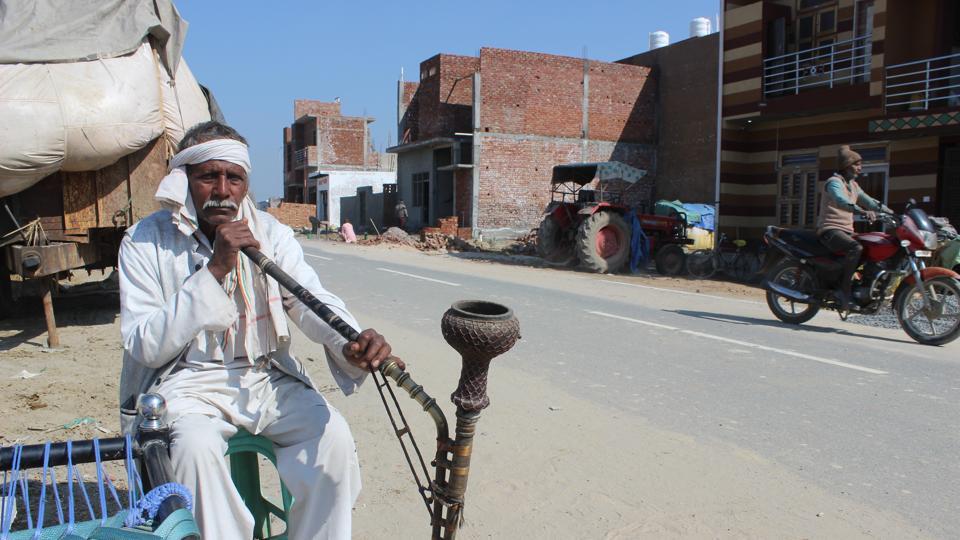
“In our village, I was always surrounded by people. But in this township, I spend most of my time alone. I am not used to living like this,” said Chauhan, who has been recently displaced from Rohi, one of the seven villages acquired by the government for a new international airport in Greater Noida.
In November, he shifted to the sprawling 48-acre resettlement township on the outskirts of Jewar, where villagers from Nagla Ganeshi, Nagla Sharif Khan, Nagla Phool Khan, Nagla Chhittar, Kishorepur, Rohi, and Dayanatpur Kheda have been relocated. Adult members of families whose land was acquired were allotted plots of various sizes through an online draw of lots, depending on the size of their houses in the acquired villages.
Developed by the Yamuna Expressway Industrial Development Authority (Yeida), the township will house over 3,500 families from the acquired villages. Over 600 families have moved in, some with their buffaloes as well as new cars bought with compensation money.
But most villagers say they are struggling to navigate life in what the government refers to as a model township. What troubles them most is not just the lack of promised amenities such as a community centre, school or health centre, but the “loss of a rural lifestyle, livelihood, neighbourhood bonds, and community feelings” in their new location.
“My neighbours, whose families lived next to ours for a hundred years, are no longer my neighbours. Even my three sons have got plots in three different parts. All of us lived together in our house in the village; now we live separately,” said Chauhan. “The shift to this place has disintegrated my family.”
Sushila Devi, his sister-in-law, said she has not met most women of her village for over two months though many have shifted here. “It looks like they have changed, or maybe they no longer have time for me,” she said. “Even my own daughters-in-law now live separately.”
The family’s tractor is parked outside the house. “It is a useless machine now as we have no land to till, but I do not have the heart to sell it,” said Chauhan.
While most villagers in Rohi sold off their cattle as there was no provision in the new township to house cattle sheds, some like Chauhan chose to bring them anyway. He has turned a 50-metre plot one of his sons was allotted into what he calls a pashuwada. “I know it is not allowed, but buffaloes have always been a part of our family of farmers,” he said, pointing to two buffaloes and a cow tethered outside the shed.
A few hundred metres away is Pocket 5, where families from Dayanatpur Kheda village have resettled. Nitin Kumar’s is among the families who have shifted here. Like Chauhan’s, a tractor stands outside Kumar’s new house.
“We sold all our agricultural instruments such as harrows, tillers, ploughs, but did not sell the tractor, which was a symbol of pride for us in the village,” said Kumar, who is studying in a local college. “Most people, including youngsters, were engaged in agriculture, which was their primary source of income. There is no commercial space here, so we cannot even start a business.”
His family spent about ₹30 lakh building the new house. “We also bought some agricultural land in Khurja district, 40 km from here, as land gives us a sense of security. Our family is living off the compensation money of ₹1 crore. At this rate, we will soon run out of money.”
His uncle, Hoshiyar Singh, who got a plot next to his in the township, said that while youngsters are coping well after the relocation, life for the elderly has turned upside down.
“A village has its own rhythm of life. You get up early, go to the fields, tend to your animals, spend time at the chaupal, but here all of us stay home with nothing to do,” said Singh. “This place is a concrete jungle. Imagine what it must be like for villagers who lived all their lives surrounded by trees and agricultural fields.”
A few children are playing cricket in the park outside his house. “That park is our everything — our chaupal, our playground, our only piece of greenery, ” said Singh. “Displacement has brought a new social order in the village. All the villages had mohallas based on their castes, but here they all are living together, so far in harmony.”
While the township is yet to get the promised school, community centre, crematorium, graveyard and health centre, the roads are paved and every residental pocket has its own park. Most houses are yet to get water and electricity connections though, and depend on generators. There is no shopping complex, but a few villagers have opened hole-in-the-wall grocery stores and pharmacies.
Gabbar Khan is sitting outside his house in Pocket 7 in the township, where he lives with his wife and five children. The pocket houses families from Nagla Chhittar, a village dominated by the minority community, most of whom were landless farm labour. The poverty is reflected in the houses in this part of the township, where, unlike Pocket 1, which has large houses and new cars, most houses are small, single-storey structures.
“I sold my goats as I had no place to keep them here. They were my source of livelihood. I used to sell their milk. Besides, in the village, my family also found work in the agricultural fields as labourers. Now we have no work. We had no land, so we got no compensation apart from this plot and little money against the small brick house I had in the village,” said Khan, who has set up an egg stall outside his house in the new township.
His neighbour Shaira interjects: “My buffaloes used to provide us with 15kg of milk every day. Now, I buy 1kg packaged milk every day to make tea. I cannot afford to buy enough milk even for my children. I am going to somehow buy a buffalo and keep it right there, whether it is allowed or not.”
But what worries Shri Pal Singh(70), a retired principal in Dayanatpur Kheda, is the lack of a crematorium. People, he said, have to travel about 10 km to cremate the dead near their razed villages. “Even our mail comes to our old addresses, where our houses are now just mounds of rubble. People here are facing many problems that no social impact study might have taken into account.”
Surendra Singh, divisional commissioner (Meerut), who is also the rehabilitation and resettlement commissioner for the airport project, said the government is sorting out the issues.
“We have bought land for both the crematorium and graveyard near the township and they will soon be ready. The tender for the school has been issued, and the one for the community centre will be issued after the elections. The township will have every facility promised in the resettlement and rehabilitation scheme.”
But Chauhan in Pocket 1 is not quite sure it will change anything. “Officials promised that they would replicate our villager here. But it is not possible. Our villages are gone for good, and so are our joys and pleasures of village life.”





