
The Municipal Corporation of Delhi on Friday was forced to shut down operations at its third largest crematorium on Friday due to the floods.
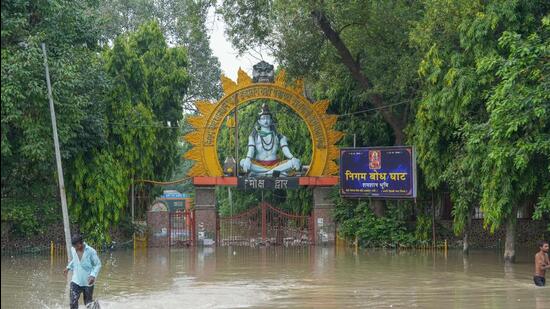
With this, all major cremation grounds located near the Yamuna have been shut, leading to increased rush at the smaller funeral centres.
Delhi’s largest facility Nigam Bodh Ghat, and the Geeta Colony Ghat were closed on Wednesday, while the Wazirabad Ghat was shut on Thursday after water entered the premises.
The civic body on Friday issued orders designating 12 grounds for cremation, including those on Panchkuian road, near Sant Nagar, Inderpuri, Beri Wala Bagh near Netaji Subhash Place, Wazirpur near Kanhaiya Nagar, Haiderpur shamshan near Shalimar Bagh. Other cremation grounds are located in Seemapuri, Ghazipur and Karkardooma, Lodhi Road, Green Park and Kalkaji areas.
Since the closure of the major ghats has translated to manifold increase in dead bodies being received at smaller sites, MCD has also issued circulars to increase the stock of wood and other resources to handle the load.
Sultan Singh, who is funeral manager at Panchkuian road Shamshan Bhumi, said, “The number of cremation platforms was increased during the pandemic so there is not waiting time at our site but the closure of Nigam Bodh Ghat has increased the pressure.”
{{/usCountry}}Sultan Singh, who is funeral manager at Panchkuian road Shamshan Bhumi, said, “The number of cremation platforms was increased during the pandemic so there is not waiting time at our site but the closure of Nigam Bodh Ghat has increased the pressure.”
{{/usCountry}}In East Delhi’s, Karkardooma cremation ground, supervisor Sonu Sharma said that normally the small facility receives just one to two dead bodies but four cremations were undertaken on Thursday and eight on Friday. “For the time being, we have enough wood stock but the ban on entry of heavy vehicles in Delhi and ongoing Kanwar yatra is making it difficult to procure additional wood from purchase sites like Bulandshahr,” he added.
MCD’s public health department oversees the operations of 49 wood-based cremation grounds, eight CNG-based cremation grounds, and one electric crematorium. The city also has six burial grounds, five infant burial grounds, and two cemeteries. Delhi records around 470 deaths daily, according to MCD estimates.
ABOUT THE AUTHOR
Paras Singh is a New Delhi-based journalist with Hindustan Times, where he serves as Deputy Metro Editor. He reports on urban governance, the Delhi government, the Delhi BJP, water management, the environment, communities and city life. He joined Hindustan Times in 2021 after beginning his journalism career at The Times of India in 2016, where he covered civic bodies, the water and power sectors, and urban infrastructure. Over the last decade, some of his reporting has led to significant public impact, with investigations into environmental violations, corruption and illegal industrial activity contributing to multiple judicial interventions by the National Green Tribunal and the Delhi High Court. A graduate of St. Stephen's College, University of Delhi, Paras studied journalism from the Indian Institute of Mass Communication (IIMC), New Delhi. Having extensively covered the capital's evolving civic and governance landscape, his recent work increasingly explores Delhi's history, built heritage, urban evolution and the relationship between people and place, alongside continuing to report on governance and public policy.
Stay updated with all top Cities including, Bengaluru, Delhi, Mumbai and more across India. Stay informed on the latest happenings in World News along with Delhi Election 2025 and Delhi Election Result 2025 Live, New Delhi Election Result Live, Kalkaji Election Result Live at Hindustan Times.
Stay updated with all top Cities including, Bengaluru, Delhi, Mumbai and more across India. Stay informed on the latest happenings in World News along with Delhi Election 2025 and Delhi Election Result 2025 Live, New Delhi Election Result Live, Kalkaji Election Result Live at Hindustan Times.
