
 E-Paper






Snehil Sinha is an Assistant Editor with the Delhi Metro bureau of Hindustan Times, where she reports on politics, governance, public policy, urban infrastructure and transport, subjects that shape the everyday lives of millions in the national capital. Over a journalism career spanning 14 years, she has built a reputation for meticulous, data-driven reporting that combines on-ground perspectives with policy analysis. She began her career with The Indian Express before joining Hindustan Times, where she has reported extensively on civic administration and urban governance in Gurugram, Noida and now Delhi. Her reporting is distinguished by its clarity, depth and balance. Whether covering large-scale infrastructure projects, environmental challenges, transport reforms or government policy, she tries to translate complex administrative decisions into accessible, engaging stories without losing nuance. Her work reflects a strong command of public records, official data and field reporting, often connecting policy announcements with their impact on citizens. Her stories go beyond headlines to explain how governance decisions influence the city's growth, mobility and quality of life, making her work an important contribution to informed public discourse.
Delhi section of rapid rail line linking Meerut set to meet 2025 deadline
In Delhi, the link begins at Sarai Kale Khan where at least 70% civil work has been completed, officials said.


Work on the Delhi section of the Delhi-Meerut RapidX Regional Rail Transit System (RRTS) is progressing fast, and is expected to meet the deadline for the overall project, officials aware of the matter said on Sunday.

In Delhi, the link begins at Sarai Kale Khan where at least 70% civil work has been completed. They added that work on four tunnels for the underground section, on both Delhi and UP side, was also on.
Also Read | Delhi LG nod to land allotment at Jangpura for RRTS project
Sarai Kale Khan is one of the biggest stations along the total 82km route. The entire Delhi-Ghaziabad-Meerut line is expected to become operational by June 2025.
“At this station, 80% of slab casting for the concourse level, and 50% at the platform level has been completed. Cross-arm construction on the concourse level has also been completed. With this, the construction of the station’s roof will begin soon. With multimodal integration at its core, this 215-metre-long, 50-metre-wide, and 15-metre-high RapidX station is strategically planned and located near a Metro station, the Indian Railway’s Hazrat Nizamuddin station and Vir Haqiqat Rai ISBT,” said a spokesperson for the National Capital Region Transport Corporation (NCRTC).
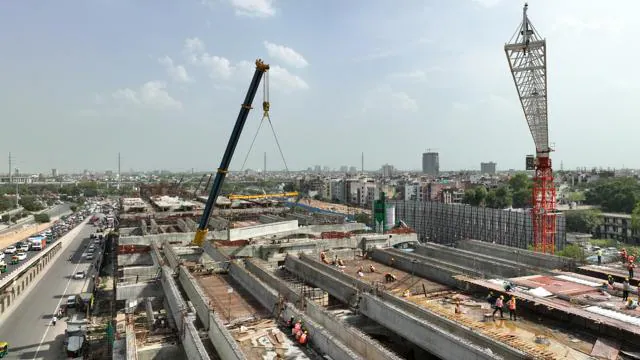
According to officials, the station is also being designed to facilitate interoperability because it is the meeting point for all three priority corridors from Delhi to Panipat, Meerut and SNB-Alwar.
“Interoperability will allow commuters to travel from one corridor to another without having to change trains. Six platforms with four tracks are being built at Sarai Kale Khan station to facilitate this,” said the spokesperson.
The station is also getting a 280-metre-long foot overbridge (FOB) with six travellators to connect it to Hazrat Nizamuddin railway station. Columns have been cast for this purpose, and a contract for the installation of travellators has been awarded, officials said.
Also Read | RRTS project: 10 trainsets fully readied to operate at 15-minute initial frequency on priority section
“Sarai Kale Khan is a prominent neighbourhood in the Capital with many well-established transit services, utilities and buildings. NCRTC faced a herculean task in shifting or modifying large-scale utilities that were impeding the construction of the corridor and the station. This is one of the largest and most complex shifting or modifications ever undertaken for the RRTS project,” the spokesperson added.
Officials aware of the matter said more than 80% of the pillars and the 4.5-km-long viaduct for the elevated section in Delhi had been completed. At least 14km of the 82km corridor is in Delhi, with the remaining 68km in Uttar Pradesh.
Also Read | RRTS: Commuters will have multiple ticketing, payment options
In the Delhi section, approximately nine kilometres are elevated and nine kilometres are underground, and Jungpura, Sarai Kale Khan, New Ashok Nagar and Anand Vihar four stations.
NCRTC intends to complete the corridor by 2025. Prior to that, it will put the 17-km-long priority section of the corridor between Sahaibabad and Duhai Depot in Ghaziabad, Uttar Pradesh, into service. According to officials, the priority section will become operational within a month.





