I did not know Arpita Singh (1937-2026). I have never met her. I don’t have a photo with her to claim intimacy nor am I an expert on her work. But she is one of the few contemporary Indian masters whose work has stayed with me long after I chanced upon a thoughtfully curated retrospective at the Kiran Nadar Museum of Art in Delhi, some years ago.
A friend recently asked who I thought was the greatest living Indian artist. I am usually dismissive of such interrogations but I didn’t lose a second before responding, “Arpita Singh”. The reasons were personal. So deeply was I moved by the humanism in her paintings that I couldn’t think of anyone else. Her work made me think beyond technique or what is visible on the canvas. The effect of the paintings I saw at the Delhi exhibition was mesmerizing; they left me in a state of perpetual daze. I could converse with their subjects. The images on canvas seemed to narrate my story too. I could identify with the characters and their actions and I wondered how the artist knew it all. What was the source of her wisdom? How could she bare it all with such childlike simplicity? To borrow from Arun Kolatkar, I felt “reduced/to so much small change/in her hand”.
The retrospective seemed to suggest the world that the artist came from – her surroundings, studio, and the events on Delhi streets that must have had an impact on her, among the numerous other concerns embodied in the images. The work was akin to a personal and social cartography of a country and culture seen through the eyes of an artist who was not a bystander but an archivist choosing to turn memory into action through her work. Her subversive and equally playful imagery is empowering. As a viewer, I thought it was an invitation to pause, to look and think deeply. In My Mother (1993), a solitary mother figure draped in white is positioned on the right-hand corner of the painting. Immediately behind her are scenes of unabashed chaos indicating riots and other forms of violence. The mother appears helpless and her white saree is a befitting contrast to the background turmoil. What can she do to resist the dance of the devil? Perhaps you empathise with the mother and understand her helplessness.
{{/usCountry}}The retrospective seemed to suggest the world that the artist came from – her surroundings, studio, and the events on Delhi streets that must have had an impact on her, among the numerous other concerns embodied in the images. The work was akin to a personal and social cartography of a country and culture seen through the eyes of an artist who was not a bystander but an archivist choosing to turn memory into action through her work. Her subversive and equally playful imagery is empowering. As a viewer, I thought it was an invitation to pause, to look and think deeply. In My Mother (1993), a solitary mother figure draped in white is positioned on the right-hand corner of the painting. Immediately behind her are scenes of unabashed chaos indicating riots and other forms of violence. The mother appears helpless and her white saree is a befitting contrast to the background turmoil. What can she do to resist the dance of the devil? Perhaps you empathise with the mother and understand her helplessness.
{{/usCountry}}Someone recently said Singh did not actively advocate her politics or endorse an ideological standpoint. But what constitutes a political act for an artist? Is this image not her politics? Is sloganeering the only form of political assertion? It’s clear that the artist too felt like the helpless solitary woman in the painting, which was created right after the Bombay riots of 1992-93.
While some of her work is reminiscent of Paul Klee and Marc Chagall, who may have influenced her, Singh’s creative voice is unique. Her style combined personal and political memory with distinctly Indian art traditions. Her paintings are like poetry – layered, introspective, bearing witness and planting doubt, never trying to have the final word or proclaiming a verdict. Unsurprisingly, she appreciated the work of Bengali poet, Jibanananda Das for his treatment of memory and the sense of melancholia and loss that reigns supreme in his work. Similar elements can be traced in Singh’s oeuvre too. In her early days, she too wrote poetry in Bengali. The work of both artists shares a dreamlike quality.
Singh also had an abiding interest in Thakumar Jhuli, a collection of Bengali folk and fairy tales collected and compiled by Dakshinaranjan Mitra Majumdar and published in 1907. An iconic work of Bengali literature and a much-loved text across successive generations of children in West Bengal and Bangladesh, this collection, whose introduction was written y Rabindranath Tagore, inspired her to compose a distinct visual universe.
Singh’s paintings also strongly resemble a kantha quilt, a layered tapestry whose surface feels like a fabric which has been worked upon again and again. Many works of kantha embroidery feature stories from the home and the world as imagined by the women makers who largely lead domesticated lives.
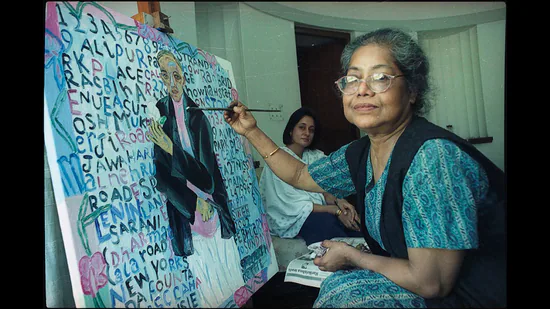
Singh’s fascination with text showed up in her paintings, where figures were replaced by text. In her canvases, the viewer sees a host of images, several events occurring simultaneously, that makes them wonder: What do I see and how? What should I be looking for? Am I viewing it the right way? Is this how it ought to be seen? That is the hallmark of a maestro.
In the end, the artist’s best gift to her viewers is a work of art that’s merely the beginning of a conversation that continues long after the exhibition has ended; long after the artist herself has left her Delhi studio in search of another.
Kunal Ray teaches at FLAME University, Pune, and writes on art and culture.
